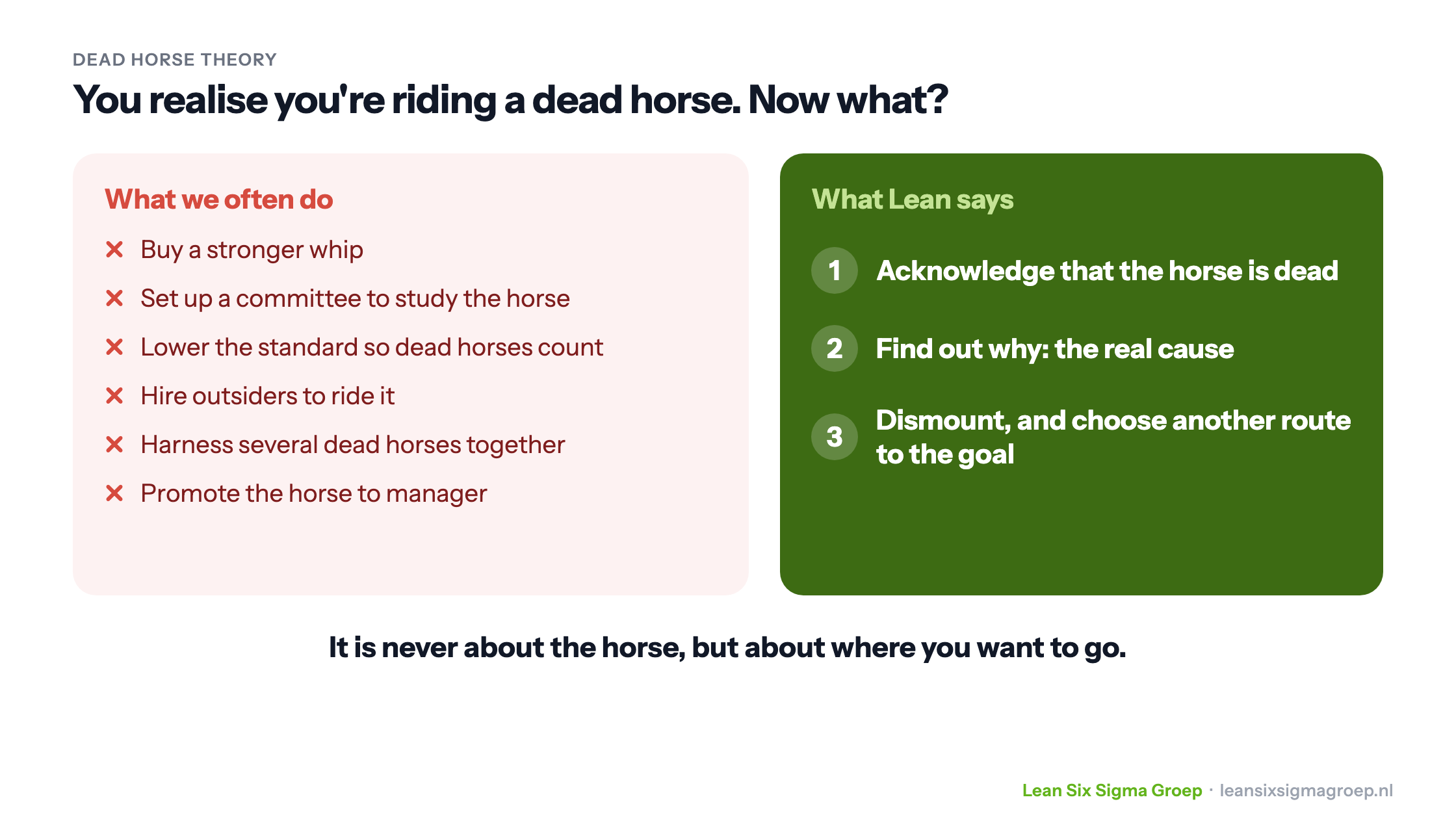
The dead horse theory is an old piece of wisdom that is still as relevant as ever. It is often attributed to a Native American saying: “When you discover that you are riding a dead horse, the best strategy is to dismount.” English has had the expression “flogging a dead horse” since the nineteenth century: pointlessly carrying on with something that no longer stands a chance.
Unfortunately, dismounting isn’t always the strategy of choice at work. What happens more often is partly shown in the image at the top of this article:
- We buy a stronger whip.
- We change riders.
- We threaten the horse with dismissal.
- We set up a committee to study the horse.
- We go on a study trip abroad to see how others ride dead horses.
- We lower the standard so dead horses also count.
- We rename the dead horse “living with a challenge”.
- We hire outsiders to ride the dead horse.
- We harness several dead horses together to increase speed.
- We increase the horse’s training hours.
- We run a productivity study to see whether lighter riders would make the horse faster.
- We conclude that because the dead horse eats less, it costs less and ultimately contributes more to the bottom line than some live horses.
- We rewrite the job descriptions so a dead horse also qualifies.
- We promote the dead horse to manager, so it can hire another horse to do the work.
I have yet to meet the first person with a bit of work experience who doesn’t recognise any of these situations. And I would be surprised if you read the list without both a laugh and frustrated recognition.
Why do we stay on a dead horse?
The reactions above are the exact opposite of Lean thinking. Lean says: stop, find the real cause and solve the actual problem. All the actions on the list only fight symptoms.
It sounds simple, but jointly concluding that the horse is dead, and acting on it, turns out to be hard in practice. A few reasons:
This is one of the tools you learn to apply in the Green Belt training.
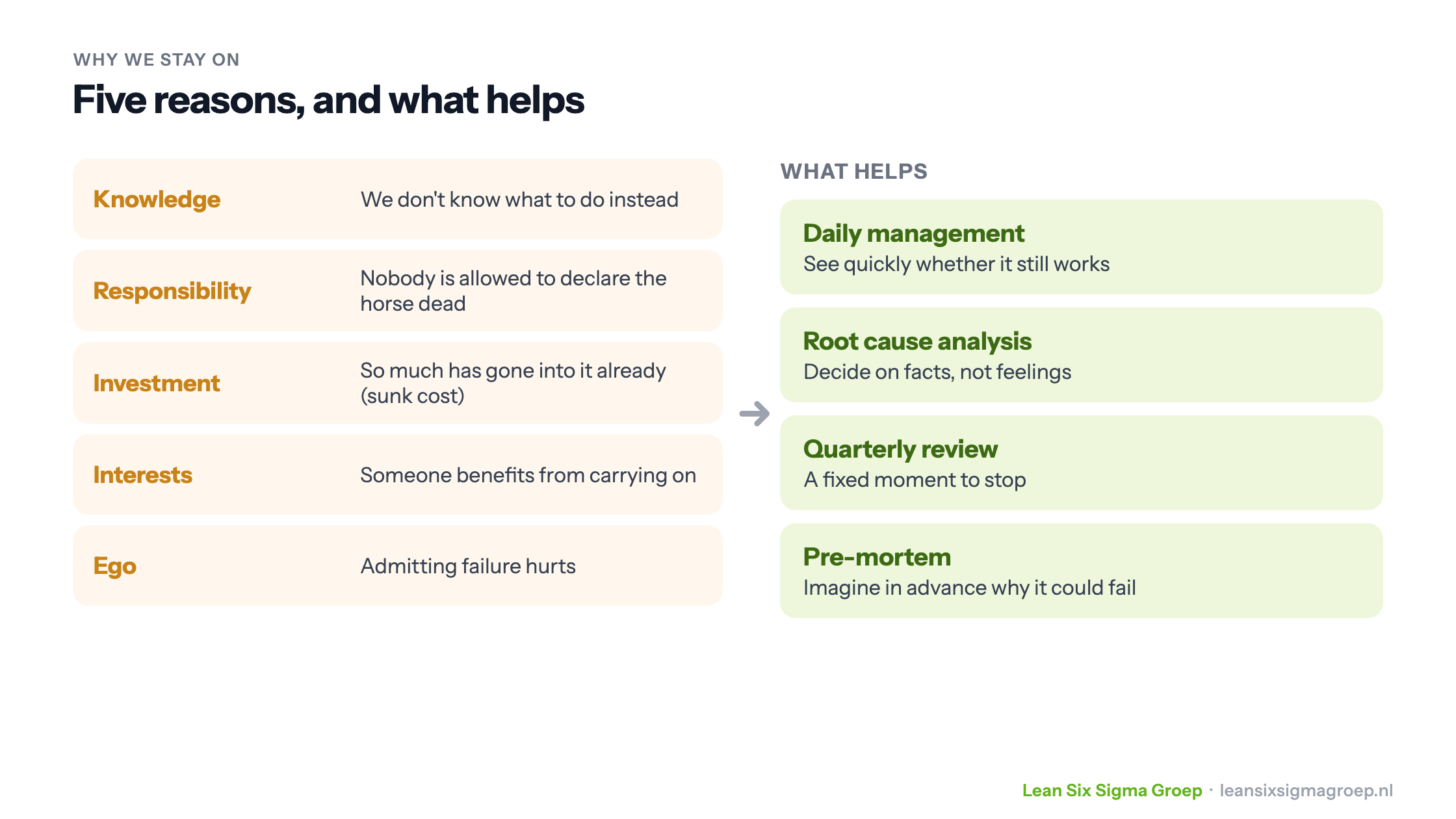
- Knowledge and skills. We do see the horse is dead, but don’t know what to do instead. “Better the devil you know” then gives the choice an air of logic.
- Responsibility. It is unclear who may decide that the horse is dead. Combined with the feeling that stopping will be seen as failure, projects carry on like zombies without ever delivering anything again.
- Investment. The sunk cost effect also applies to dead horses: we look at what has already gone in, instead of at what it will still deliver.
- Interests. Sometimes someone benefits from not declaring a horse dead. As long as a project exists, it gets money and people, which can then be used for other things. That creates a zombie project: dead, without results, but still consuming resources. (Add your own zombie music.)
- Ego. Admitting that something didn’t work hurts. We like to see ourselves as successful, and a failed project doesn’t fit that picture. So we would rather keep the illusion alive.
How do you stop your organisation investing in dead horses?
If these are the causes, what can you do? There is no silver bullet, but a combination of measures helps.
- Daily management. Short daily moments to review progress, with the right KPIs, give fast and repeated insight into how a project is doing. Read more about operational management.
- Root cause analysis. One swallow doesn’t make a summer, and a cough doesn’t make a dead horse. Deciding to stop requires a good root cause analysis: why isn’t it working, have we kept asking why, checked the data and looked at the problem from several angles?
- Monthly or quarterly reviews. Make sure the people who decide on a project meet regularly to look at the trends. A system such as OKR with fixed quarterly reviews ensures you regularly ask whether a project still contributes. That is the moment to stop a project that misses its goals despite corrective action.
- Pre-mortem. We usually only think about a project failing once it has failed. With a pre-mortem, devised by psychologist Gary Klein and popularised by Daniel Kahneman (Thinking, Fast and Slow), you do it in advance. With the stakeholders you imagine the project has failed a year from now, and work out why. That lets you reduce or remove those risks.
Perhaps the most important insight for leaders: this whole story is never about the horse. The horse, the project, is only a way to get from where you no longer want to be to where you do want to be. It is not the only horse, nor even the only route. Leaders who keep the goal in view and don’t fixate on one horse can dismount and look afresh at how to reach the goal.
How many (nearly) dead horses are there in your organisation? Let us know and we will look at what we can do about it together. Email [email protected].