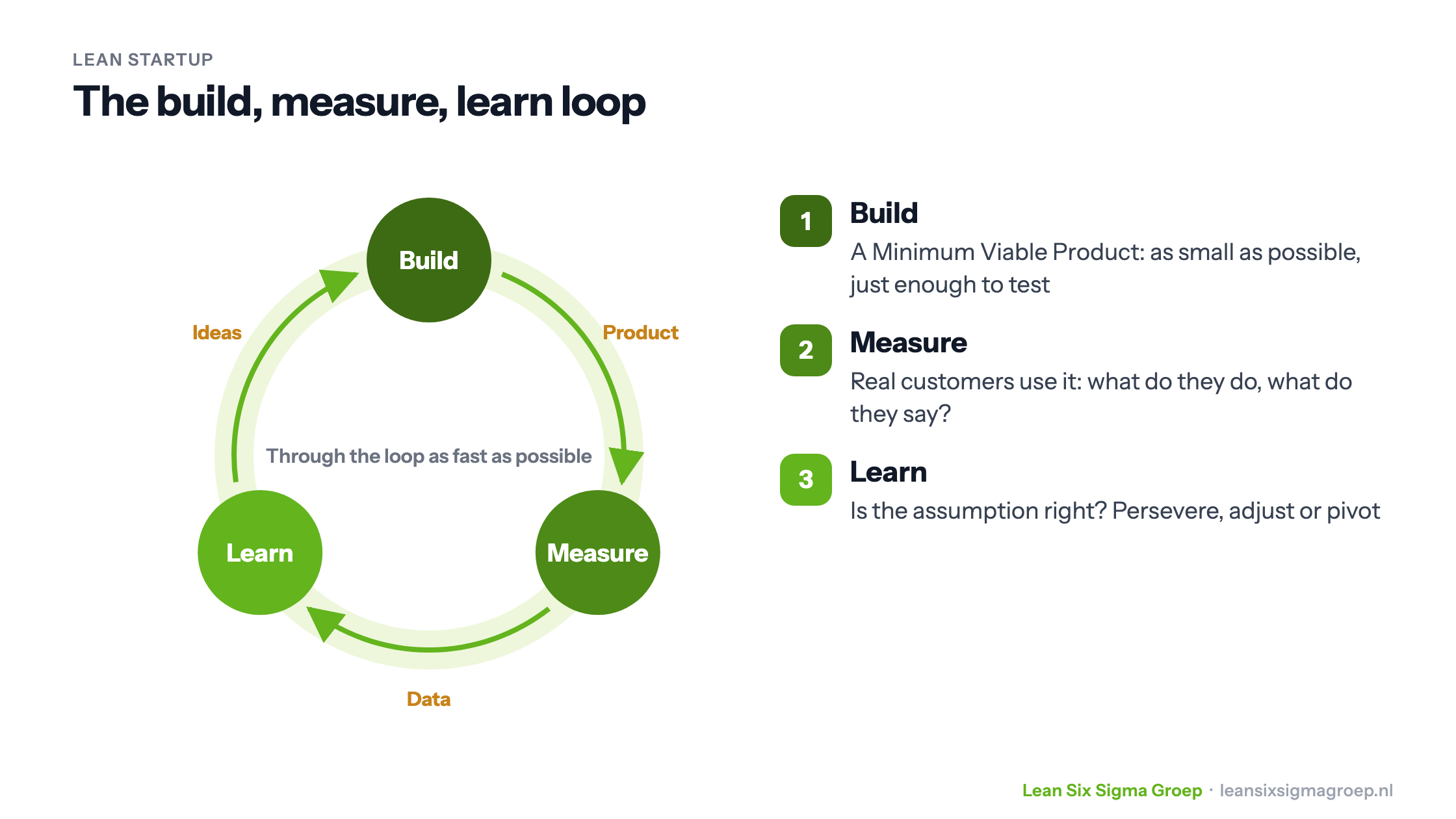
Lean Startup is a method for developing new products and businesses with as little waste as possible. Instead of first making an extensive plan, you test your ideas with real customers as quickly as possible, and learn what works. Eric Ries described the method in 2011 in his book The Lean Startup.
Lean Startup puts customer feedback above intuition, and flexibility above planning. You quickly discover whether an idea or business model is viable, and a mistake costs less because you find it early. The method was developed for startups, but is also widely used within established organisations that want to develop something new.
Build, measure, learn
Founders and innovation teams often don’t know what customers will value. You can write thick reports with development plans, strategies and a detailed schedule, but that takes a lot of time, and whether it pays off is uncertain.
Lean Startup turns this around: don’t plan first, build first. Make something a customer can react to as quickly as possible, a product or a service, and show it. Measure the reaction, learn from it and adjust. That is the build, measure, learn loop from the image at the top of this article. The sooner you know what doesn’t work, the better.
Ries summed it up as: success is not delivering a feature; success is learning how to solve the customer’s problem.
The Minimum Viable Product
The Minimum Viable Product (MVP) is the simplest version of your product that lets you test an important assumption. It doesn’t have to be pretty or complete. Sometimes an MVP isn’t even a real product, but a web page, a video or a service you first carry out by hand. Below is an example.
This is one of the tools you learn to apply in the Green Belt training.
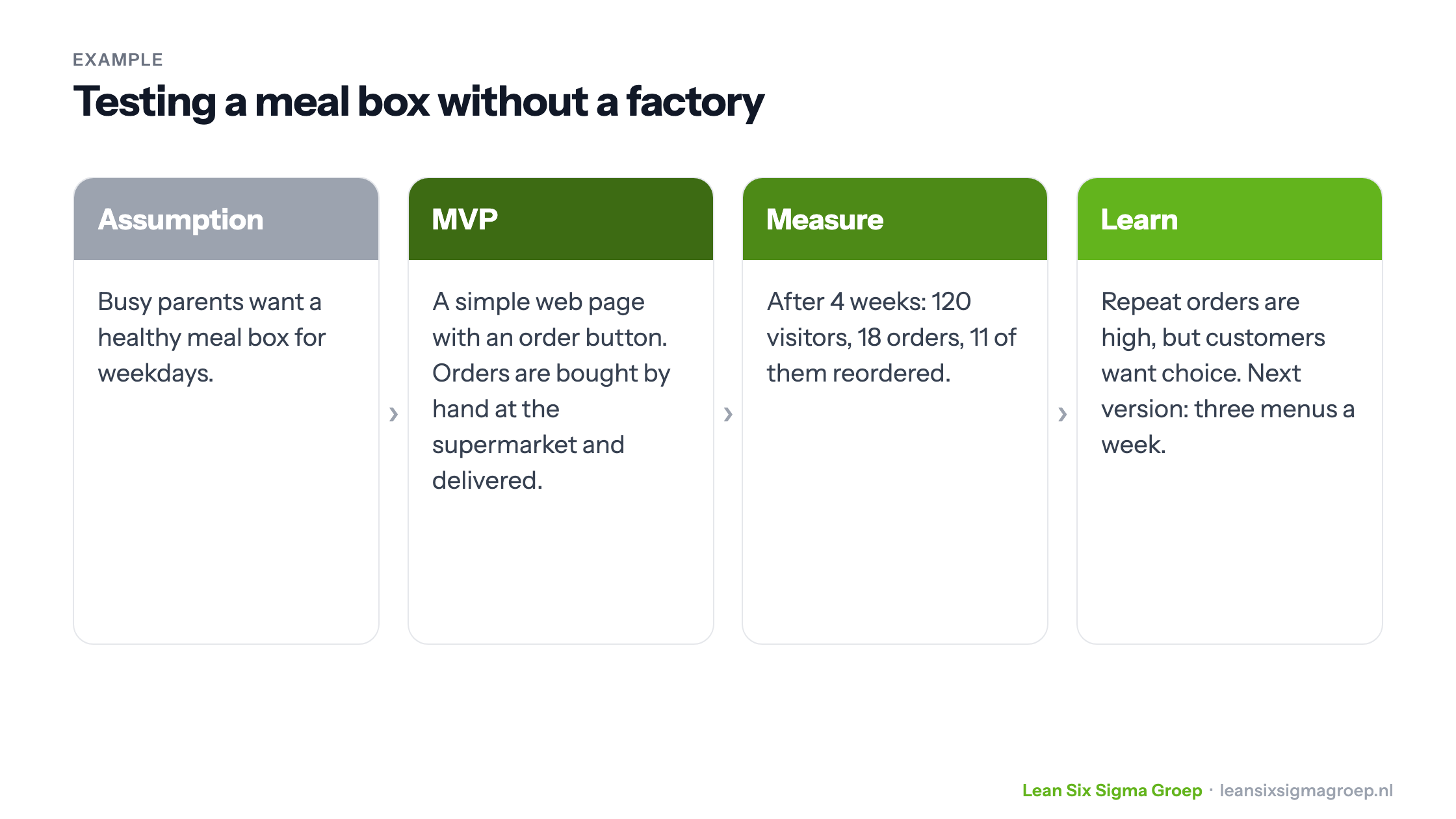
After each round you choose: persevere on the same path, adjust, or pivot, taking a fundamentally different direction because the assumption was wrong.
The five principles
- Entrepreneurs are everywhere. Not just in a garage, but also within large organisations. Give employees room to develop and experiment; that also increases their engagement.
- Entrepreneurship is management. A startup needs its own form of management: flexible and focused on learning.
- Validated learning. A startup exists to learn how to build a sustainable business. You test that learning with experiments with real customers, not with colleagues.
- Innovation accounting. Measure progress by what you have learned, with the right metrics, rather than by how much work has been done.
- Build, measure, learn. Go through the loop as fast as possible, again and again. Only after several rounds do you know whether the product is ready for a big investment. You can only spend your money once.
Tips
- Work in small steps: many small experiments are better than one big one.
- Make your assumptions explicit, and test the riskiest first.
- Compare your product as fairly as possible with the alternative customers use today.
- Look at what customers do, not just at what they say.
Lean Startup, Lean and Agile
Lean Startup shows how Lean and Agile come together. From Lean comes the focus on customer value and avoiding waste: don’t make anything the customer doesn’t want. From Agile comes working in short cycles with fast feedback. Together they help you develop a product customers value, without wasting time, money and energy. The PDCA cycle and Design Thinking work with the same idea: try, learn and adjust.
Want to know how to apply this in your own work? Get in touch.