Stakeholder management is everything you do to know who has an interest in your project, what that interest is, how they view the project, and how you take that into account. It is a crucial part of any project, programme or change.
What is a stakeholder?
A stakeholder is anyone who has influence on your project or is affected by it. For an organisation as a whole, these are for example investors, employees, customers and suppliers. In an improvement project, they are decision-makers, the people who work in the process, end users, suppliers and the people who have to make the solution possible, such as IT.
In short, stakeholder management consists of four steps:
- identifying stakeholders;
- determining their power and interest;
- drawing up a communication plan;
- involving stakeholders and, where needed, influencing them.
Power and interest
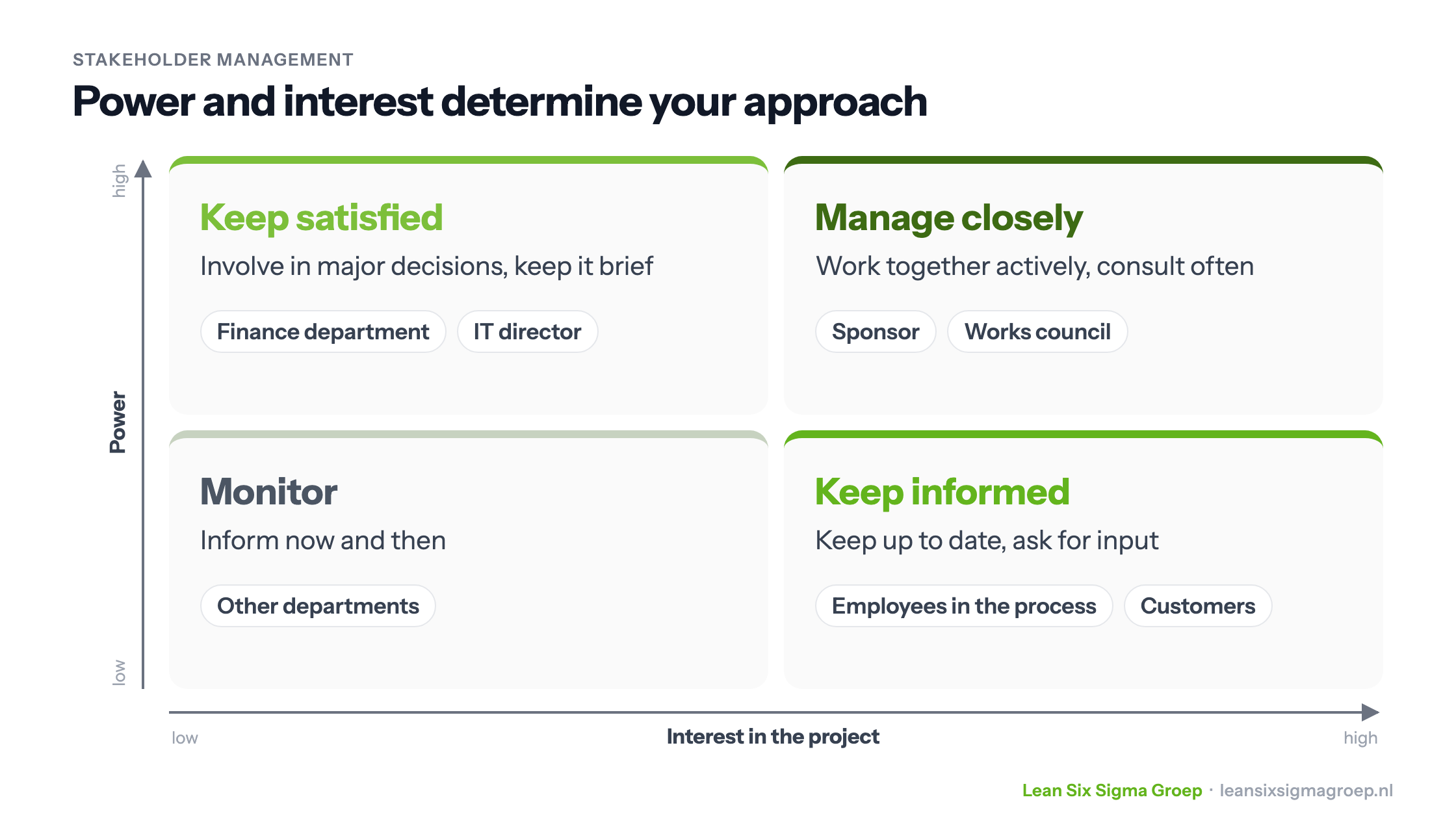
A widely used tool is the power-interest grid, shown at the top of this article. You place each stakeholder in one of the four boxes, and each box calls for its own approach:
- Manage closely (high power, high interest): work together actively and consult often. Think of the sponsor.
- Keep satisfied (high power, low interest): involve them in major decisions, but keep it brief.
- Keep informed (low power, high interest): keep them up to date and ask for their input. These are often the people who have to work with the change.
- Monitor (low power, low interest): inform them now and then.
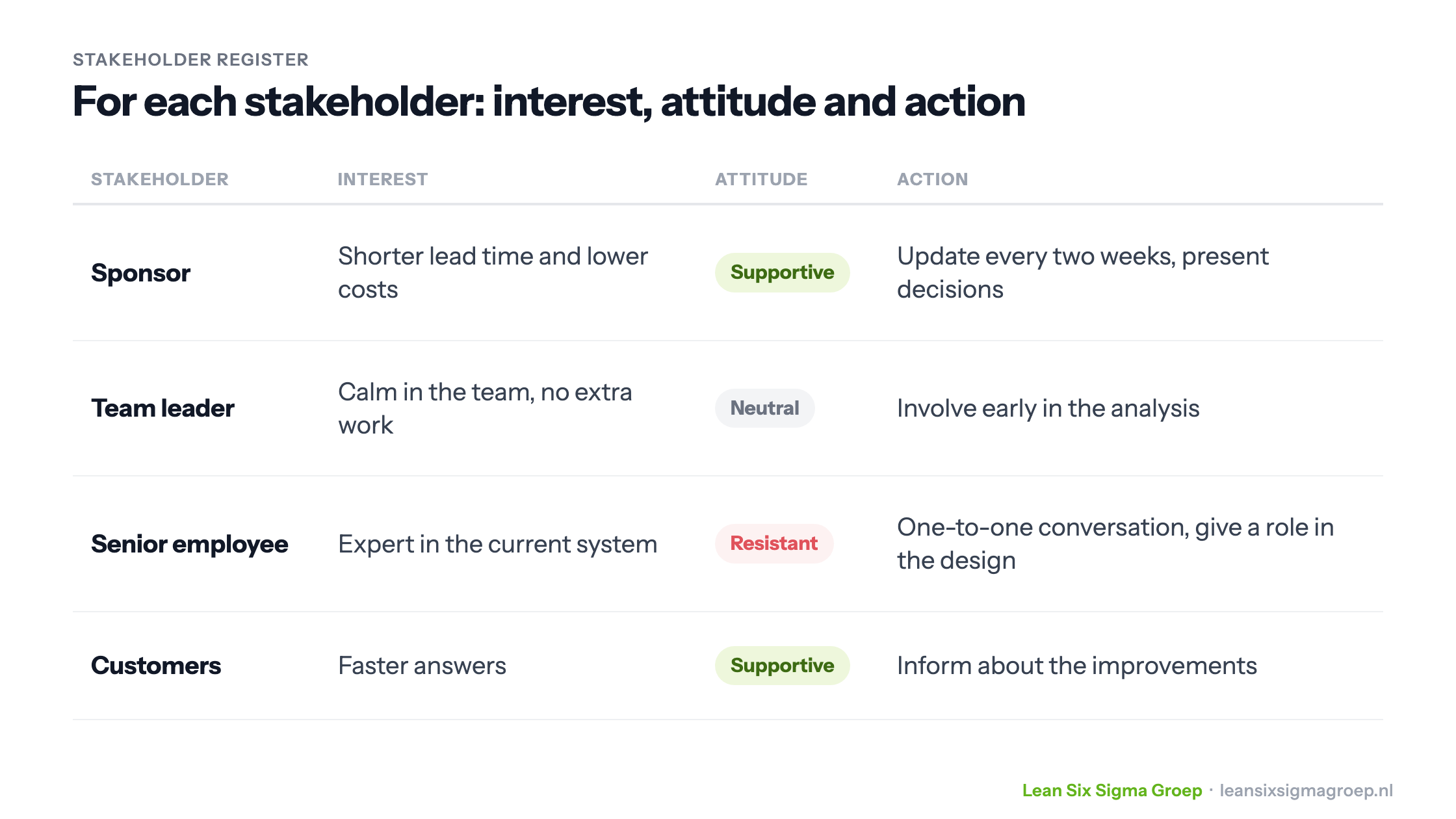
For each stakeholder, record their interest, their attitude towards the project and what you will do. Such an overview is called a stakeholder register.
This is one of the tools you learn to apply in the Green Belt training.
Why stakeholder management?
Not every project gets people cheering on the tables. That often has to do with expectations about the outcome. In some organisations, Lean has unfortunately acquired a negative ring (“lean and mean”): once the process is improved, jobs will go. Then you can’t expect people to simply cooperate.
There can be other reasons why someone isn’t immediately enthusiastic. Perhaps there is fear of losing freedom or autonomy. Or the fear that the analysis will show that you, as the manager of the process, aren’t performing well, because otherwise the process would run better, wouldn’t it?
What does it deliver?
Good stakeholder management prevents surprises later in the project. In a Lean Six Sigma approach, the first phases are investigative: from problem to causes. Little changes then. Only when the team starts implementing solutions does the project have impact. Colleagues have to move, or an application in which someone has been the expert for years is switched off. Then there is a good chance that stakeholders who feel threatened will start working against the project.
So look early at who has an interest in the current situation, and who in the new one. The first group will mainly hold back, the second wants to move forward. The second group gives you the most energy: finally people who understand you. That makes it tempting to ignore the first group. But then they feel even less heard, and hold back even harder.
Applying stakeholder management
Make stakeholder management a fixed part of your project instead of an afterthought. Break it into small, achievable steps: start with a first list and a grid, and update them in every phase. Above all, listen, and look for options and alternatives together. That prevents a lot of grief, for the stakeholders who prefer to hold on to what was and for yourself.
Also read about change management, and about the RACI matrix for clarifying roles and responsibilities.