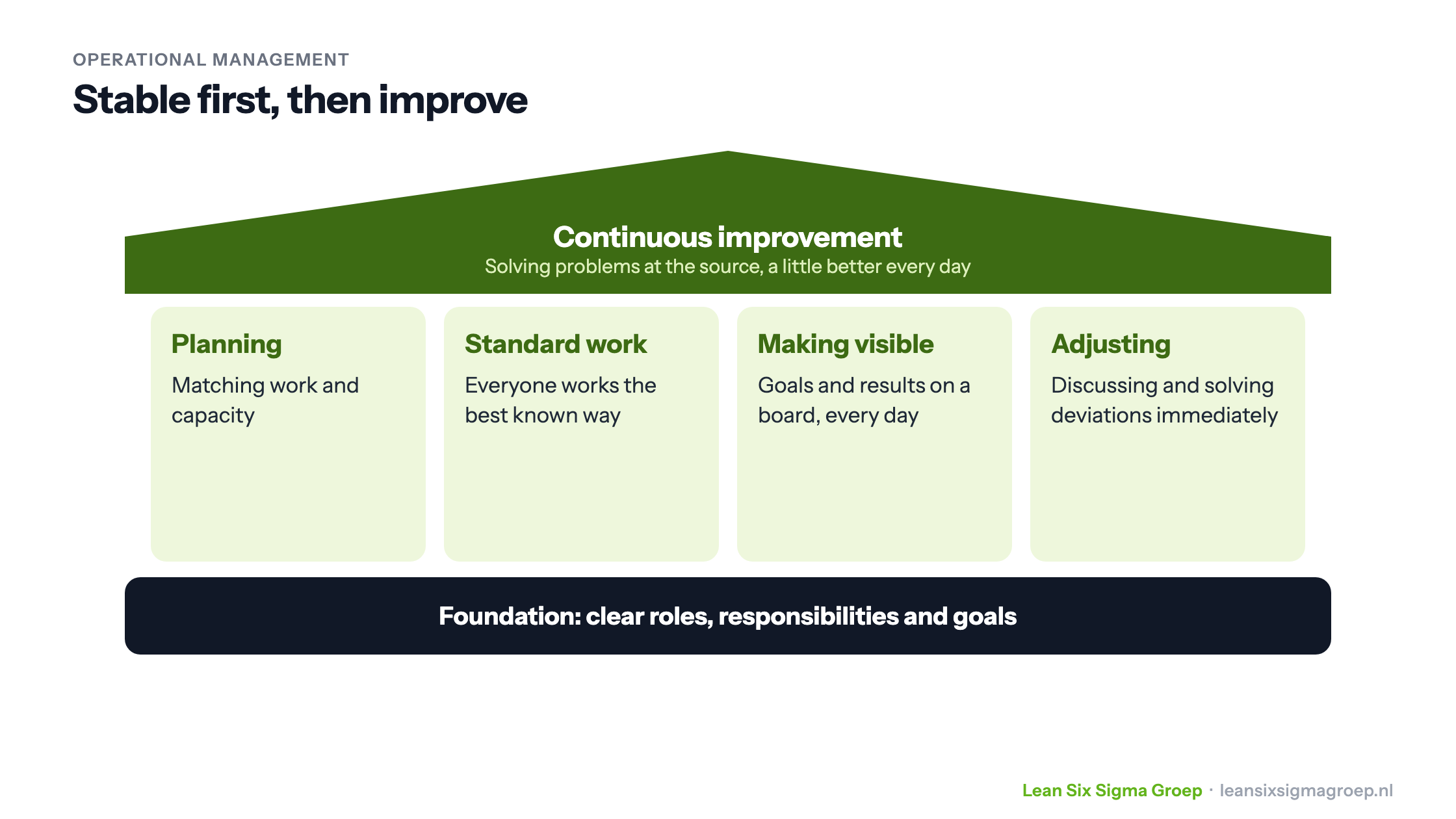
Operational management is the way an organisation steers its daily work: planning, carrying out the work to standards, making results visible and adjusting immediately when things deviate. It creates stability, and that stability is the precondition for lasting improvement.
Why stability first?
It is a familiar pattern. An organisation carries out a fine, successful improvement project, but after a while the results have disappeared. Old habits are back. The cause rarely lies in the project itself, but in what is missing around it: a way of working in which agreements are held to, deviations are noticed and someone is responsible for the performance of the process.
That is operational management. It is the breeding ground for improvement. Without that foundation, improving is like mopping the floor with the tap still running.
The building blocks
The image at the top of this article shows what operational management consists of:
- Planning: matching work and capacity, so you know what needs to happen today and this week and whether that is feasible.
- Standard work: everyone works the best known way, captured for example in standard operating procedures. Only once there is a standard can you see deviations.
- Making visible: goals and results are on a board, and are reviewed every day.
- Adjusting: deviations are discussed and solved immediately, instead of weeks later in a report.
The foundation is clarity: who is responsible for what, and what are the goals? The roof is continuous improvement: solving problems at the source and making the work a little better every day.
The meeting rhythm
An important element is a fixed rhythm of short meetings that connect.
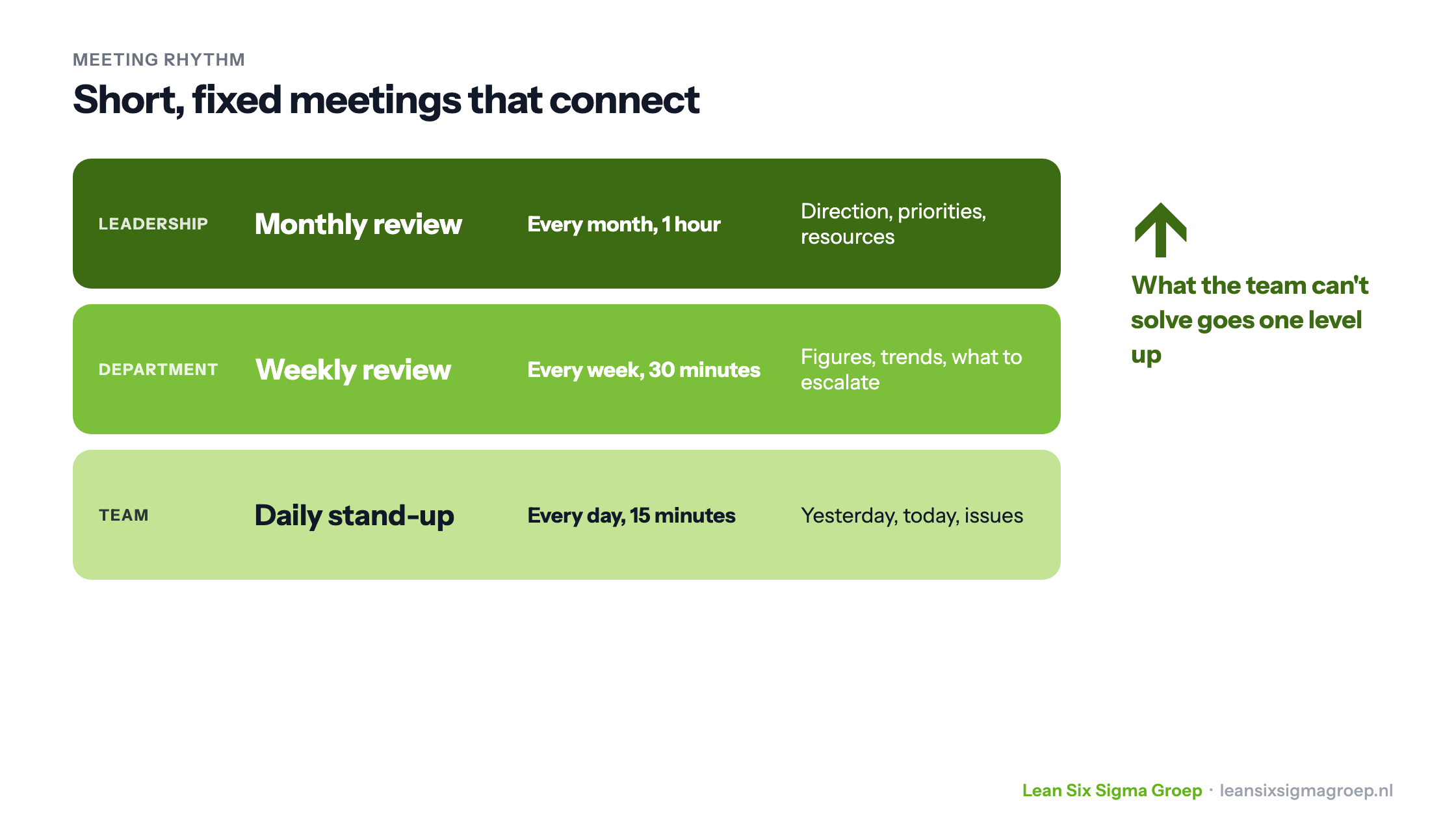
The team holds a short daily stand-up at the board every day: how did yesterday go, what is on today, where are we stuck? What the team can’t solve itself goes to the department’s weekly review, and from there if needed to leadership’s monthly review. That way problems quickly reach the level where they can be solved.
Managers play a key role. They are regularly on the shop floor, the gemba, and help their team solve problems instead of solving them themselves.
Do you recognise this?
A lack of operational management has consequences for both process and result. Which observations do you recognise in your own organisation?
| Observation | Consequence |
|---|---|
| We spend too much time reactively firefighting | Little stability and seemingly little time to tackle things systematically |
| Improvements are often sticking plasters, not real solutions | Problems come back, often at the worst moment |
| Improvement is seen as something on top of the work, or something others should do | Little engagement, and improvement opportunities are only half used |
| Processes are not stable or standardised | Widely varying results, and solutions keep being reinvented |
| Solving problems and making decisions is slow | Long-running projects and expensive or partial solutions |
| No uniform approach | Each team does it differently, and the whole doesn’t get better |
| Stability and improvement are poorly measured | Nobody knows whether something is a real improvement or a recovery from a setback |
| Blind spots: we have always done it this way | The small improvements that come from looking critically at your own work are left untouched |
| Unclear roles and responsibilities | Problems are left unsolved or solved too late, causing frustration |
| No proper role descriptions for operational jobs | New colleagues take long to find their role, and expectations don’t match |
Why it often fails
Many organisations start enthusiastically, but don’t manage to really embed operational management in daily work. The tools are there, the board is on the wall, but it isn’t used. One of the causes: operational matters are often not seen as interesting enough. Many managers have little experience of steering and improving the shop floor day to day, so it doesn’t get the attention it needs.
Just doing it is therefore not enough. Operational management requires an approach that is systematic, standardised and integrated, and managers who lead by example. It is a craft in its own right.
Want to learn how to set this up in your own organisation? It is covered in the Green Belt training course.