Andon is a signal an employee uses to show immediately that there is a problem: with a cord, a button or a light. The idea comes from Toyota. Anyone who spots a deviation may and must call for help, and if it isn’t solved quickly, work stops. That way a defect never reaches the customer.
Where does andon come from?
Andon is Japanese for paper lantern. In the Toyota Production System it is one of the most important parts of jidoka: built-in quality, or “automation with a human touch”. The idea goes back to Sakichi Toyoda, founder of what later became Toyota. His automatic loom of 1924 stopped by itself as soon as a thread broke, so no faulty cloth was woven and one operator could watch several machines.
Toyota applied the same principle to the assembly line: every employee can stop the line if something is wrong. That turned stopping production from failure into a way to make problems visible and solve them.
How does andon work?
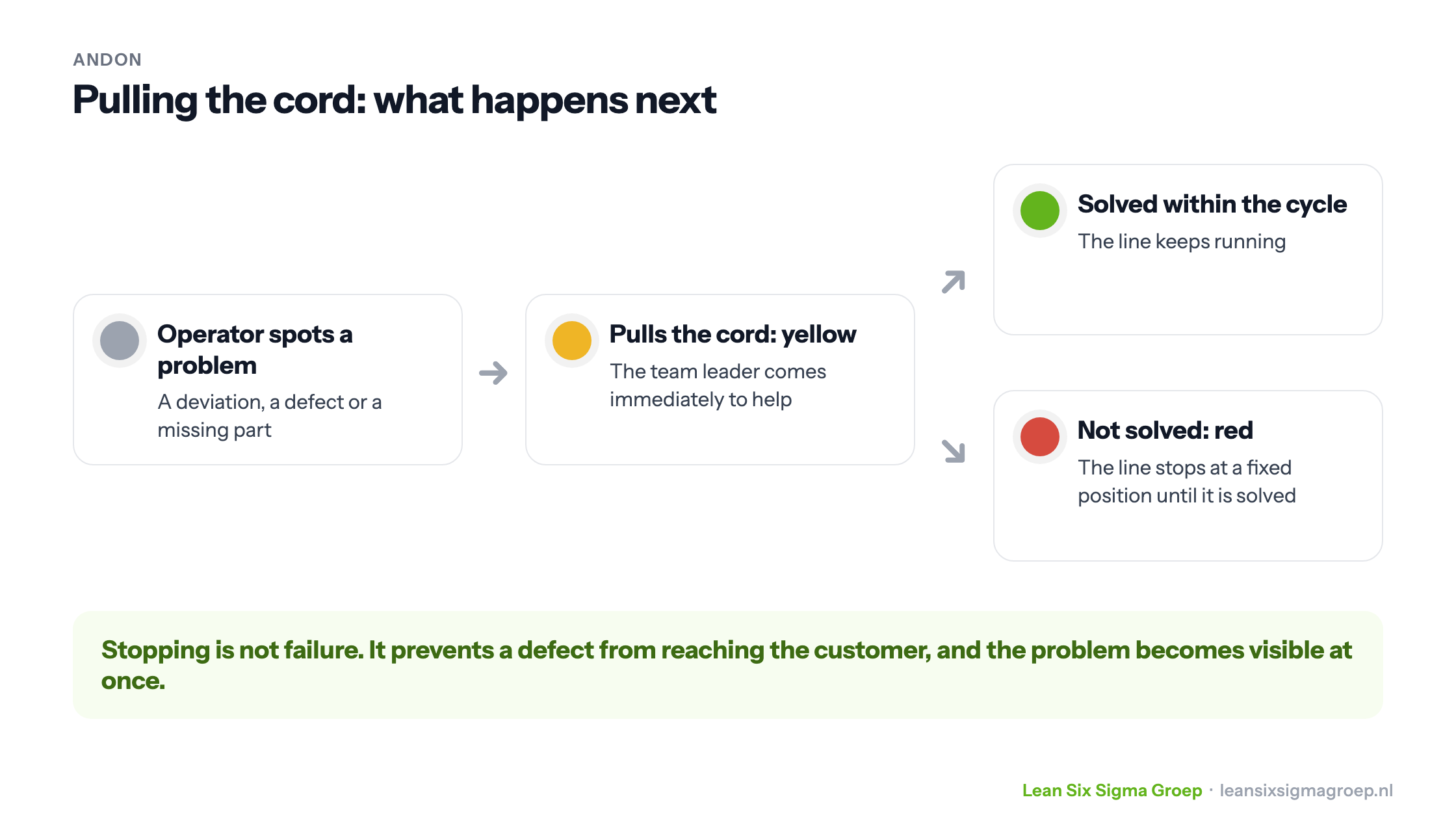
A common misunderstanding is that the line stops immediately when someone pulls the cord. At Toyota it works in steps, as shown in the image at the top of this article:
- An operator spots a problem: a deviation, a defect or a missing part.
- They pull the cord. A yellow signal comes on, and the team leader comes immediately.
- If the problem is solved within the cycle, the line keeps running.
- If not, the signal turns red and the line stops at a fixed position until the problem is solved.
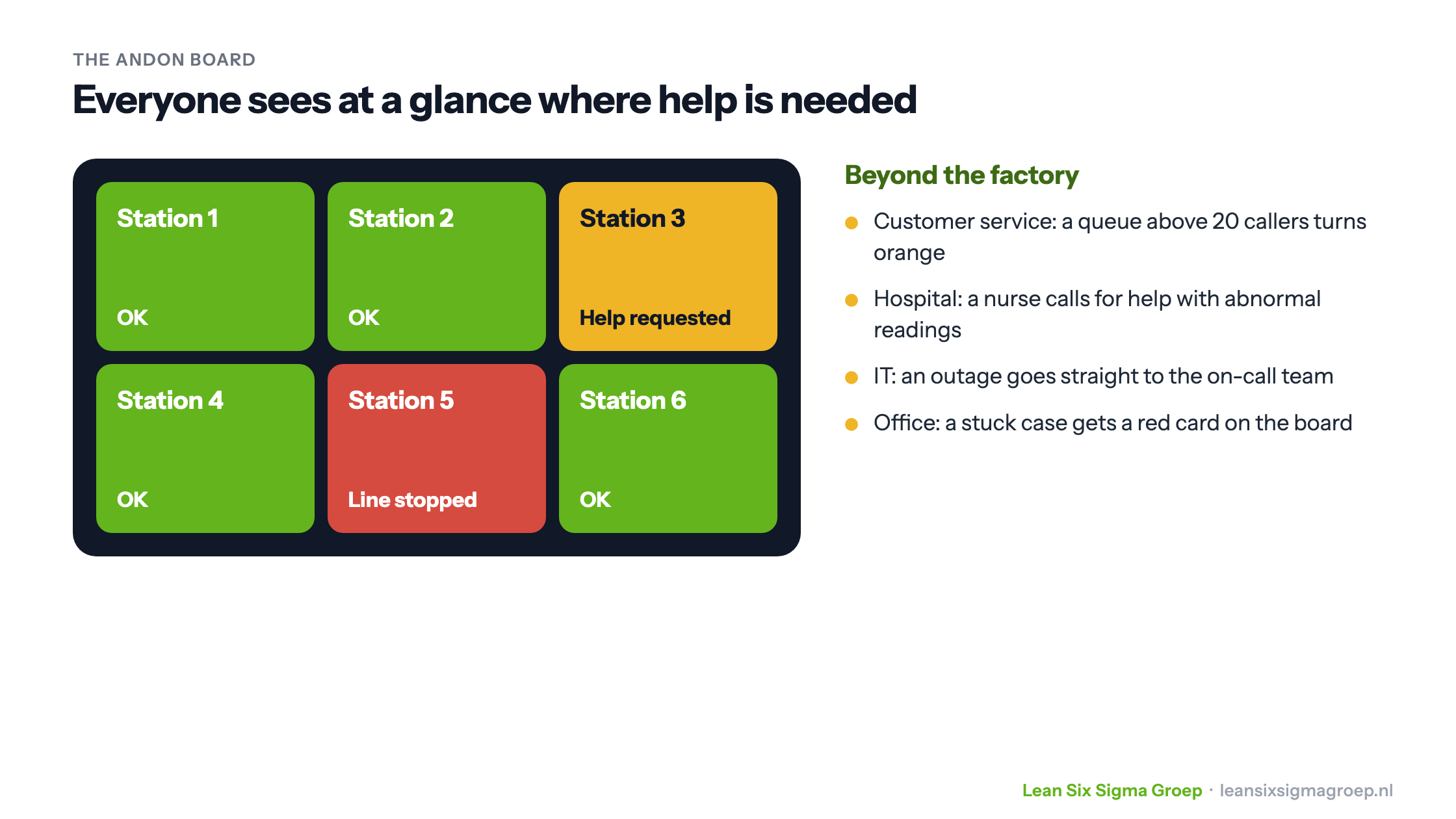
The signal can also come automatically, for example from a machine that measures a deviation. On an andon board above the shop floor, everyone sees at a glance where help is needed.
What does it take to make it work?
Andon only works if people really use it. That takes more than a cord or a button:
- Safety: whoever pulls the cord is thanked, not reprimanded. Toyota team leaders thank employees who report a problem.
- Fast response: someone must come straight away. A signal nobody responds to soon gets ignored.
- Tackling the cause: after the quick fix, find out why it happened with a root cause analysis, and prevent recurrence, for example with poka yoke.
Andon beyond the factory
The principle works wherever you want problems to surface quickly:
- A customer service centre where the queue board turns orange when more than twenty callers are waiting.
- A hospital where a nurse immediately calls a colleague or doctor for abnormal readings.
- An IT department where an outage automatically reaches the on-call team.
- An office where a stuck case gets a red card on the team board, so it is discussed at the daily stand-up.
What does it deliver?
- Defects are found immediately, not by the customer.
- Problems become visible, so they are solved structurally instead of being worked around again and again.
- Employees feel responsible for quality and get room to intervene.
- In the long run: less scrap, less downtime and better products.
Andon is covered in the Green Belt training course.