First Time Right, abbreviated FTR, simply means: right first time. It is about quality: how many questions are answered correctly in one go, how many files are handled correctly in one go, how many customers are helped to their satisfaction in one go? First Time Right can be a goal, but above all it is a way of thinking, comparable to the pursuit of perfection, the fifth principle of Lean.
First Time Right pleases customers and the organisation
Customers are naturally satisfied when things go right first time. They don’t need to exchange anything, send a parcel back or call again. In Lean, what the customer wants is called the Voice of the Customer.
The organisation itself, the Voice of the Business, benefits too. When everything goes right first time, no errors need correcting and checks can be reduced. That saves time, which you can spend on work that adds value for the customer.
Measuring First Time Right
First Time Right is usually expressed as a percentage: the share of work that goes through the process right first time, without rework, correction or complaint. The goal of many Lean Six Sigma projects is to raise that percentage. For example: in the mortgage department 60% is right first time today, and the aim is 80%.
Note: the customer may still experience 100% in such a case, because errors are found and corrected beforehand. But that correction costs time and money. That is why First Time Right measures the process, not just the end result.
An example from practice
A financial services provider received many complaints about the quality of its work. At the same time, employees experienced a heavy workload, and working late was the rule rather than the exception. Customer research showed that the intermediaries, the customers in this case, understood that mistakes happen, but no more than 5%. So at least 95% had to be right.
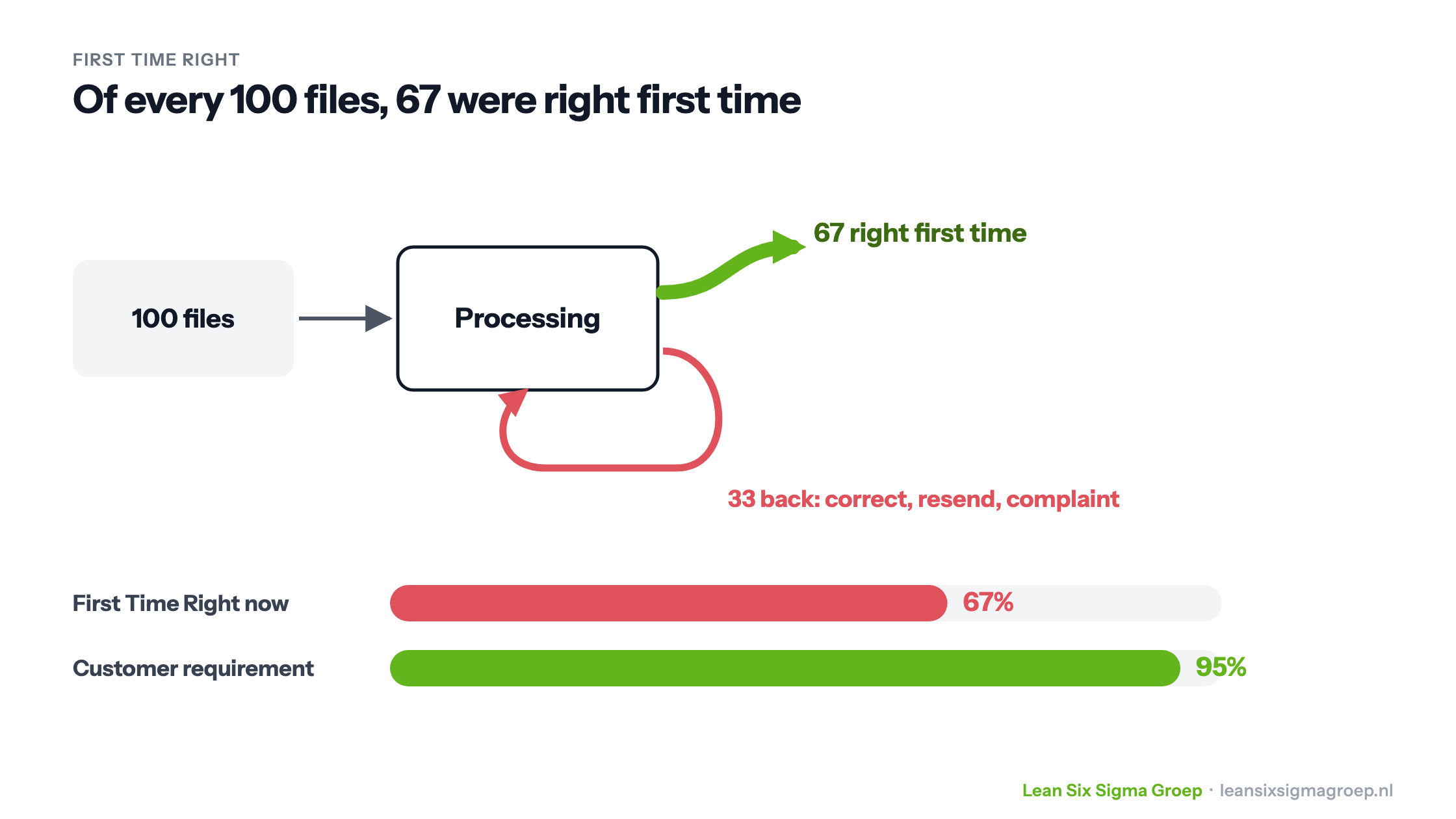
Because of the workload, the focus was mainly on speed. Work wasn’t checked, so nobody knew how good it actually was. A baseline measurement made it visible: one in three files went to the intermediary with an error. So of every 100 files, 67 were right first time, while the customer wanted at least 95.
The root cause analysis showed that only one employee could do everything. The others were good at a few types of work, but mediocre at the rest. Combined with the workload and the focus on speed, that led to errors.
The solution was a work cell, with a training programme, rewritten work instructions, checks and continuous measurement of First Time Right. The work cell itself was simple: four employees at one desk cluster, with the colleague who could do everything alongside them. She answered questions on the spot and trained the others on the job. Everyone simply took the next item from the digital pile, including work they weren’t yet good at, instead of cherry-picking.
The First Time Right percentage rose, getting ever closer to what the customer wanted. It wasn’t without struggle and it took time, but in the end more compliments than complaints came in. An added benefit: lead time got shorter, because less time was needed for complaints and rework.
How to achieve First Time Right
- Standardise: everyone does the work in the same, best way. A useful method is BOB versus WOW: compare the best performance (Best of the Best) with the worst (Worst of the Worst), learn from both and turn that into a standard. Because everyone does the work the same way, the chance of errors falls.
- Make errors impossible: with Poka Yoke you set up the process so that an error can’t be made, or stands out immediately. That works better than ever more checking.
- Tackle causes: with DMAIC you find out why things go wrong and solve the cause.
First Time Right and Rolled Throughput Yield
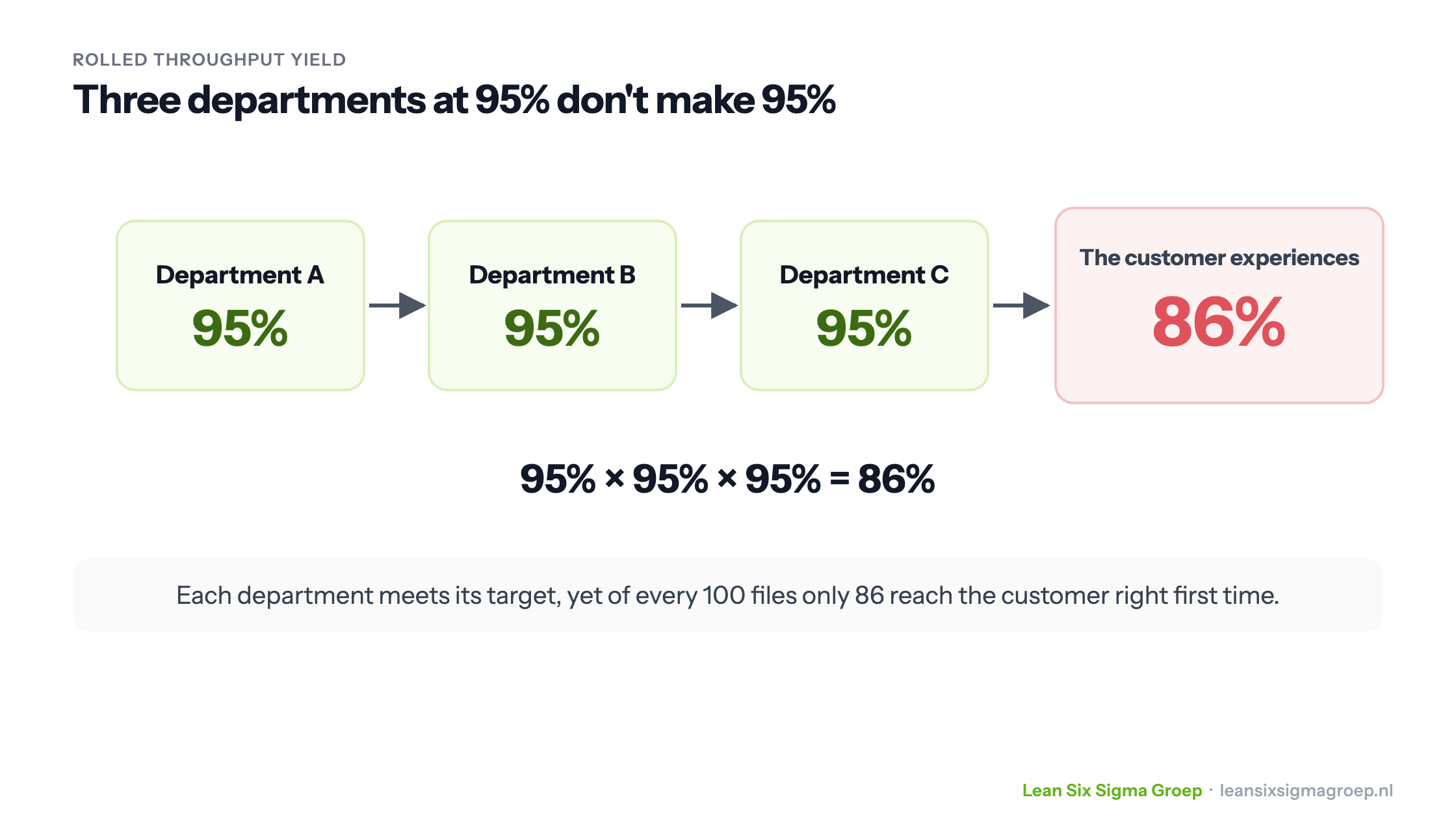
Related to First Time Right is yield. The First Time Yield shows, for each process step, how many units pass through right first time. If a process runs through several steps or departments, you multiply those percentages. That is called the Rolled Throughput Yield.
An example: the customer wants 95% right first time. The process runs through three departments, and each department achieves exactly 95%. Is the customer satisfied? No: they experience 95% × 95% × 95% = 86%. Of every 100 files, only 86 arrive right first time. Measuring per department doesn’t show that.
First Time Right and Lean Six Sigma
Some Black Belts see quality as the most important, sometimes even the only, goal of improving with Six Sigma. You don’t have to go that far, but improving quality always adds value, with shorter lead times and higher customer satisfaction as welcome side effects.
First Time Right, yield, DMAIC and standardisation are all covered in the Green Belt and Black Belt training courses. Questions? Contact us at [email protected] or +31 88 53 26 700.