Poka Yoke is Japanese for “mistake-proofing”: poka means an unintended mistake and yokeru means to avoid. It is a Lean technique for setting up a process so that a mistake cannot be made, or is noticed straight away if it is made anyway.
The aim is to prevent defects by making human errors impossible, correcting them or making them visible at once. Shigeo Shingo made the concept part of the Toyota Production System in the 1960s. He first called it baka-yoke, “idiot-proofing”, but changed it to the milder poka-yoke: people aren’t stupid, the process needs to be better.
Two levels and three methods
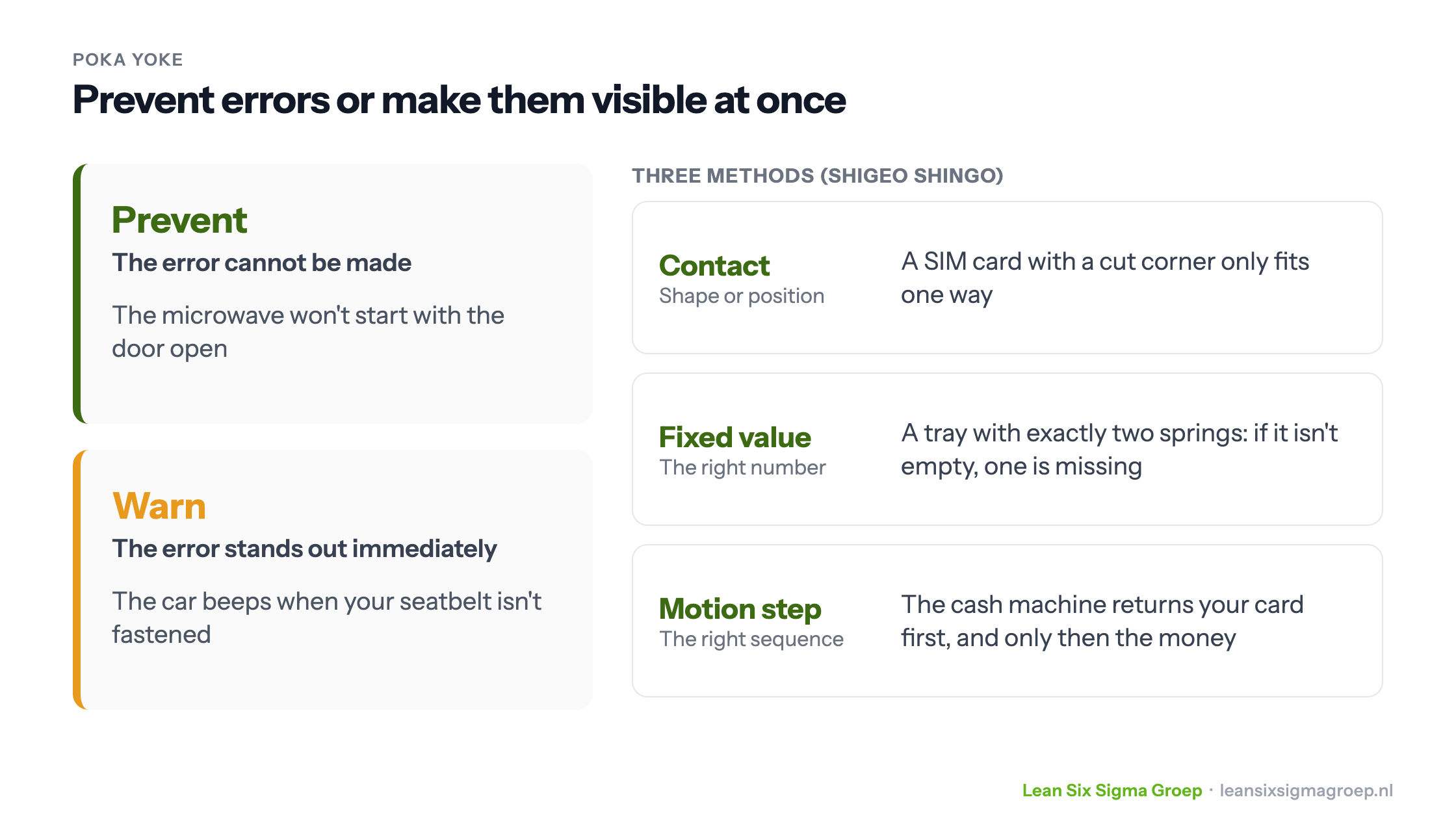
A Poka Yoke works at one of two levels, as shown in the image at the top of this article:
- Prevent (control): the mistake cannot be made, or the process doesn’t continue. A microwave won’t start with the door open.
- Warn (warning): the mistake can be made, but stands out immediately. The car beeps when your seatbelt isn’t fastened.
Preventing is stronger than warning, because a warning can be ignored. Shingo also distinguished three methods:
- Contact method: shape, size or position make sure something only fits one way. A SIM card with a cut corner, or a jig that a part only fits into correctly.
- Fixed-value method: you check that the right number has been used. A tray with exactly the number of parts for one product, or a surgical instrument set that must be complete after the operation.
- Motion-step method: the next step is only possible once the previous one is done. The cash machine returns your card first and only then the money, so you don’t forget the card.
History: Shingo’s switch
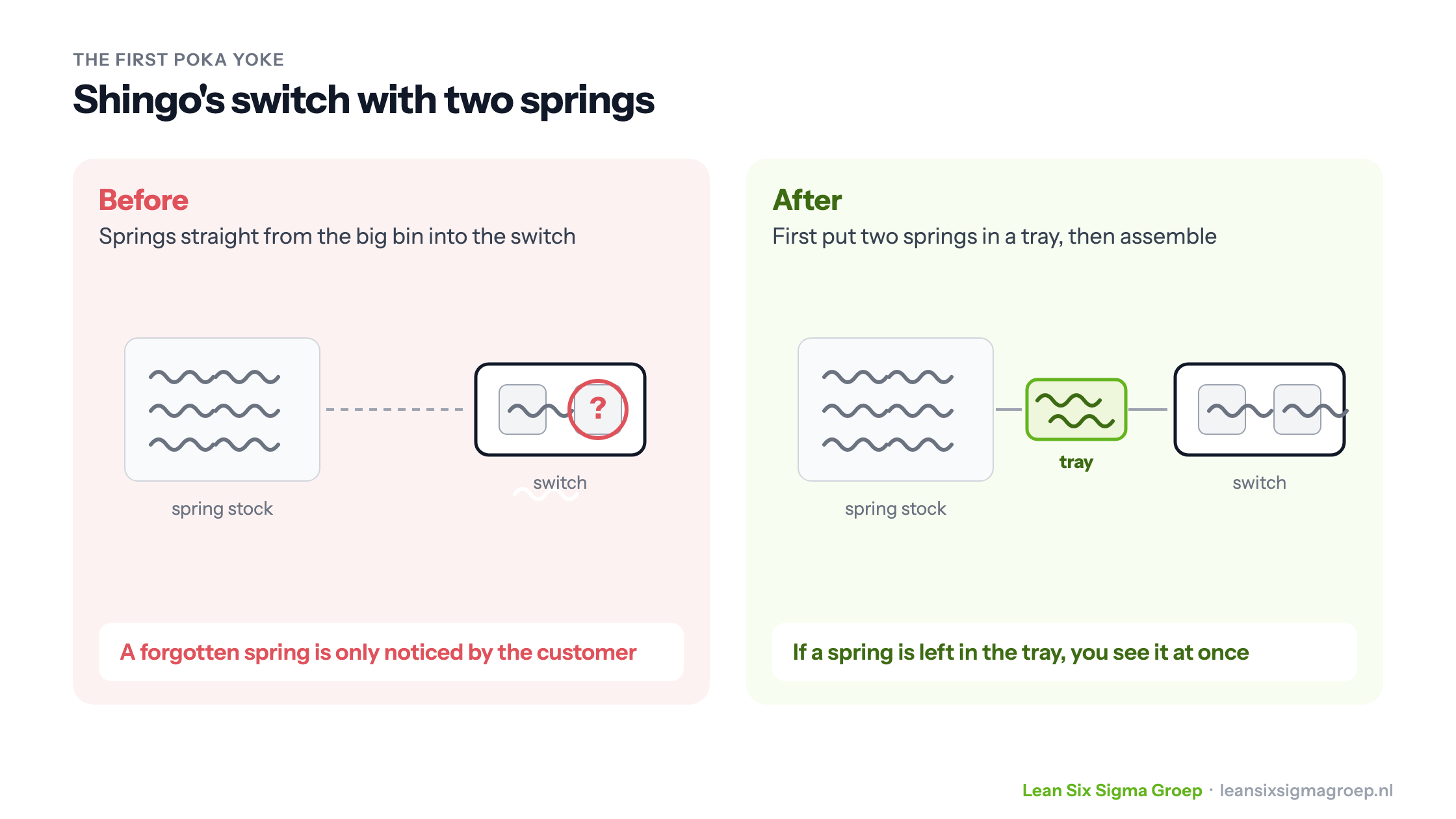
Shingo came up with the technique at a factory where workers assembled small switches. They regularly forgot to put one of the two springs under the buttons. Shingo changed the work into two steps: first put two springs from the stock into a tray, then put the springs from the tray into the switch. If a spring was still in the tray after assembly, the worker knew straight away that one had been forgotten.
This is one of the tools you learn to apply in the Green Belt training.
Shingo distinguished between mistakes and defects. Mistakes are human and can never be fully prevented. A defect only arises when a mistake reaches the customer. Poka Yoke sets up the process so that mistakes are found and fixed immediately, so no defect arises.
Examples of Poka Yoke
- A fuel nozzle switches off automatically when the tank is full.
- The diesel nozzle is wider than the filler neck of a petrol car, so you can’t fill up with diesel by mistake.
- A washing machine or microwave won’t start with the door open.
- The earth pin of a plug is longer than the other pins, so the connection is always earthed first.
- Lift doors open again when something is in the way, and a lift refuses to move when it is overloaded.
- A web form only lets you submit once all required fields are filled in, and checks that a postcode has the right format.
Design principles that prevent mistakes
Designer Don Norman described, in his book The Design of Everyday Things, principles for designing a product or process so that people naturally get it right. They are very useful when coming up with a Poka Yoke:
- Constraints: make it impossible to do anything other than what is intended, like the washing machine that won’t start with the door open.
- Visibility: the more visible the next task, the clearer what you need to do. Think of a checklist or an instruction right next to the machine.
- Feedback: show straight away whether something went right, with an error message, a beep or a light that shows something is ready.
- Consistency: the same action always gives the same result. That is why you can drive any car with a licence, and everyone knows what the left and right mouse buttons do. Reports that always have the same structure also make mistakes less likely.
- Mapping: the control matches the effect. Turn a volume knob to the right and the sound gets louder.
- Affordance: the shape shows how to use something. A door handle invites you to pull, a plate on the door to push.
What does Poka Yoke deliver?
- Less scrap and rework, because mistakes are prevented or found immediately.
- Quality built into the process, instead of checked afterwards.
- Less chance that a mistake reaches the customer.
- Less time needed to train new employees, because the process itself enforces the right way of working.
- Less mental strain in repetitive work: you don’t have to remember everything.
Applying Poka Yoke yourself
Making mistakes is human, and sometimes even necessary to learn. But the customer shouldn’t notice. So look at where mistakes arise in your own process, for example with an FMEA or a root cause analysis, and ask for each mistake: can we make it impossible, and if not, can we make it visible straight away? Poka Yoke is a standard part of the Improve phase in DMAIC.