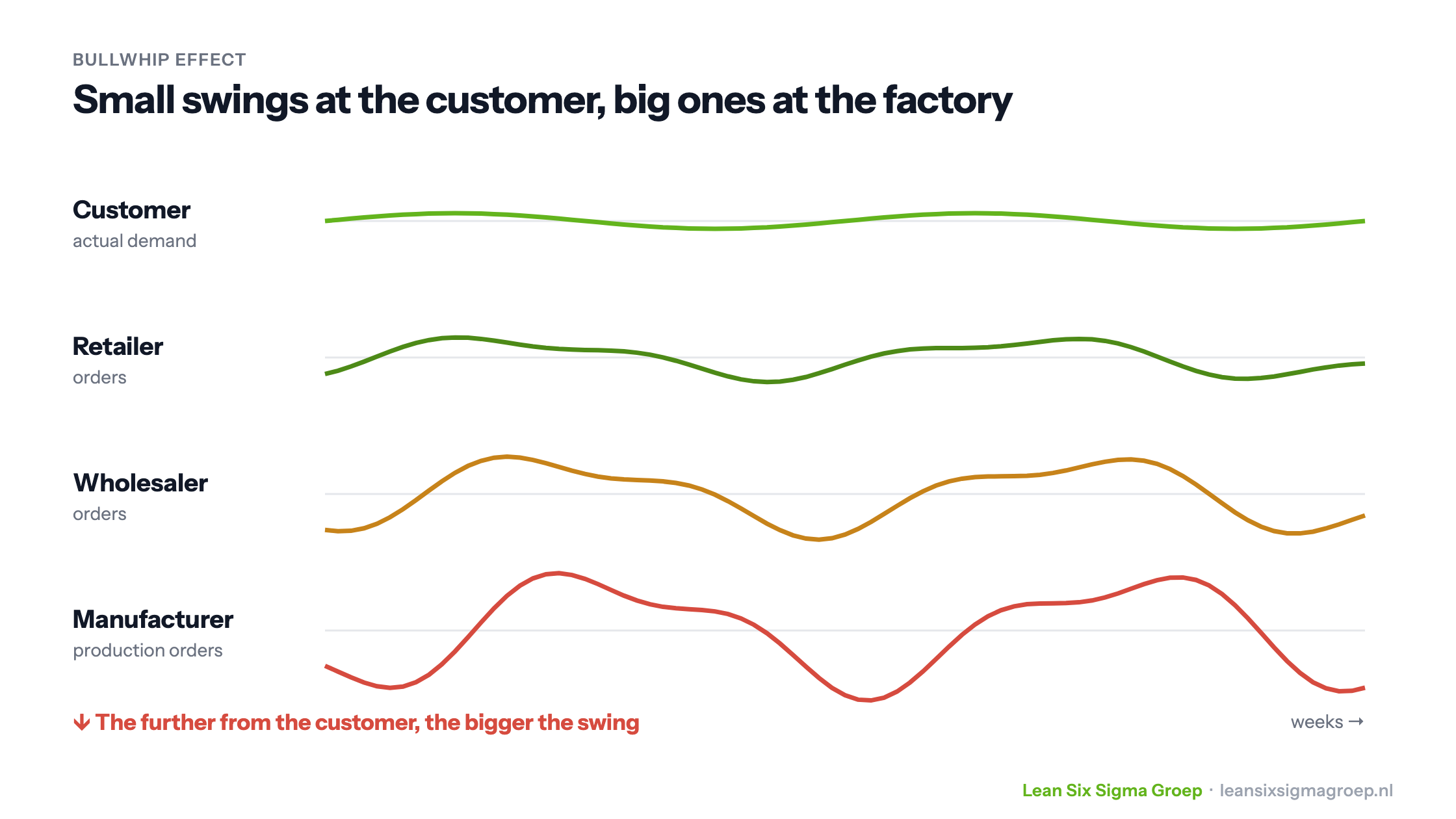
The Bullwhip Effect is the phenomenon in which small fluctuations in customer demand grow larger the further you move up the supply chain. The retailer orders a little more than customers buy, the wholesaler a bit more still, and at the manufacturer production orders swing back and forth. The result: alternately too much and too little stock, and high costs.
What is the Bullwhip Effect?
Think of a whip: a small movement of the wrist becomes a big crack at the end. The same happens in a supply chain. End-customer demand is usually fairly stable. But each link orders based on the orders of the next link, not on what the end customer actually buys. At each step something is added, and the swings grow the further you get from the customer. The image at the top of this article shows this.
The phenomenon was described in 1961 by Jay Forrester of MIT. It became well known through Procter & Gamble, which in the 1990s saw that orders for Pampers nappies fluctuated strongly, while babies use roughly the same number of nappies every day. Business schools have made the effect tangible for decades with MIT’s Beer Game, a simulation in which participants run a beer supply chain themselves.
A comparison: the traffic jam
You know it from the motorway. The first car brakes slightly for a pothole. The car behind sees the brake lights, doesn’t know why, and brakes a bit harder to be safe. The car behind that brakes harder still. A few hundred metres back traffic stops, while the first car has long since driven on. A small change at the front becomes a big disruption at the back.
The four causes
Hau Lee, V. Padmanabhan and Seungjin Whang described four causes in 1997. They are shown, with remedies, in the image below.
This is one of the tools you learn to apply in the Green Belt training.
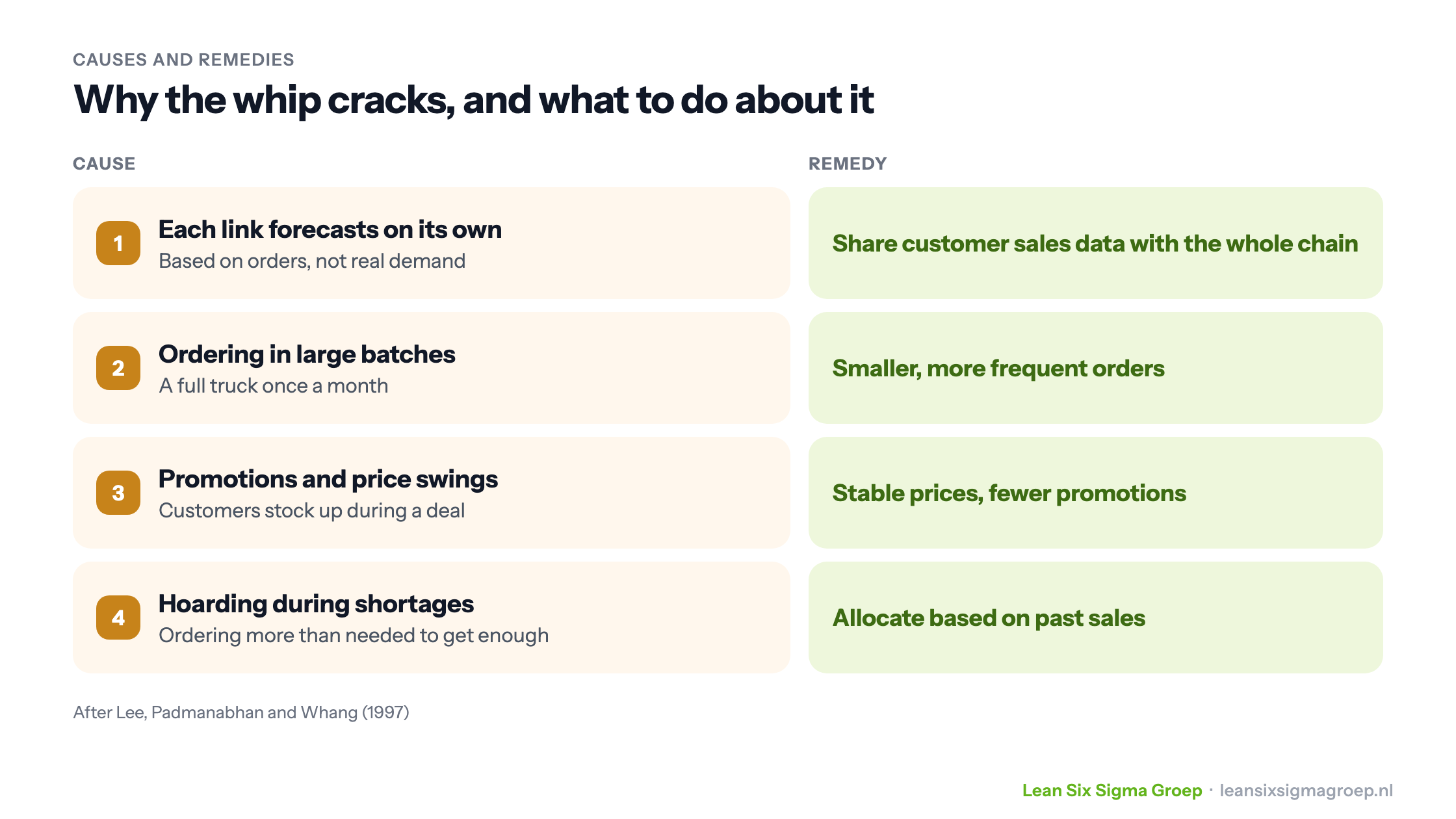
- Each link forecasts on its own. Everyone bases their forecast on incoming orders, and adds a buffer on top. A small increase becomes a big one.
- Ordering in large batches. Ordering a full truck once a month turns even demand into an erratic pattern.
- Promotions and price swings. During a deal customers stock up, then buy nothing for a while.
- Hoarding during shortages. When a product is scarce and suppliers ration, everyone orders more than needed to get enough. As soon as the shortage is over, orders collapse.
Why it clashes with Lean
The Bullwhip Effect runs counter to the principles of Lean:
- Waste: too much inventory at one moment, shortages and rush orders at another.
- Flow: Lean aims for an even flow, the Bullwhip Effect causes peaks and troughs.
- Customer demand: production is matched to orders that have little to do with real demand.
What helps?
- Share real demand. If the whole chain sees end-customer sales, nobody has to guess. That is the most powerful remedy.
- Smaller batches, more frequent deliveries. Exactly what Just in Time and one piece flow aim for.
- Shorter lead times. The shorter the delivery time, the less buffer everyone thinks they need.
- Stable prices instead of ever new promotions.
- Fair allocation during shortages, based on past sales rather than orders.
- Vendor-managed inventory: the supplier monitors stock at the customer and replenishes it, so one less link forecasts.
The Bullwhip Effect is therefore above all an information problem. Whoever sees real demand and delivers in small steps takes the whip out of the chain.