SMED stands for Single Minute Exchange of Dies: changing over a machine within a few minutes. It is a Lean method that drastically shortens changeover times. That lets you produce in smaller batches, respond faster to customer demand and hold less stock.
What is SMED?
SMED was developed by Japanese engineer Shigeo Shingo, who from the 1950s worked with Toyota, among others, on the Toyota Production System. He is also known for Poka Yoke. “Single minute” doesn’t mean a changeover takes one minute, but that it should take less than ten minutes: a single-digit number.
A shorter changeover means the machine is stopped for less time. That increases availability, and with it OEE. More importantly: when changeovers are quick, you no longer need large batches to earn back the changeover time. You can make what the customer asks for, when they ask for it, with less finished stock.
Internal and external
The core of SMED is the distinction between two types of work in a changeover:
- Internal tasks can only be done while the machine is stopped, such as removing the old mould and fitting the new one.
- External tasks can also be done while the machine is still producing, such as laying out tools, fetching or preheating the new mould.
In practice, much external work is still done during the stoppage. Moving it to the time the machine is still running often wins back a large part of the changeover time straight away.
SMED in four steps
Shingo described a fixed approach. In effect, you go through a small DMAIC cycle, together with the people who do the changeover every day.
This is one of the tools you learn to apply in the Green Belt training.
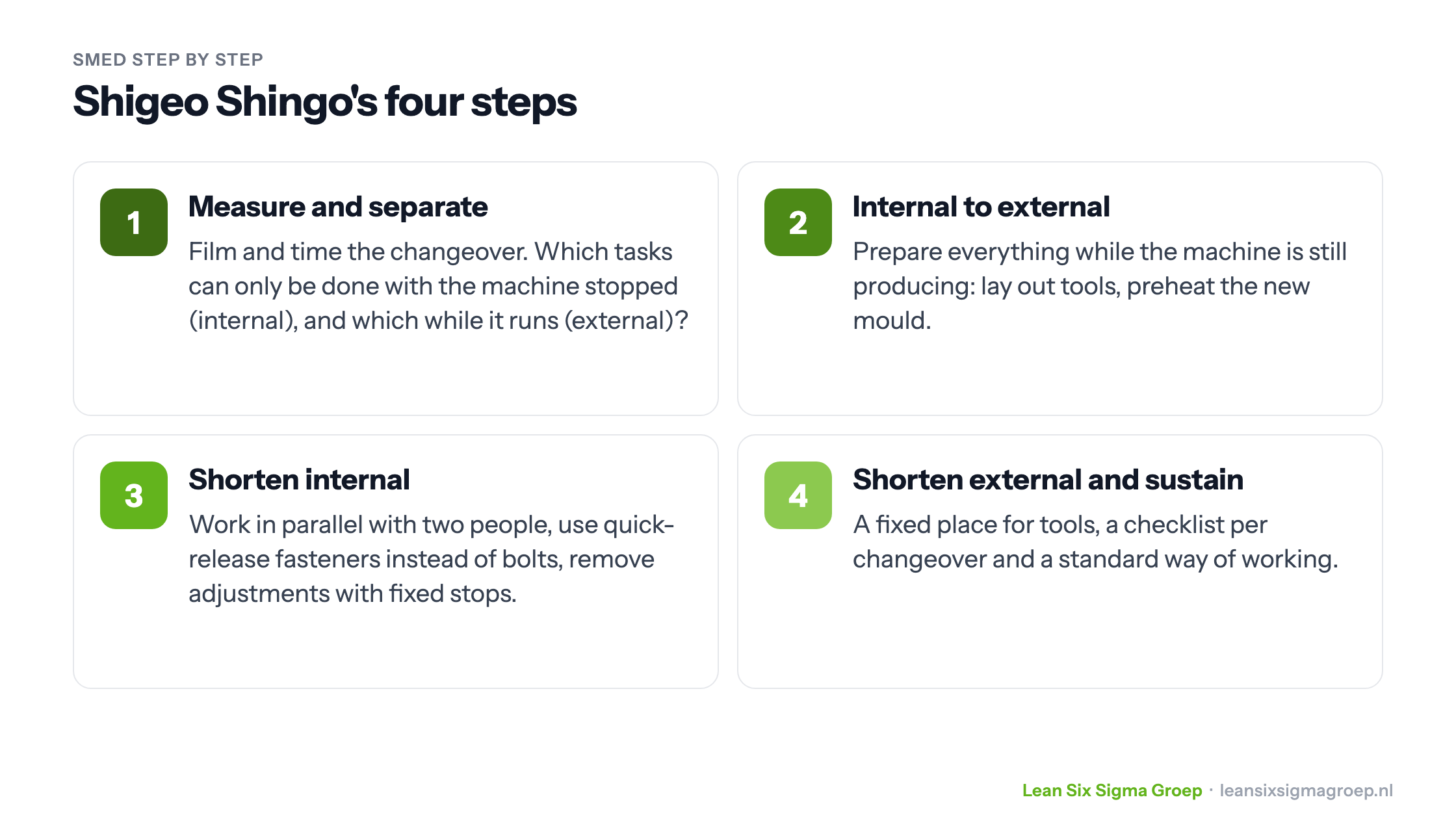
- Measure and separate: watch the changeover several times, preferably on video, and time each task. List everything and decide for each task whether it is internal or external.
- Internal to external: move as much as possible to the time the machine is still running.
- Shorten internal: have two people work in parallel, replace bolts with quick-release fasteners, and remove adjustments with fixed stops or standard heights.
- Shorten external and sustain: a fixed place for tools and parts, a checklist per changeover and a standard way of working.
After the first measurement you often already see quick wins, such as waiting times that can disappear without investment. Harder improvements, such as a different way of fixing the mould, follow later.
Example: an injection moulding company
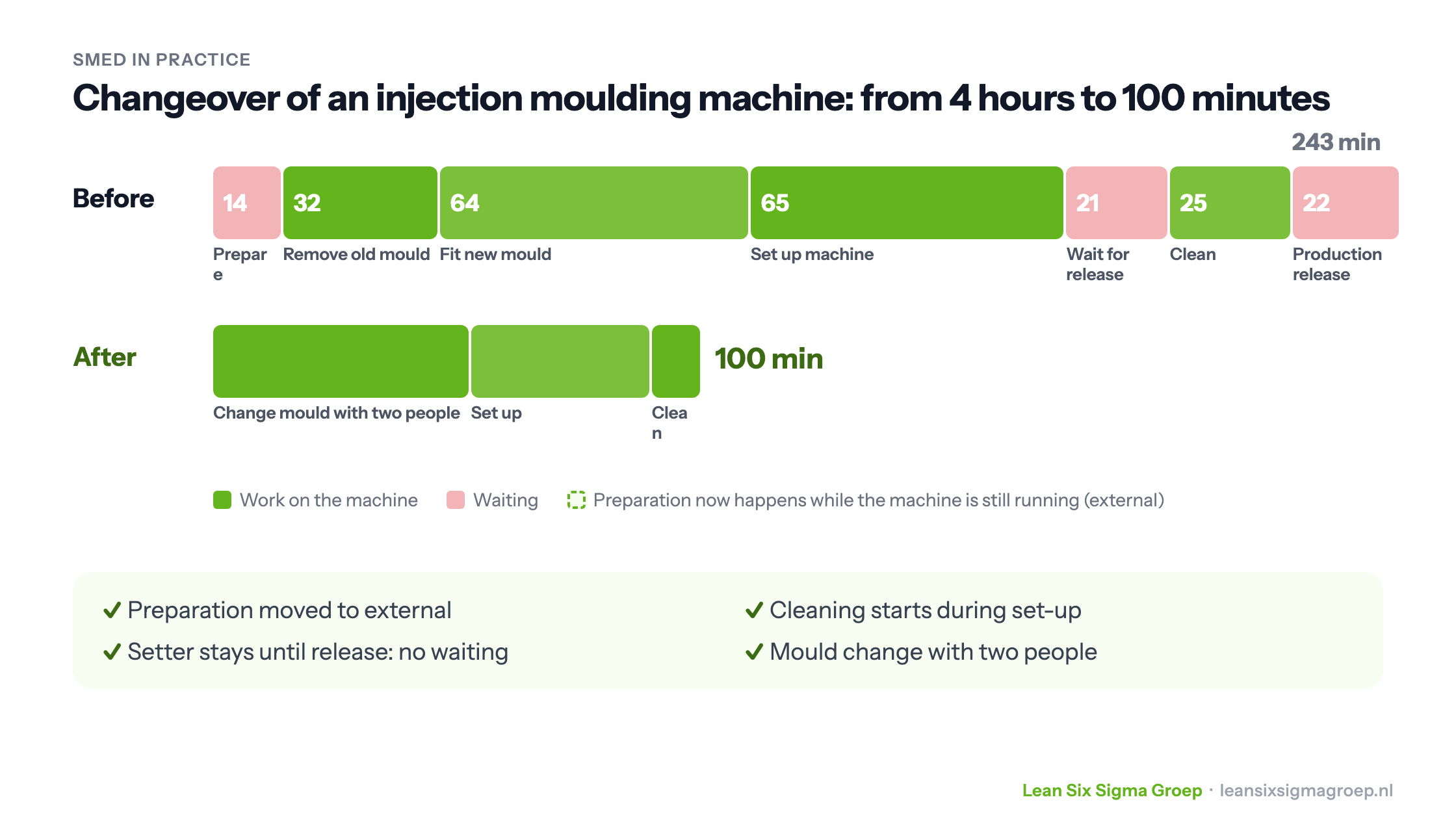
An injection moulding company makes plastic packaging. Demand is high and lead times have become long. A changeover takes over four hours. The measurement shows these phases:
- preparing and taking the machine out of production: 14 minutes;
- removing the old mould: 32 minutes;
- fitting the new mould: 64 minutes;
- setting up the machine for the new product: 65 minutes;
- waiting for release for cleaning: 21 minutes;
- cleaning: 25 minutes;
- release for production: 22 minutes.
Together that is 243 minutes. Preparing and the two releases take 57 minutes, while nothing happens to the machine. The team takes these measures:
- Preparation now happens while the machine is still running: from internal to external.
- Cleaning starts during the last set-up tasks. That saves 15 minutes of cleaning time, and the wait for the cleaning release disappears.
- The setter stays until cleaning is done and releases the machine straight away, so that wait disappears too.
That alone saves 14 + 21 + 15 + 22 = 72 minutes. Then two people change the mould together, which cuts removal, fitting and set-up substantially. An added benefit: an experienced and a less experienced colleague learn from each other.
The result: the changeover now takes 100 minutes. Much more can be produced, OEE rises, and the team already has ideas to shorten the changeover further.
SMED outside the factory
SMED comes from manufacturing, but services have changeovers too, even if they are less visible. Every time you switch tasks, for example from writing a quote to a customer on the phone, or when a new e-mail notification pulls your attention away, it takes time to get back into your work. There too it helps to avoid unnecessary switches and keep the transition as short as possible.
In summary
SMED is a powerful way to cut changeover times sharply, so you can produce in much smaller batches. It lies at the basis of Lean, and the effect is often bigger than you expect. So take a critical look at the changeovers in your own process.