Efficiency means doing something with as little time, money and effort as possible. Effectiveness means reaching the goal. The two are often confused, but you need both: doing the right things, and doing them right. This article explains the difference, how to measure efficiency, and why a change only works if people accept it.
The difference between efficiency and effectiveness
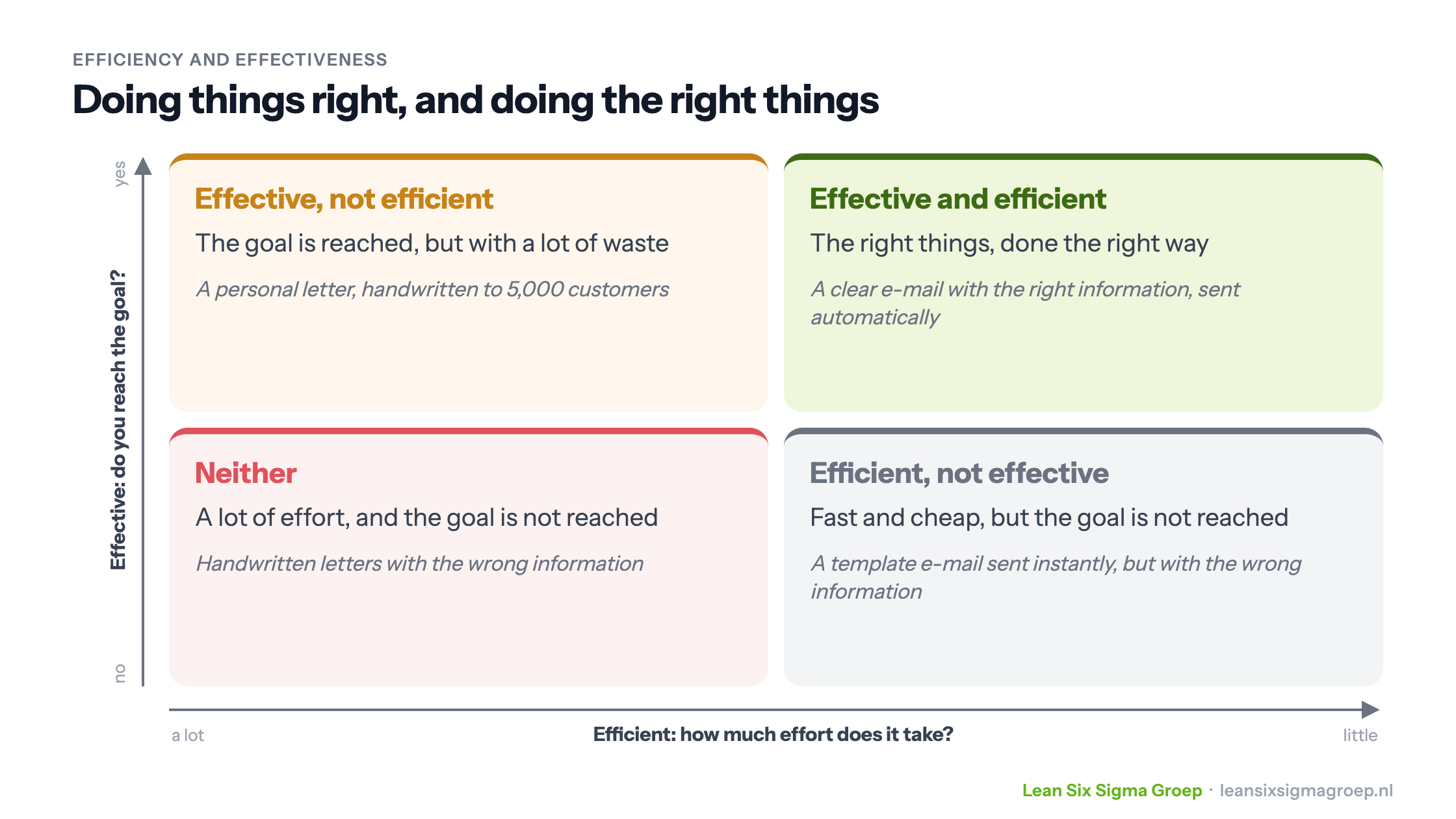
- Efficient is about the effort it takes to do something: doing things right.
- Effective is about the result: do you reach the goal? Doing the right things.
An example: a municipality wants to inform all residents about a change. A template e-mail sent automatically to everyone is efficient. But if it contains the wrong information, or ends up in spam, it is not effective. A handwritten letter to every resident might reach its goal, but takes far too much effort. The image at the top of this article sets the four combinations side by side.
The best is of course the combination: reaching the goal with as little waste of time, resources and effort as possible. The right things, done the right way.
Measuring efficiency
You measure the efficiency of a process with Process Cycle Efficiency (PCE): the time that adds value for the customer, divided by the total lead time, including waiting, transport and storage.
Value-adding time is time in which something happens that the customer is willing to pay for, such as kneading and baking a loaf. The rest is non-value-adding: waiting for ingredients, stock between steps, transport. Some activities add no value for the customer but are still necessary, for example because of legislation; these are called business non-value-added. Below is an example.
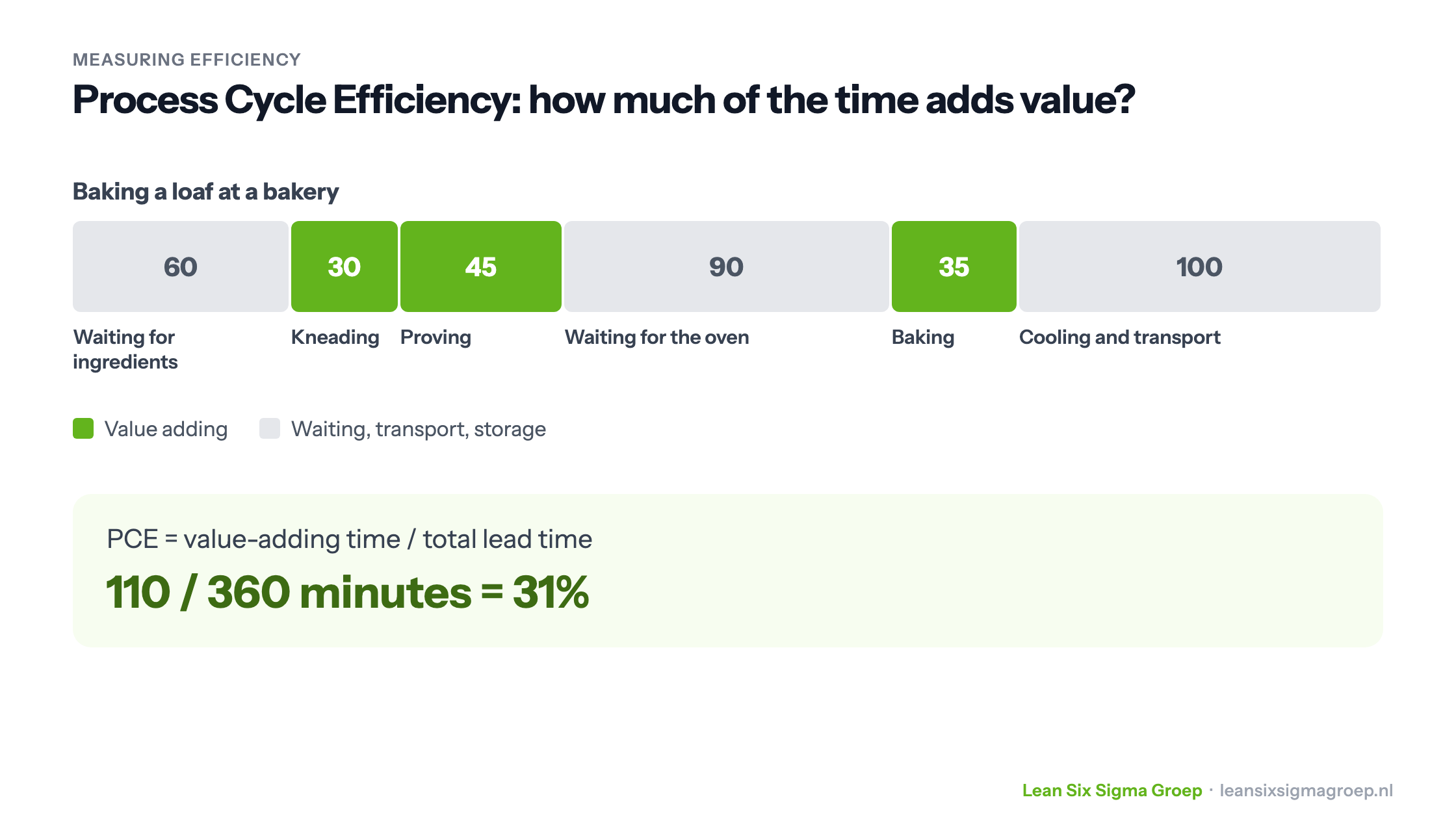
A PCE of 31% is actually high in practice: in many processes it is below 10%, because the work mostly sits waiting. A value stream map makes that visible.
Efficiency and Lean
Lean is often explained as making processes more efficient, by removing waste and improving time, quality and cost. Lean originated in the Japanese car industry and became known in the West through Womack and Jones. There is still great interest in this way of improving.
But working more efficiently requires change, and change doesn’t happen by itself. We all want to make things better, but improving also means different routines, things that don’t work straight away, and unrest. That takes energy. That is why change management is just as important as the improvement itself.
Engagement and acceptance
A change only becomes enjoyable when it leads to real improvement, and when everyone notices that the new way of working is better. A few principles:
- Start with what works. First look together at what works well now, and then at how it can be better. Emphasising only what is wrong drains energy you need.
- Look at the system, not at people. A safe evaluation without blame makes people tell honestly what is going on.
- Use the knowledge of the people in the process. They know best how things can improve.
- Let the customer lead. An improvement is only really an improvement if the customer benefits from it.
A good example from Lean manufacturing is the andon cord: if a worker sees an error or an opportunity to improve, they pull the cord. They are listened to, and a solution is sought together. Respect for whoever spots a fault in the system means errors come out in the open instead of being covered up.
Effectiveness of a change: E = Q × A
The effectiveness of a change depends on two factors:
- Quality (Q) of the solution: how good is the solution in content?
- Acceptance (A) of the solution: how far do the people who have to work with it support it?
Effectiveness is the product of the two: E = Q × A. A solution with quality 10 but acceptance 0 therefore has an effectiveness of 0. Some even write E = Q × A², because people often make choices based on feeling, so acceptance weighs extra heavily.
For Green Belts, Black Belts and Master Black Belts this means: work not only on a good solution, but also on support. Involve the people from the process, listen to their feedback and create an environment in which they dare to share ideas and report mistakes.
Conclusion
To make a process more efficient and deliver more value to the customer, you need to see the waste, find the root causes and tackle them. To implement those solutions effectively, acceptance is just as important as quality, or even more so. So always involve the people with knowledge and experience of the process.
In the Green Belt and Green to Black Belt training courses you learn the principles, method and tools to make processes more efficient and more effective.