The Theory of Constraints (TOC) is based on a simple idea: every process has one weakest link that determines how much the process can deliver. Improving anywhere else achieves little. Improve the constraint, and the whole process improves.
What is the Theory of Constraints?
Eliyahu Goldratt developed the Theory of Constraints in the 1980s and made it known through his novel The Goal (1984). According to Goldratt, the goal of an organisation is to make money, now and in the future. Whatever limits that goal most is the constraint: the bottleneck.
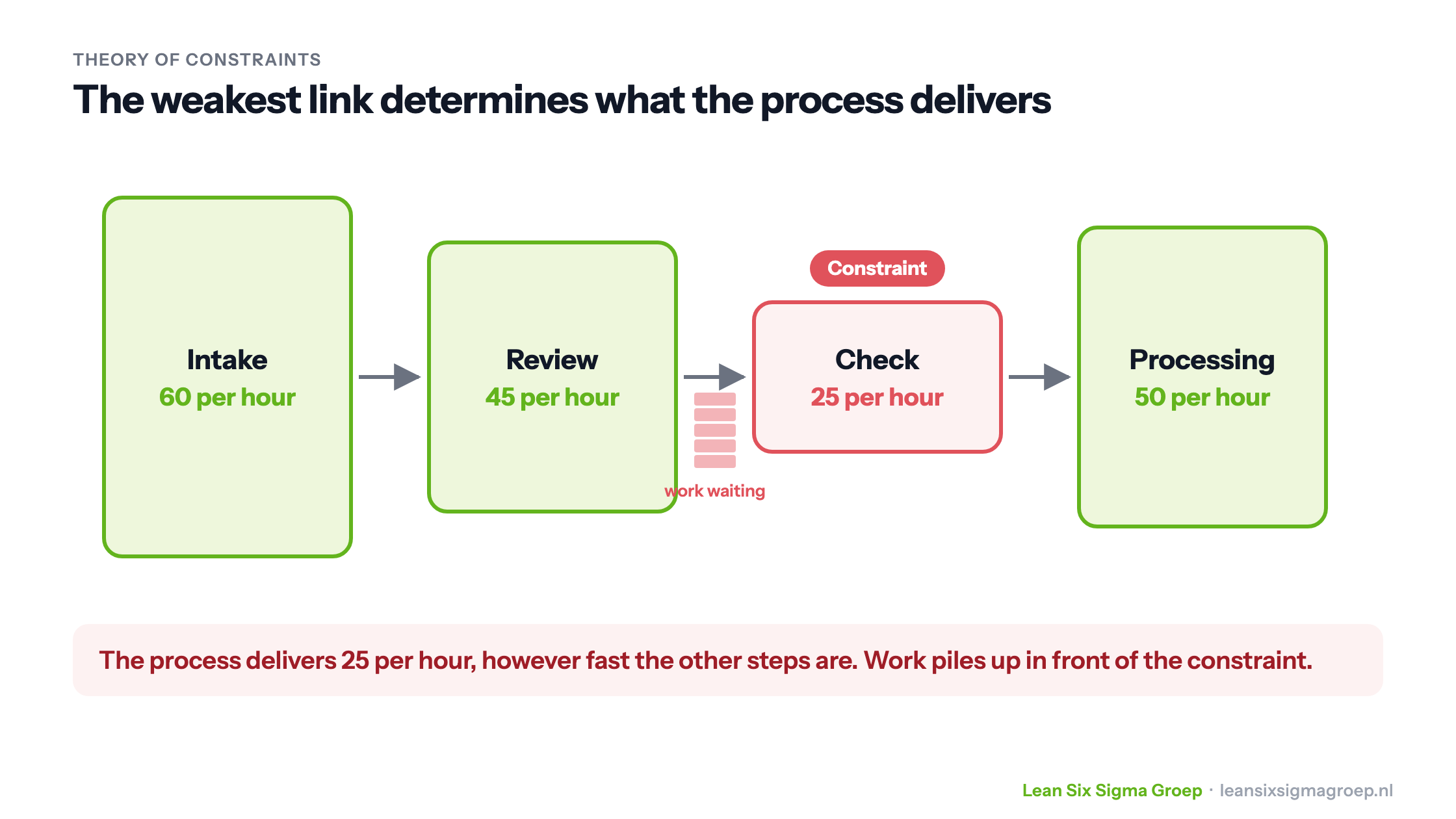
The image at the top of this article shows why. The process has four steps, but the check can only handle 25 per hour. So the whole process delivers 25 per hour, however fast the other steps are. Work piles up in front of the check. Gaining an hour at intake achieves nothing; losing an hour at the check costs the whole process an hour.
Once the constraint is solved, a new, perhaps less severe, constraint appears elsewhere. That makes the Theory of Constraints a cycle of continuous improvement, just like the PDCA cycle.
The Theory of Constraints rests on three pillars: the five focusing steps, the thinking processes and throughput accounting.
1. The five focusing steps
Goldratt described five steps for dealing with a constraint:
This is one of the tools you learn to apply in the Green Belt training.
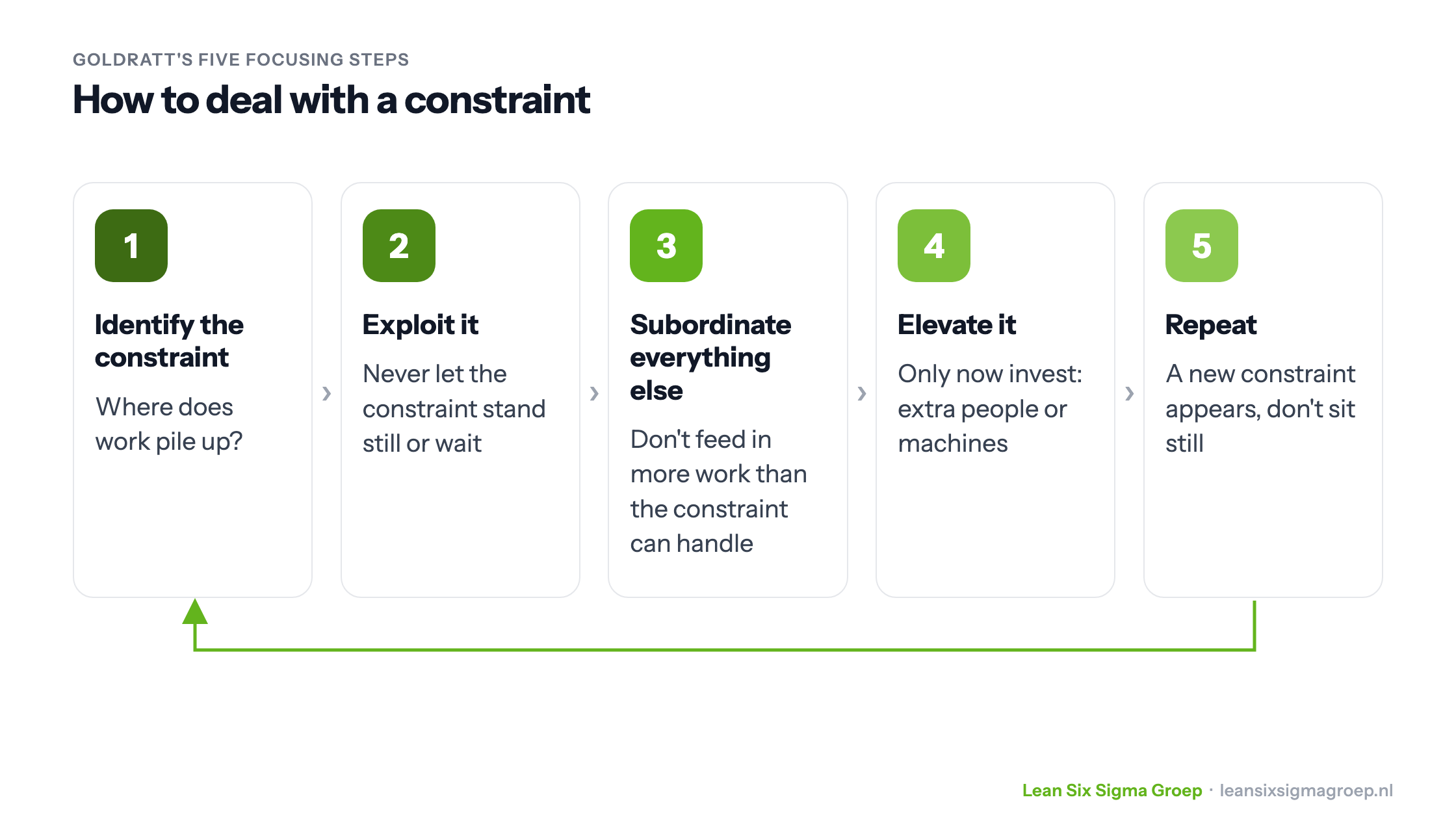
- Identify the constraint. Where does work pile up? What are the others waiting for?
- Exploit it. Get everything out of the constraint without investing: never let it stand still, don’t let it do work that can be done elsewhere, and don’t let it lose time on rework.
- Subordinate everything else. Don’t feed in more work than the constraint can handle. Feeding in more only creates longer queues and more stock. Goldratt called this drum-buffer-rope: the constraint sets the pace.
- Elevate it. Only if the first three steps aren’t enough do you invest in the constraint, for example with extra people or machines.
- Repeat. A new constraint appears. Don’t let inertia become the constraint.
2. The thinking processes
To really solve a constraint, you need to know its causes. Goldratt developed logical thinking methods for this, such as the current reality tree, in which you connect causes and effects. This resembles the Analyse phase of a DMAIC project, in which you use tools such as 5 whys and the fishbone diagram.
3. Throughput accounting
Throughput accounting is a way of calculating that helps managers make the right decisions. It looks at three measures: throughput (the money sales bring in, minus material costs), inventory or investment, and operating expense. A good decision increases throughput or reduces inventory and expense. A minute of the constraint is worth far more than a minute elsewhere.
What does it deliver?
Improving with a focus on the constraint leads to less stock, shorter lead times, better use of capacity and ultimately more profit. The Theory of Constraints was first used mainly in manufacturing, but is now also applied in project management, healthcare and in areas such as finance, HR and sales.
The Theory of Constraints has a lot in common with Lean: continuous improvement, finding the root cause and improving flow. It also shares features with Agile, such as improving in short cycles and evaluating regularly. The video with this article gives a short explanation.
From theory to practice
Learn to apply this in practice
Topics like Theory of Constraints are applied directly to an improvement project from your own organisation in the Green Belt training.
Next start dates
Lean Six Sigma Green Belt training →Not ready for a training yet?