Gemba (現場) is Japanese for “the real place”: the shop floor, where value is added for the customer. In Lean, gemba simply means going to look at the place you want to improve, instead of talking about it in a meeting room. But there is more to it than a visit.
Where does gemba come from?
Gemba belongs to the Toyota Production System. Taiichi Ohno, one of its founders, sometimes had new managers stand in a chalk circle on the shop floor for hours to observe, the so-called Ohno circle. Only once they really saw what was happening could they move on. That idea, look for yourself first before you judge or solve, is the core of gemba, and a fixed part of Lean and kaizen.
Value, what a customer is willing to pay for or what an organisation must do by law, is the first principle of Lean. And that value is created at the gemba.
What is a gemba walk?
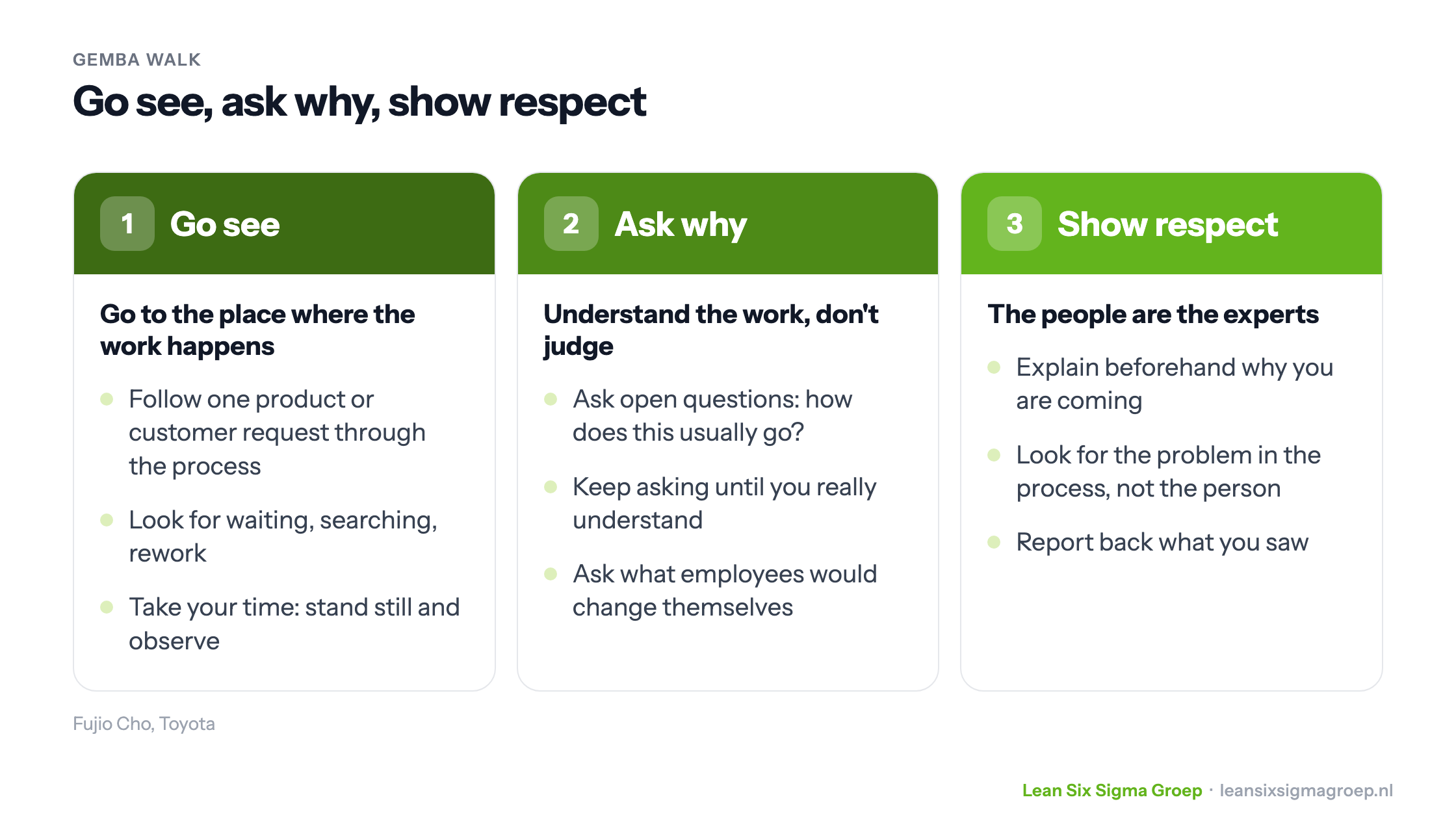
In a gemba walk, a manager or improver goes to the shop floor to see and understand the process. Toyota summed it up as: go see, ask why, show respect. The image at the top of this article shows what that means in practice.
Use all your senses. Look at what people and machines do and don’t do, pay attention to the whole and the details, and sense the atmosphere. Feel where to ask that one open question to get to the heart of the matter. Above all, listen, and leave your judgement at home for now.
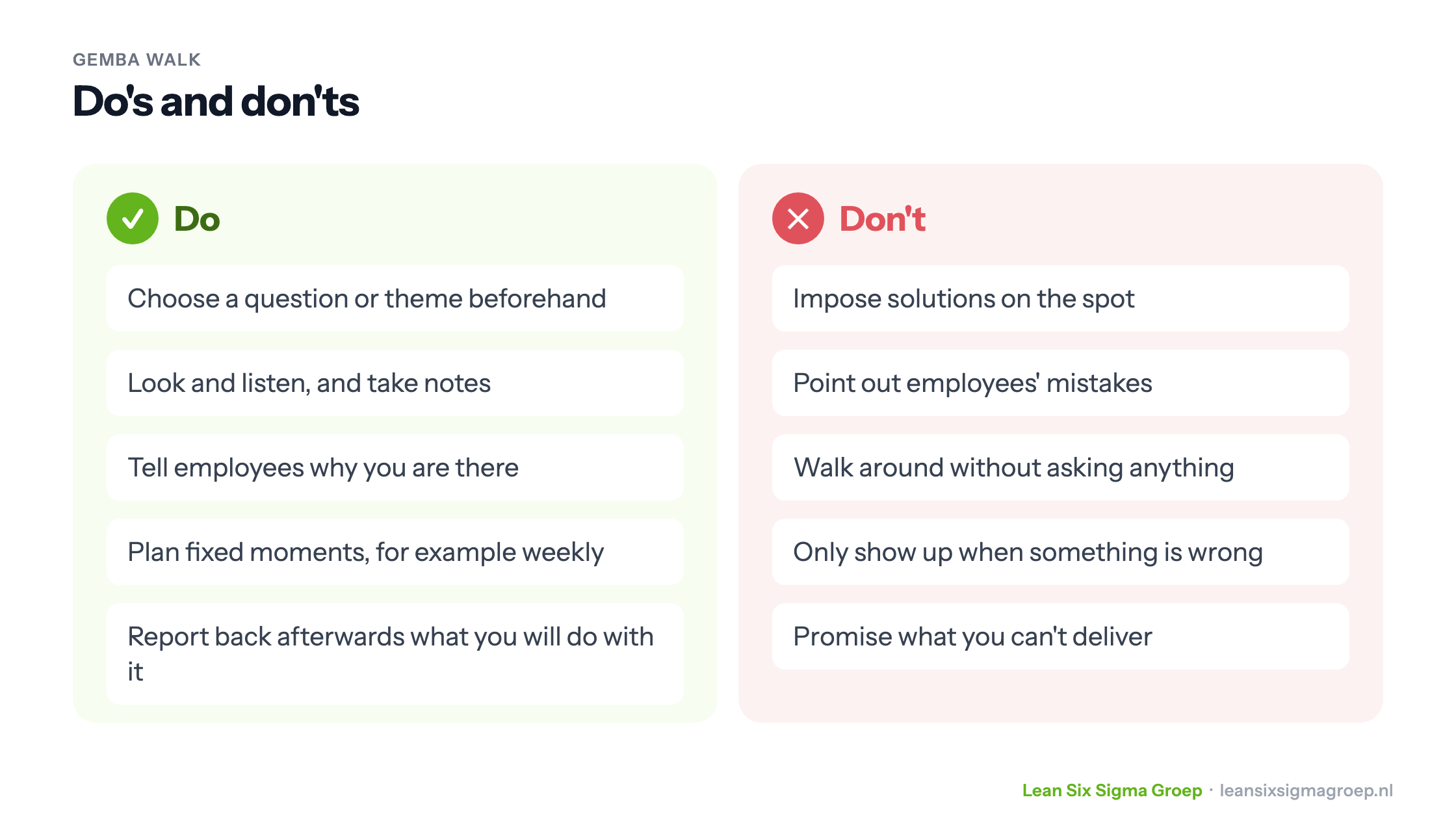
The idea is that problems in a process are often simply visible if you look in the right place, and that the best improvements come from there too. A gemba walk also improves communication, openness and trust between employees and management. That is why it is not meant for pointing out employees’ mistakes or enforcing rules. Then people close up, and you see nothing at all.
This is one of the tools you learn to apply in the Green Belt training.
A gemba walk can also be done remotely, for example with teams that work from home or at another location. Watching digitally has its limits, but you can largely make up for them by taking more time, for example with one-to-one conversations in which someone shares their screen and shows the work.
What does gemba deliver?
Anyone who regularly goes to the shop floor comes to value it more and more. It delivers, among other things:
- insight into the processes you want to improve;
- insight into the bottlenecks in those processes;
- improvement opportunities handed to you on a plate, often quick wins;
- engaged employees and stakeholders, because they notice they are being listened to.
An example from practice
Krijn Vrolijk, trainer at Lean Six Sigma Groep, guided a change programme in a mail room. The manager had just started. He was positive about change, because he experienced problems in his process, but he already knew the solution: faster sorting machines. Was a whole three-month Lean project really necessary?
They agreed that Krijn would first observe for two weeks. During that gemba he met people who, without exception, loved their work but felt little appreciation. Because he showed genuine interest, he received a lot of information. After one week he could already report back.
What he reported made the manager doubt whether the speed of the sorting machines was really the cause. The insights surprised him and left him wanting more. The Lean project was approved, and the employees were happy to take part. In the end, the biggest improvement turned out to be reducing the number of handovers, not faster machines.