
Where do OKRs and the OKR method come from?
The OKR method was born in the 1970s in Silicon Valley, at Intel, by Andy Grove, then president and later CEO of Intel. Grove used OKRs to make clear what the organisation’s most important goals were and to make progress towards those goals measurable.
After John Doerr (a former Intel employee) introduced OKRs to Google’s founders, Google successfully adopted them as part of the way it is managed. Following Google’s success, the practice spread both among technology companies and well beyond them.
The success of OKRs is documented in John Doerr’s book “Measure What Matters”, which spread the method further and made it mainstream. OKRs are now recognised worldwide as an effective way to set and achieve goals within organisations.
What value do OKRs bring to an organisation?
OKRs help you define goals sharply. It is important to keep objectives short and inspiring, so teams clearly understand why their activities matter. The Key Results then show which interim results need to be achieved to realise these strategic goals.
That way an organisation can sense at all times whether it is on the right track. Unlike KPIs, which are a snapshot of, for example, operational or financial performance, OKRs focus on mobilising an organisation to achieve future goals. And that is exactly where their strength lies.
They set a point on the horizon, the Objectives, and a dynamic, concrete measure of progress through the Key Results. This keeps people motivated to direct their steps and energy towards achieving the objectives, time and again.
In summary:
- Objectives: These are qualitative, inspiring and challenging goals that give a clear direction. They describe what you want to achieve.
- Key Results: These are quantitative, measurable outcomes that show how you will know you have achieved your objective. They are specific and time-bound.
How do you use OKRs effectively in an organisation?
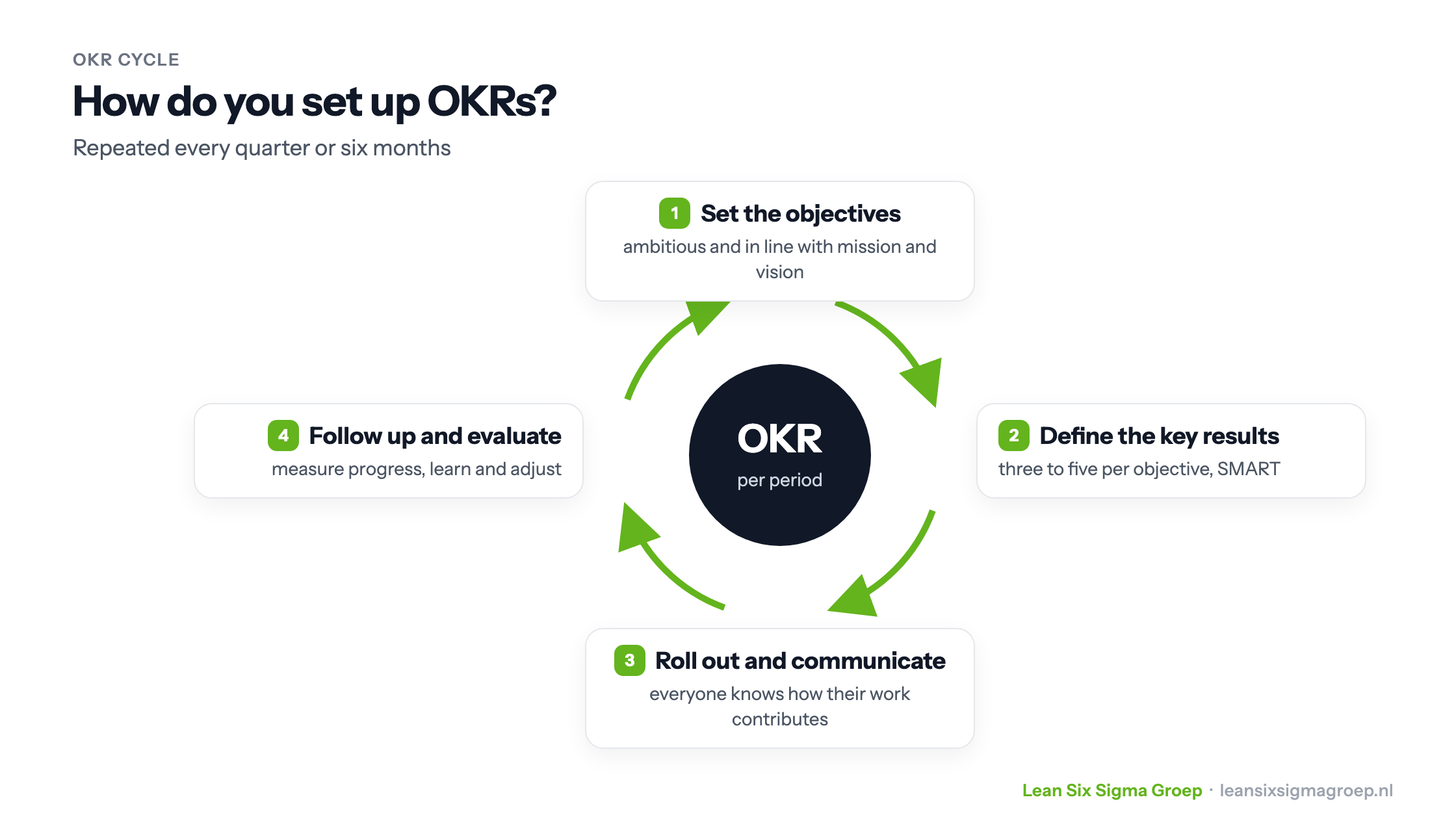
To use OKRs effectively, you can follow these guidelines:
- Set the objectives: Start by setting inspiring, ambitious objectives. They should be in line with the organisation’s mission and vision. Ask yourself what would have the biggest impact on the organisation if it were achieved.
- Define the key results: For each objective, define three to five key results. These results should be specific, measurable, achievable, relevant and time-bound (SMART). They should make clear what success looks like.
- Roll-out and communication: It is crucial that everyone in the organisation understands the OKRs and knows how their work contributes to these goals. Regular communication and updates are essential.
- Follow-up and evaluation: OKRs are usually set for a fixed period, for example every quarter or every six months. At the end of each period it is important to evaluate progress, learn from the experience and adjust the OKRs where needed. These evaluations drive continuous improvement.
This is one of the tools you learn to apply in the Green Belt training.
Examples of effective OKRs
NASA
Context: One of the most inspiring objectives any organisation has ever had was NASA’s in the run-up to the first moon landing. Although there was no documented OKR approach at the time, this is what NASA put into practice. A well-known story illustrates it well, although it is not certain it happened exactly like this. President John F. Kennedy once asked a cleaner during a visit to NASA:
“Hi, I’m Jack Kennedy, what are you doing?”. The cleaner replied: “I’m helping to put a man on the moon.” This answer shows the shared mission and vision within NASA, whatever an employee’s role.
Translated into an OKR for the cleaning team, it could look like this.
Objective: Give every NASA employee an optimal working environment every day, so they can focus fully on the mission: the first man on the moon.
Key Results
- Remove 100% of visible dirt and dust in all work areas at the end of every shift.
- Complete cleaning inspections twice a day of all critical work areas, including control rooms, laboratories and storage areas, with a compliance score of at least 98%.
- Ensure at least 4 cleaning team members are present during all pre-launch and post-launch activities to provide immediate cleaning and support in case of incidents.
FizzyBrew
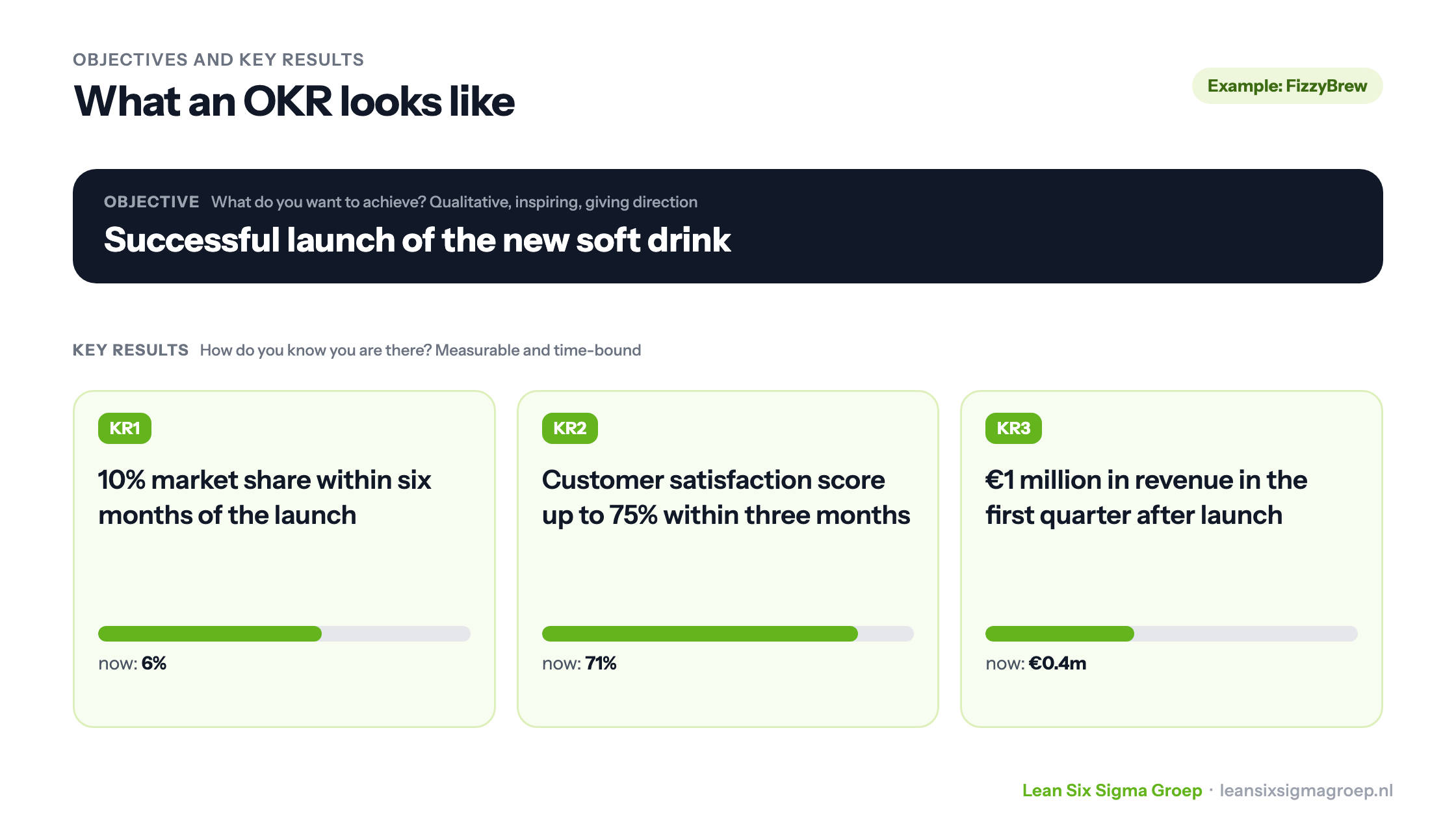
Context: Imagine a large soft drinks company, let’s call it “FizzyBrew”, that wants to launch a new drink that is not only tasty, but also more sustainable and healthier than traditional soft drinks. FizzyBrew’s objective is to become market leader in this new category of healthier soft drinks within two years.
Although they may not officially work with an OKR system, the shared mission and vision are clearly present throughout the company.
Objective: Successfully launch the new soft drink
Key Results
- Achieve a 10% market share within six months of launch.
- Raise the customer satisfaction score to 75% within three months.
- Generate €1 million in revenue within the first quarter after launch.
OKRs: a good match with Lean and Agile
The OKR method fits well with Lean and Agile. It brings focus to critical objectives: in other words, how the organisation creates value for its customers and can deliver on its critical business objectives. This is entirely in line with the focus on value in the Lean philosophy.
Activities are aimed at achieving these objectives, with waste of any kind kept to a minimum. It also focuses on getting the organisation moving and on continuous improvement.
Achieving the Key Results can then be put into practice very effectively with Agile/Scrum, where the Key Results serve as input, for example as input for the product goal and the sprint goals of the coming period.
The Lean Agile Model we developed, together with well-designed OKRs, is a powerful tool to mobilise your organisation and shape change successfully, from strategy to implementation.
Conclusion
OKRs are a powerful tool for organisations that want to achieve their goals and improve their performance. By setting clear, ambitious objectives and linking them to measurable results, teams can stay focused, track progress and pursue continuous improvement. With OKRs, organisations can realise their full potential and excel in a competitive market.