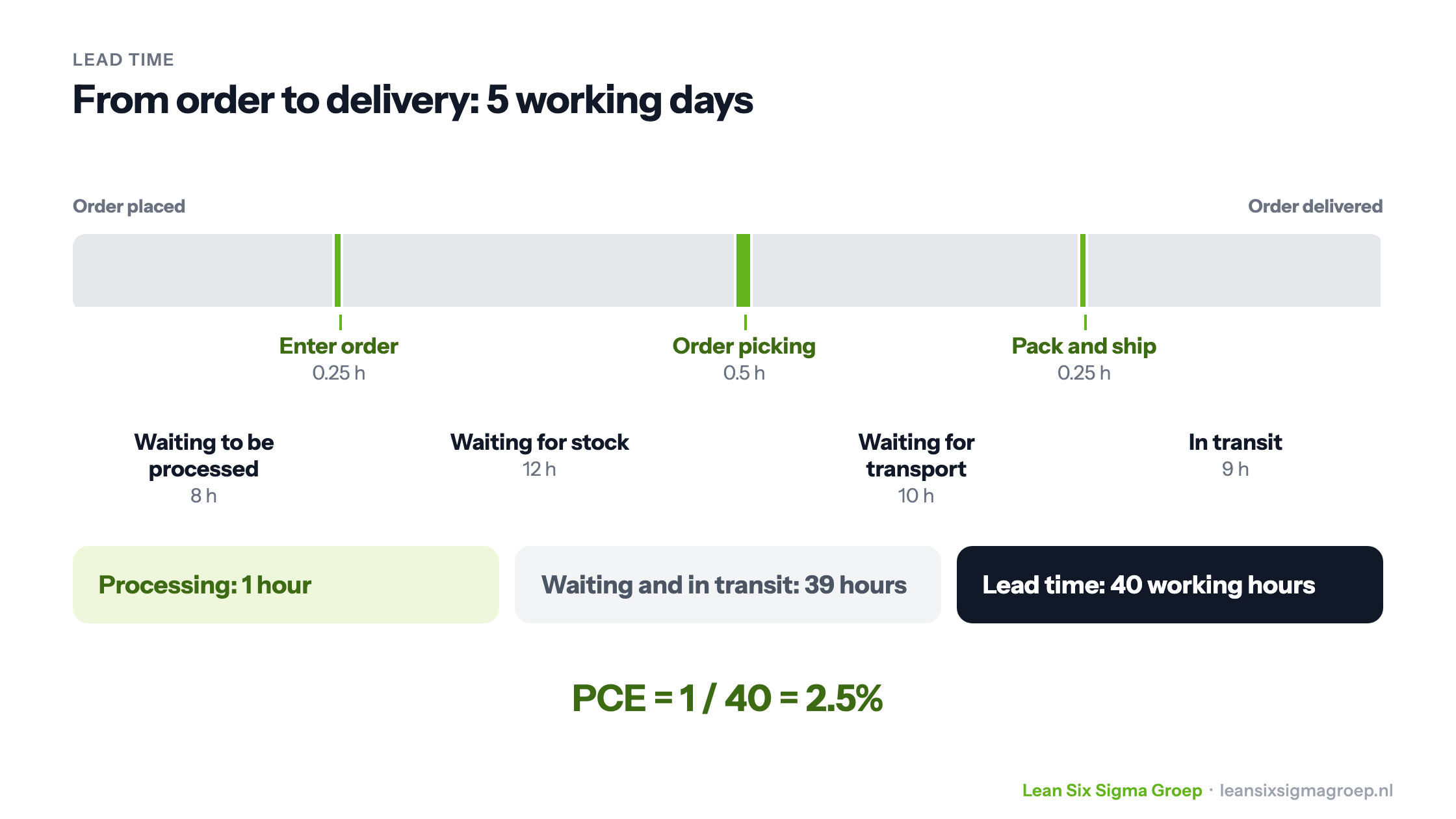
Lead time is the total time a product, service or customer request takes to go through a process from start to finish. For example the time between placing an order and delivery. It is expressed in minutes, hours or days, depending on the process.
Processing time and waiting time
Lead time consists of the time in which the work is actually being done, the processing time, plus all the time the work sits waiting: between process steps, in an inbox, in stock or in transit.
The image at the top of this article shows an example. An order takes five working days, but only one hour is spent working on it in total. The rest is waiting. That is very common: in many processes the waiting time is many times greater than the processing time. That is exactly where the gains are.
Note the difference with cycle time: cycle time is the time between two consecutive finished products, or the time one step needs. Lead time is the whole journey through the process.
How efficient is the process?
Once you know the lead time, you can calculate how efficient the process is with Process Cycle Efficiency (PCE): value-adding time divided by lead time.
A simple example: the first process step takes 30 seconds, then the product waits for 120 seconds, and the second step takes 20 seconds. Value-adding time is 50 seconds, lead time 170 seconds. So the PCE is 50 / 170 = 29%. In the order example at the top, the PCE is 1 / 40 = 2.5%. Read more about efficiency.
Little’s Law
There is a simple relationship between lead time, the amount of work in progress and throughput, known as Little’s Law.
This is one of the tools you learn to apply in the Green Belt training.
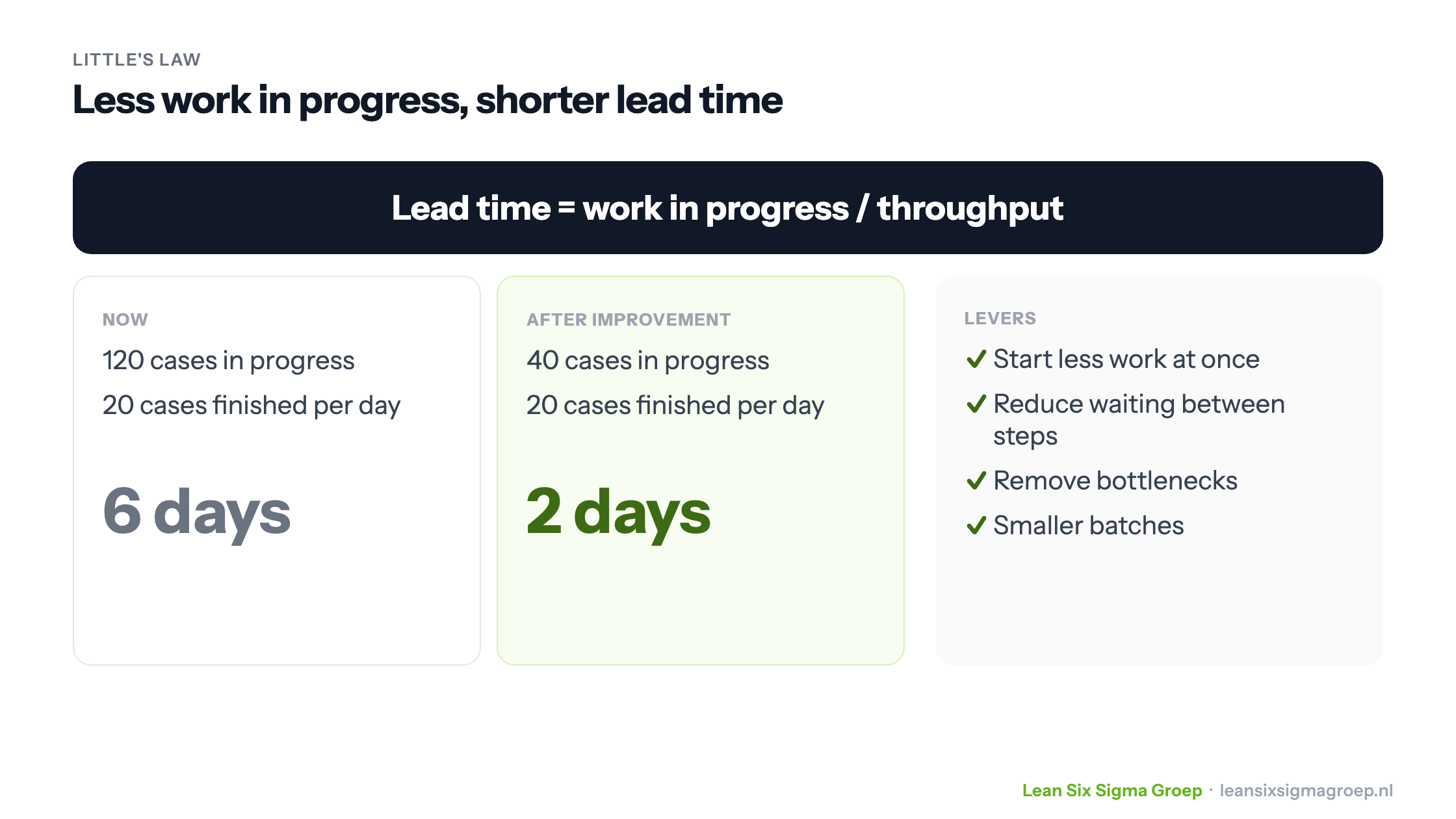
So taking on more work at once than the process can finish makes lead time longer, without getting more done. Taking fewer items into progress at once is often the fastest way to shorten lead time.
Shortening lead time
A long lead time often means dissatisfied customers, internal or external, and a lot of work sitting somewhere. To shorten it, look above all at waiting time:
- take less work into progress at once;
- reduce waiting between steps, for example by combining steps or reducing handovers;
- tackle the bottlenecks, where work piles up;
- work in smaller batches.
A value stream map shows where the time is lost. When shortening lead time, you are in effect going through the five principles of Lean: value, value stream, flow, pull and perfection.
When measuring, make sure everyone uses the same start and end point. If one person measures from the request and another from the start of work, the figures can’t be compared.