Ineffective communication is a major source of waste, in improvement projects too. Even though those projects are meant to remove waste. Overlong meetings, people who say yes and do no, endless discussions: it costs time, energy and results. What is the solution?
The core: start with yourself
A precondition for doing something about communication is to first become aware of how effective it is, and what your own part in it is. Improvement often starts with your own communication.
Do you find it hard, for example, to raise sensitive subjects? Does the other person often react irritably when you give your opinion? Do you regularly feel unheard? And how do you deal with that: do you get irritated yourself?
Many publications and my decades of experience show that almost everyone experiences such situations. So you needn’t take it personally. But in (project) teams it leads to unhealthy discussions, with misunderstanding, irritation, tension and difficult cooperation as a result. It doesn’t have to be that way: everyone can learn to communicate effectively.
Signals in Lean Six Sigma projects
As a project leader in particular, it is important to set a good example. If you recognise one or more of these signals in your improvement project, there is room to improve the communication:
- overlong and ineffective project meetings;
- people who say yes and do no;
- mutual irritation and a tense atmosphere;
- endless discussions and clinging to positions;
- conflicts that are not addressed, or too late;
- people dropping out early;
- team members’ strengths not coming into their own;
- delays through disagreement on causes, solutions or approach;
- disappointing project results.
The Lean Communication Kata
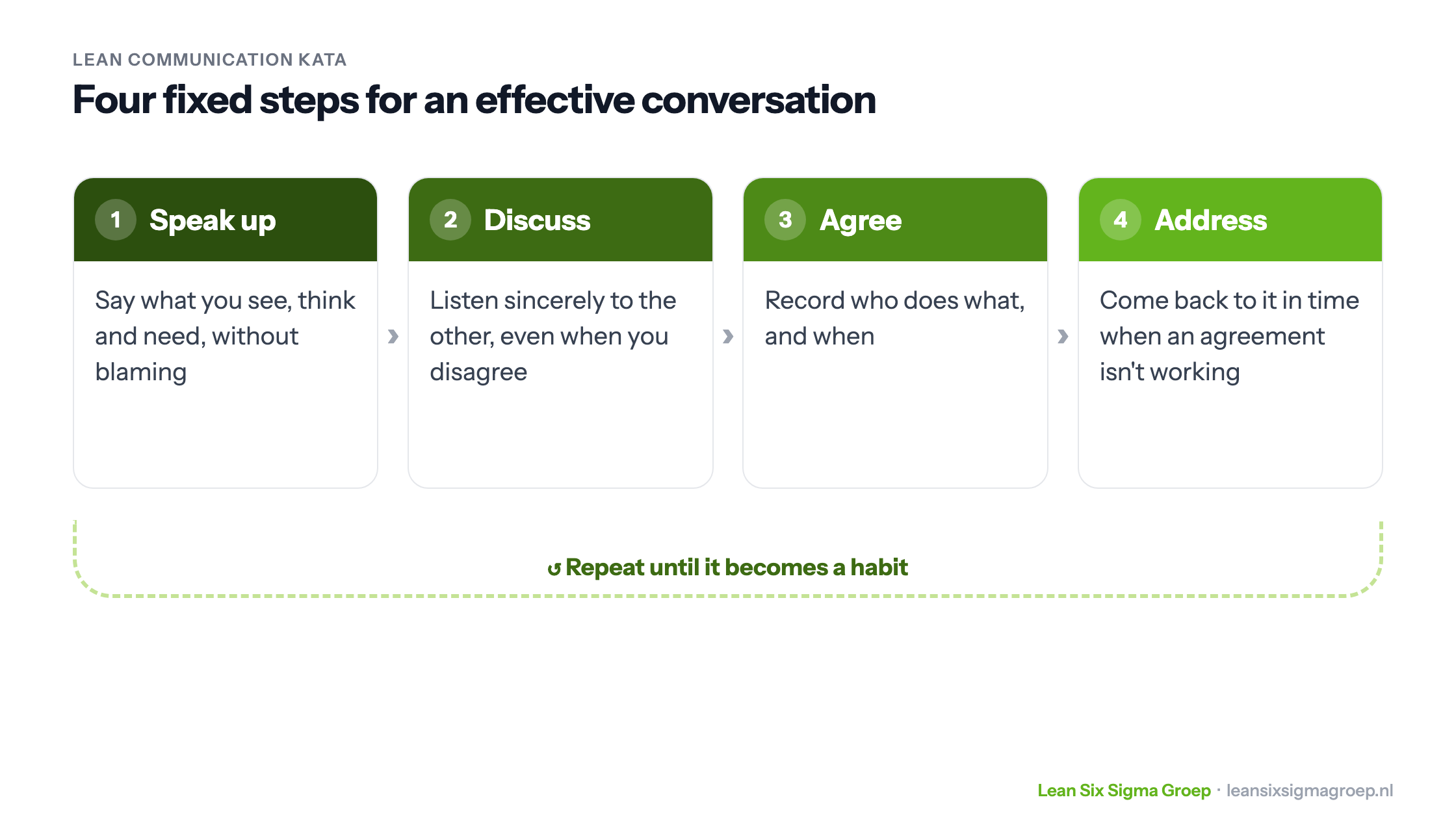
In Lean a Kata is a fixed routine you practise so often that it becomes a habit. The Lean Communication Kata applies this to communication, in four steps, as shown in the image at the top of this article: speak up, discuss, agree and address. Effective here means that you and your team members achieve what you want to achieve, without unwanted side effects.
Success factors for effective communication
The problem is often that people feel too uncomfortable to really say what they think, or are unwilling to listen sincerely to someone else, especially when they disagree or hold a prejudice. Effective communication rests on, among others, these success factors:
- Sincere understanding of the other person’s point of view. Pretending doesn’t help.
- Using reactions to your own communication as a reason to find out what lies behind them. A form of continuous improvement you choose yourself.
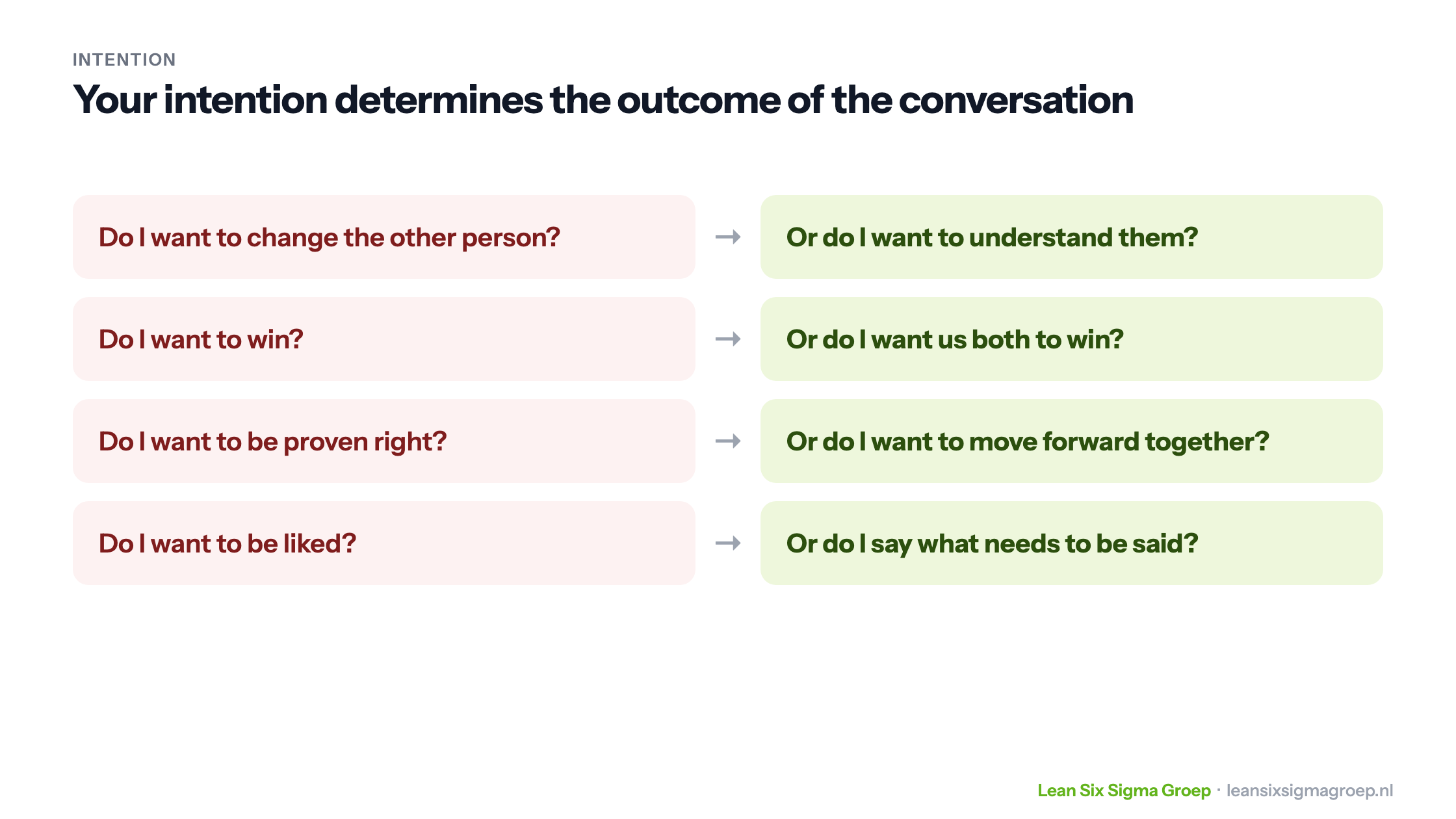
- Realising that your intention determines the result, as the overview above shows. Do I want to change the other person, or understand them? Do I want to win, or do I want us both to win? Do I want to be proven right, or move forward together? Do I want to be liked?
- Being aware of your attitude. An attitude of equality is essential, especially in improvement projects that aim to bring out the best in everyone.
- Feeling comfortable in difficult situations, and addressing conflicts early. Never let them run their course.
- Recognising destructive and constructive patterns, in yourself and in others, and making them discussable. That is called metacommunication: talking about how you talk to each other.
Behind many communication problems are emotions that get no room; read more in managing emotions at work. And to know who you mainly need to talk to in a project, the stakeholder analysis helps.
Want to know more?
Communication is a good addition to the Green Belt course: the method helps the project, the communication helps the people. Contact us for more information.
Leo Sonneveld MBA, network partner of Lean Six Sigma Groep