
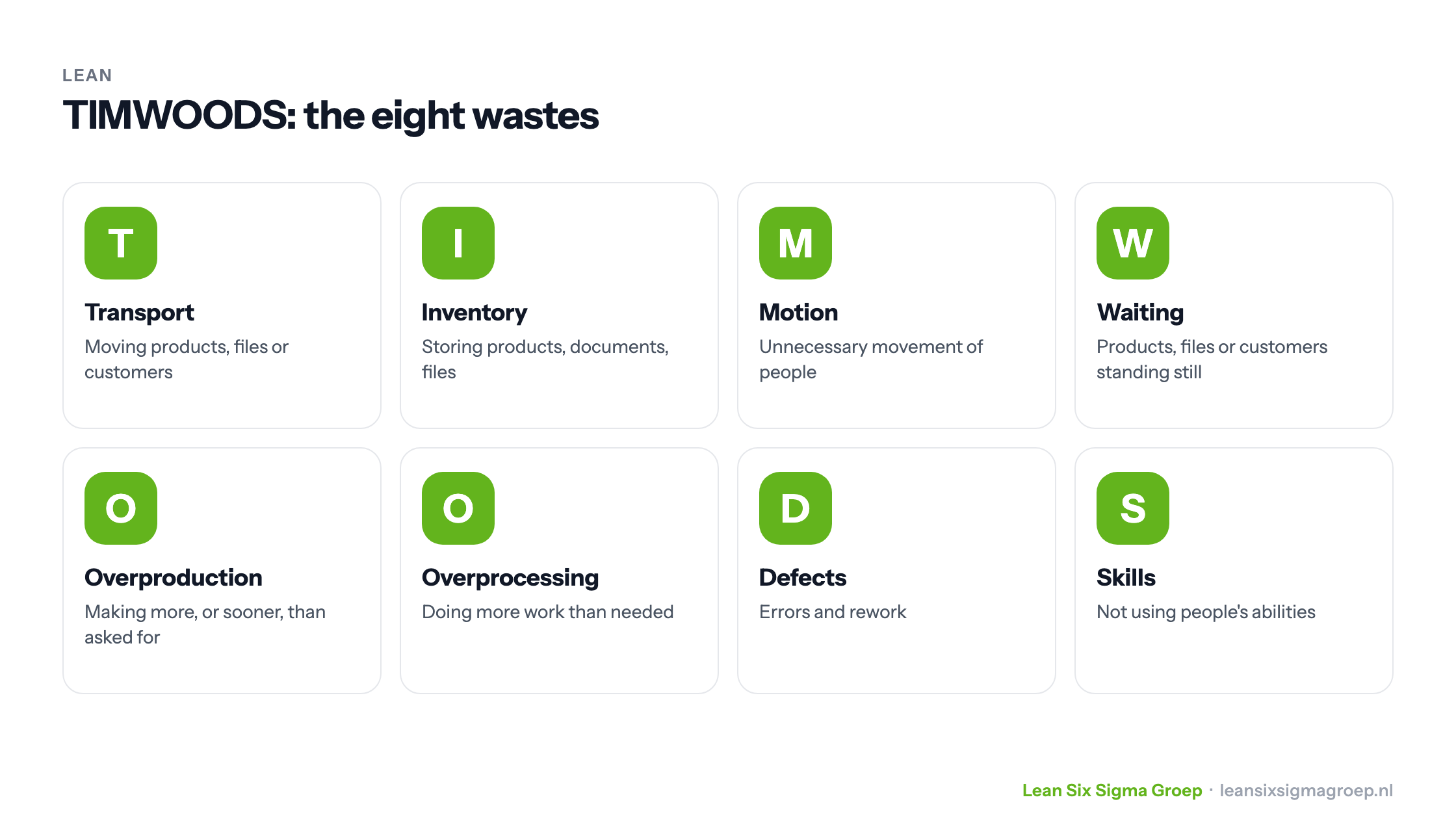
Each letter of TIM WOODT stands for a category of waste. It is really a mnemonic that makes the types of waste easy to remember. TIM WOODT is the Dutch version; in English the same list is usually known as TIMWOODS. With it, you can spot the waste in your process quickly.
T = Transport: moving products, files or customers
I = Inventory: storing products, documents, files
M = Motion: employees moving around within the process
W = Waiting: products, files or customers waiting
O = Overproduction: making products for stock
O = Overprocessing: doing more work than is needed
D = Defects: making mistakes in the process
T = Talent: making poor use of employees’ abilities
In English it is written TIMWOODS, where the ‘S’ stands for Skills (the Dutch ‘Talent’).
How is TIMWOODS used?
Lean aims for a process free of waste. Everything is geared towards making waste visible and then eliminating it.
Once you have mapped a process, for example with a value stream map, you look at which steps add value for the customer and which add little or none. TIMWOODS is a handy tool for naming and recognising those non-value-adding steps.
This is one of the tools you learn to apply in the Green Belt training.
Where does the method come from?
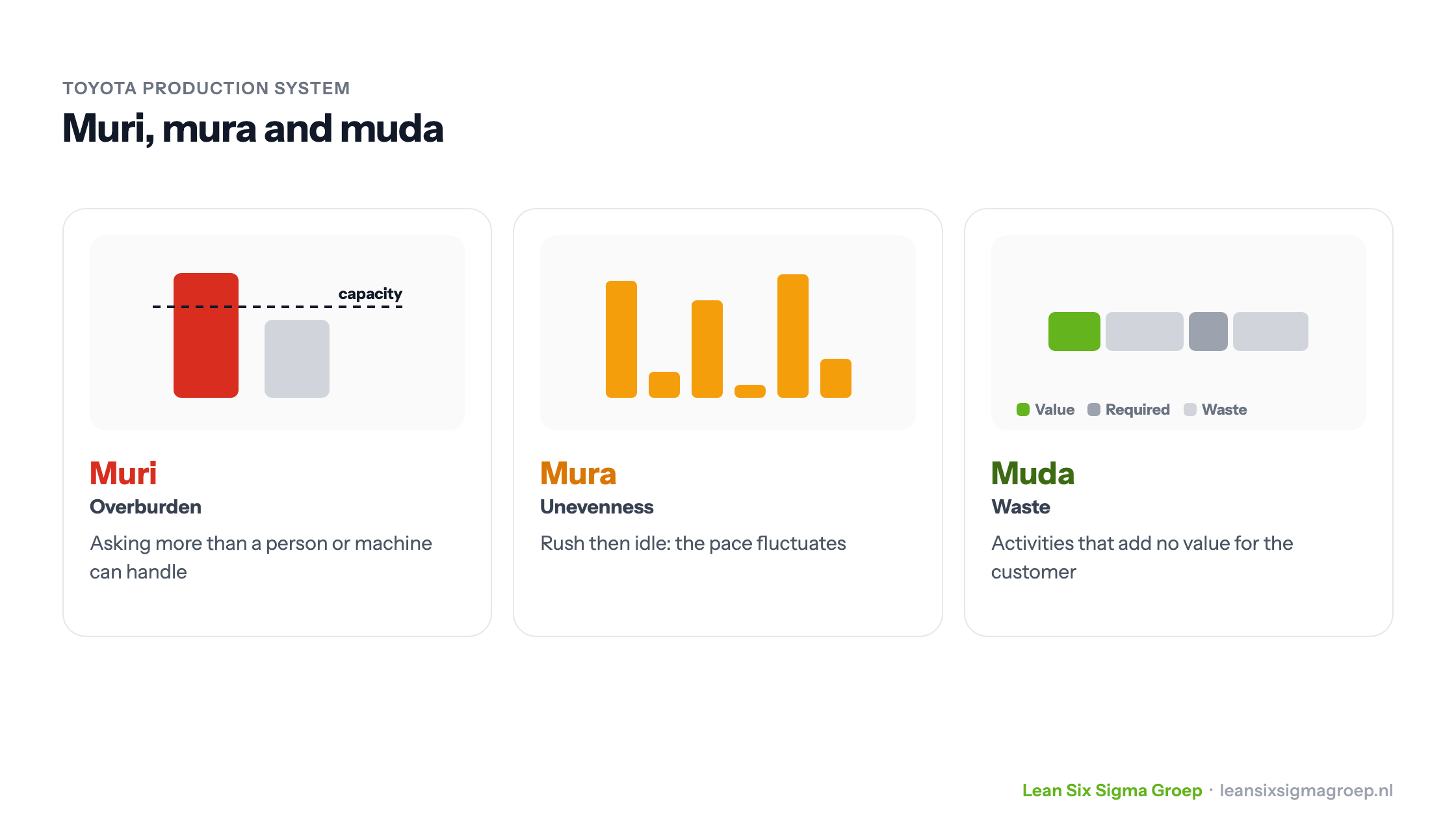
According to Toyota, its production system is built on eliminating three harmful effects that can occur in a process: muri (overburden), muda (work that adds no value) and mura (unevenness). Tackling them brings bottlenecks and problems in the process to the surface, and the tools of Lean help you work towards reducing them.
Muri: Muri occurs when a person or machine has to produce beyond their capacity; in other words, overburden.
Think of an employee with so many tasks that they have to work harder than is healthy, or a process that cannot cope with the normal workload, so it grinds to a halt and files ‘disappear’.
Muda: Muda is any activity that uses up resources but adds no value for the customer; in other words, waste. Lean is about reducing whatever does not add value. Three groups of activities are distinguished:
- Value Add: activities that add value for the customer directly. This is what a customer is willing to pay for.
- Business Non-Value Add: activities that add no direct value for the customer but are needed for other reasons. Think of safety legislation, inspections or accounting.
- Non-Value Add: activities that add no value at all; these are what we call waste.
We can describe the forms of waste with TIMWOODS.
Mura: Unevenness within a process is called mura. One example is big swings in pace. Mura is like the saying ‘feast or famine’. You can prevent it by responding to production times and matching capacity to them.