“Lean doesn’t apply to healthcare.” “Isn’t Lean just for factories?” I hear those reactions often. Nothing could be further from the truth. Throughout healthcare people work hard and with heart, and everywhere that happens in processes: from hospitals to GP practices, from family support to care for people with intellectual disabilities. And where there are processes, Lean can help.
Why Lean in healthcare?
Healthcare is under heavy pressure: a structural staff shortage, supply problems and one crisis after another. We increasingly hear that care workers can no longer cope.
Recruiting and training more people seems to be the solution, but they simply aren’t there. Time to take a different approach: not more people, but looking at how the people who are there can do their work differently. With less waiting, less duplicate work and more time for the client or patient.
Lean fits well, because it starts from people: the customer who receives care and the employee who does the work. Together with care professionals we look at their work, asking what adds value for the customer. That customer can be the client or patient, but also a colleague, the organisation or society.
That it works has long been proven. A well-known example is Virginia Mason hospital in Seattle, which began applying the Toyota Production System to healthcare in 2002 and became an example worldwide.
An example: Frits looks for help
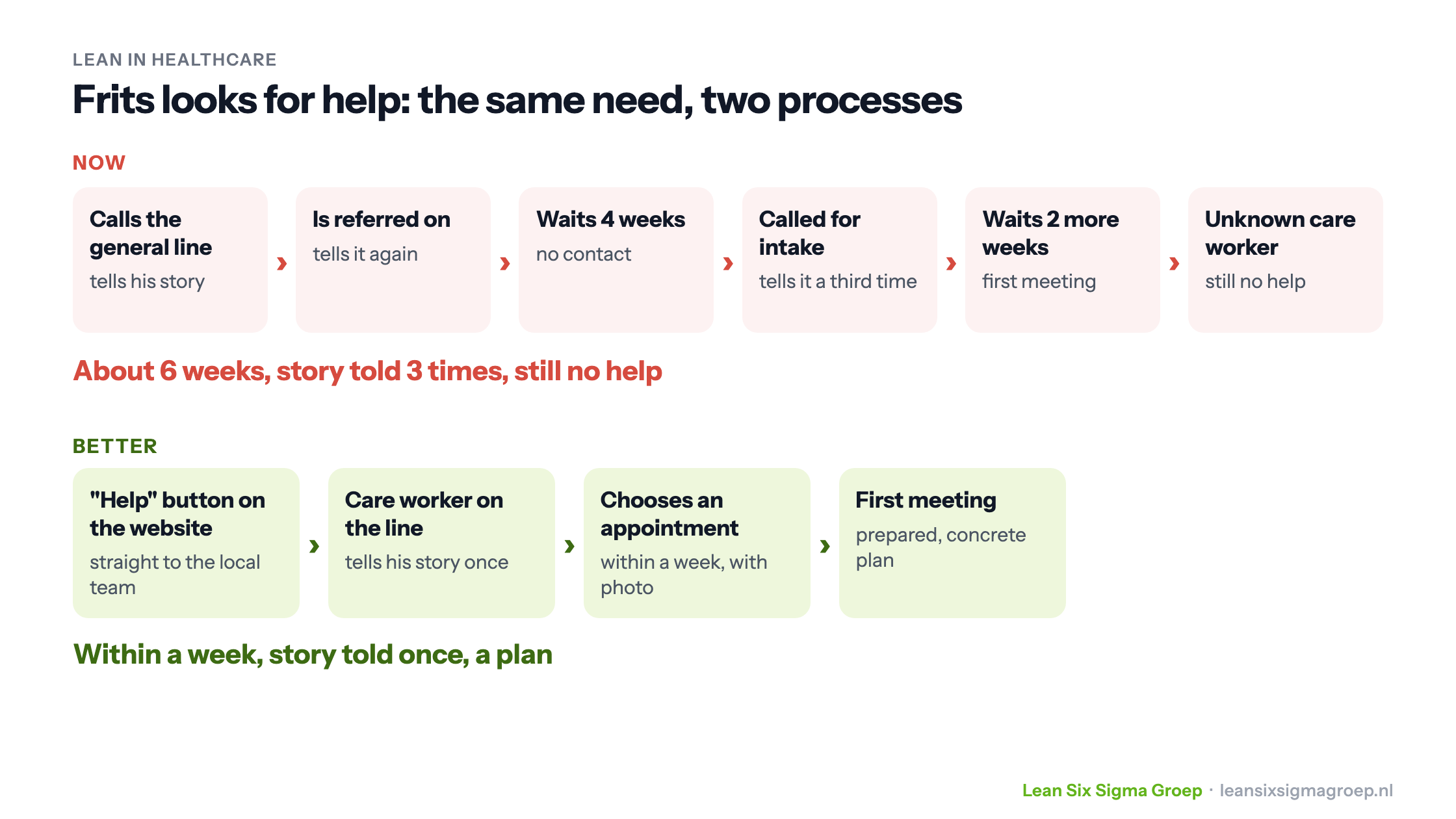
A fictional example. Frits is a single father of two children. Since the divorce he has been struggling, and he realises he needs help. He calls the family support service in his city and gets the secretary on the line. He doesn’t know how to start, so he tells his whole story.
The secretary listens carefully and refers him to the team in his area. Frits calls again and tells his story once more. The friendly care worker asks all kinds of administrative questions and says they will be in touch within three weeks.
After four weeks Frits gets a call. To match the right colleague, the care worker asks once again what the problem is. A first meeting can take place within two weeks. On that day a man Frits doesn’t know is at the door, and Frits tells his story for the umpteenth time. And there is still no help.
It can be done differently
Frits visits the family support website and sees a large button: “Click here for help”. A menu takes him straight to the team in his area. He chooses direct contact by phone and immediately gets a care worker on the line, who listens and records his story.
Frits gets two proposals for an appointment within a week. His choice is confirmed by email, with a photo and the contact details of the care worker. On the day of the meeting he recognises the care worker immediately, and she already knows what is going on. Frits gets tips straight away, and together they make a concrete plan with follow-up appointments.
The image below shows both processes side by side.
What does Lean have to do with this?
Lean looks at the process from the customer’s point of view, in this case Frits. What adds value for him? Help, as quickly as possible, from someone who knows his situation. What doesn’t add value? Telling his story three times, waiting for weeks and a care worker who isn’t prepared. Lean calls that waste.
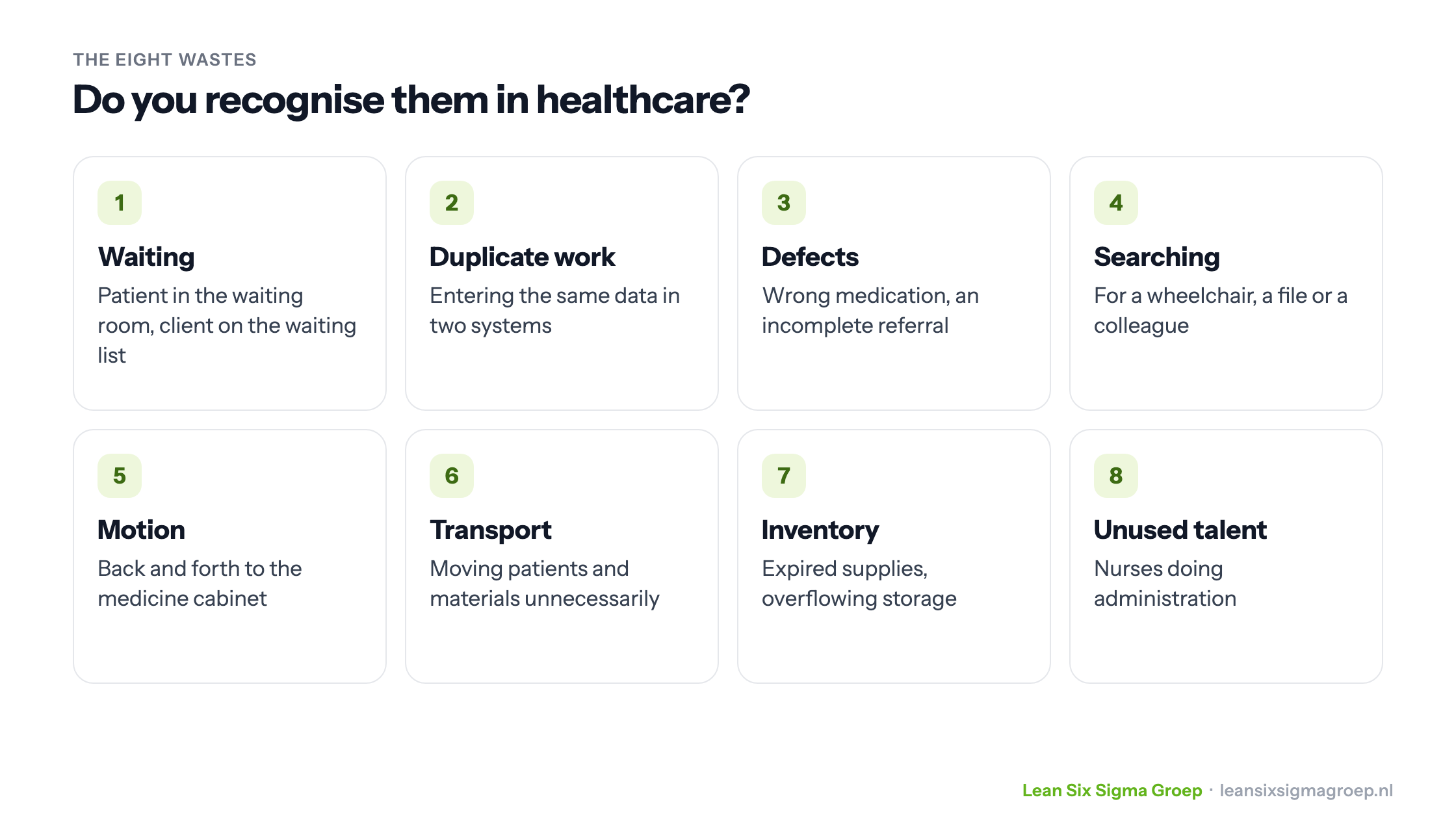
In healthcare you see the classic eight wastes everywhere, as the image at the top of this article shows: waiting, duplicate work, defects, searching, motion, transport, inventory and unused talent. Improvement starts by making them visible together with the staff, for example with a value stream map of the route a client follows.
Well-known Lean tools in healthcare
- Kanban to manage supplies or plan tasks, so materials are there when they are needed.
- A heijunka board to spread appointments evenly over the week, instead of peaks and troughs.
- Flow: arranging the patient’s route so there is as little waiting as possible between steps.
- Data analysis, because Six Sigma works in healthcare too: predict the number of referrals or the lead time, and see where the process varies.
- Visual management: making goals, figures and improvement actions visible. At team level with daily stand-ups, at management level with an Obeya room.
The most important thing is not the tool, but the culture of continuous improvement that develops when care workers learn to improve their own processes. The result: care that works differently, with less pressure and even better quality.
Want to learn how to apply Lean in your healthcare organisation? Take a look at the Green Belt training course.
From theory to practice
Learn to apply this in practice
Topics like Lean in healthcare are applied directly to an improvement project from your own organisation in the Green Belt training.
Next start dates
Lean Six Sigma Green Belt training →Not ready for a training yet?