A bottleneck is the step in a process with the lowest capacity. That step determines how much the whole process can handle: however fast the other steps are, the process never produces more than the bottleneck can process. Work piles up in front of the bottleneck.
Where does the term come from?
The term comes from the neck of a bottle. It is narrower than the rest, and determines how fast the bottle empties. However wide the bottle is otherwise, the liquid can’t come out faster than the neck allows.
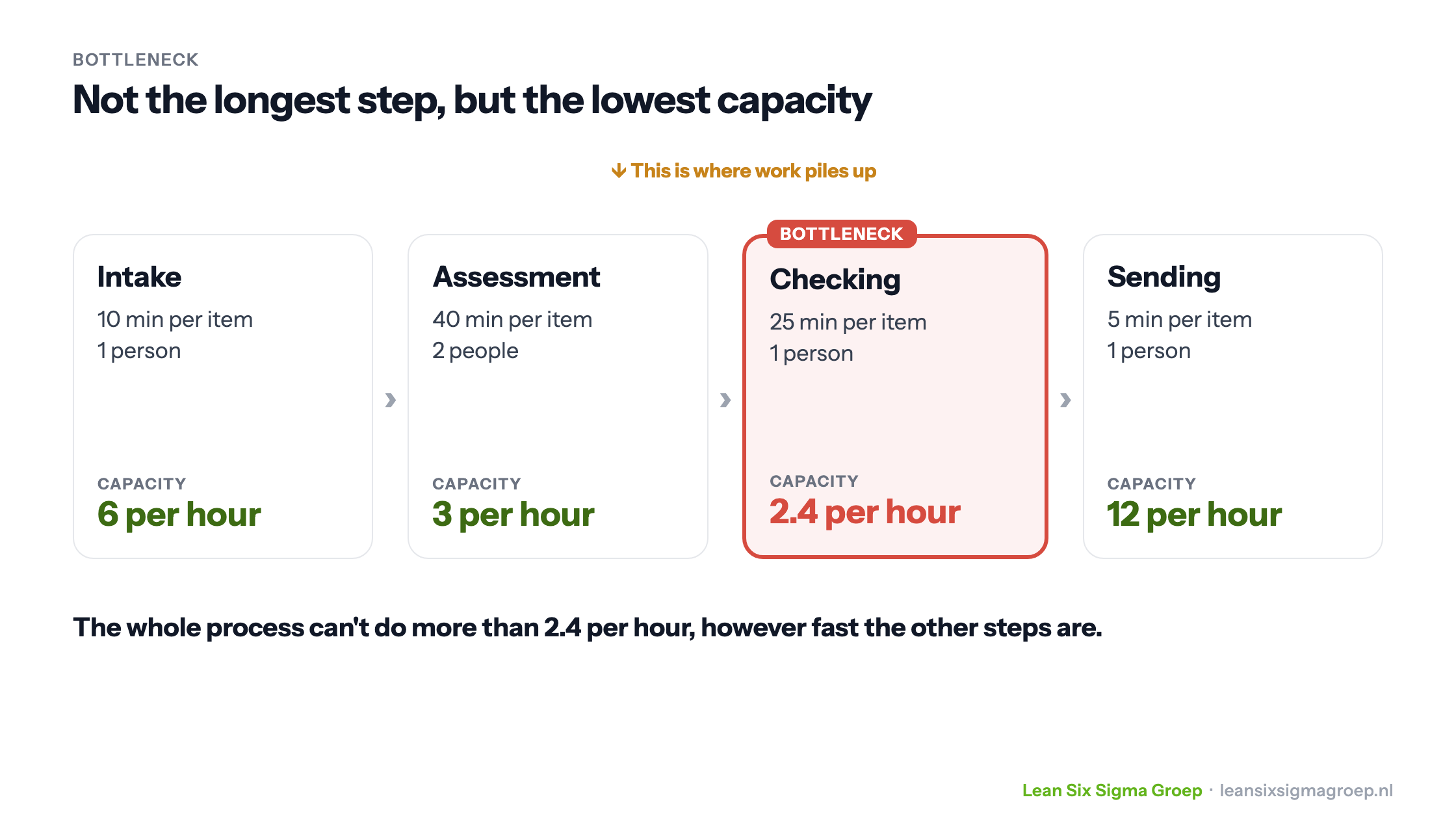
Not the longest step, but the lowest capacity
It is often said that the bottleneck is the step that takes the longest. That isn’t always true. It is about capacity: how many items a step can process per hour. That includes how many people or machines work on it at the same time.
In the image at the top of this article, assessment takes 40 minutes per application, the longest of all steps. But two people work on it, so together they manage 3 applications an hour. Checking takes less time, 25 minutes, but one person does it, managing 2.4 an hour. So checking is the bottleneck. The whole process can’t do more than 2.4 applications an hour.
How do you find a bottleneck?
- Look where work piles up. Map the process, for example with a value stream map, and note at each step how much work is waiting. The most is in front of the bottleneck.
- Look in practice. At an airport you see it immediately: the longest queues are at check-in, security and the gate. In an office you see it in piles of files or a full queue in the system.
- Measure the capacity of each step: how many items per hour, including staffing. The step with the lowest capacity is the bottleneck.
Note: the step where everyone is busiest isn’t necessarily the bottleneck. And a bottleneck can shift: solve one, and another step becomes the new bottleneck.
How do you solve a bottleneck?
Eliyahu Goldratt’s Theory of Constraints gives a fixed order: identify the bottleneck, get the most out of it, align the rest of the process to it, only then increase its capacity, and start again. In practice that means:
- Never let the bottleneck stand still, for example by staggering breaks or preparing work in advance. An hour lost at the bottleneck is an hour lost for the whole process.
- Remove work that can be done elsewhere, and prevent errors from entering the bottleneck.
- Talk to the people who do the step: they often know where the time goes.
- Increase capacity, for example with an extra person, but only when the other measures are not enough.
Balancing the process with takt time
Sometimes one step simply takes more time than another. Then it helps to redistribute the work, with takt time as a guide.
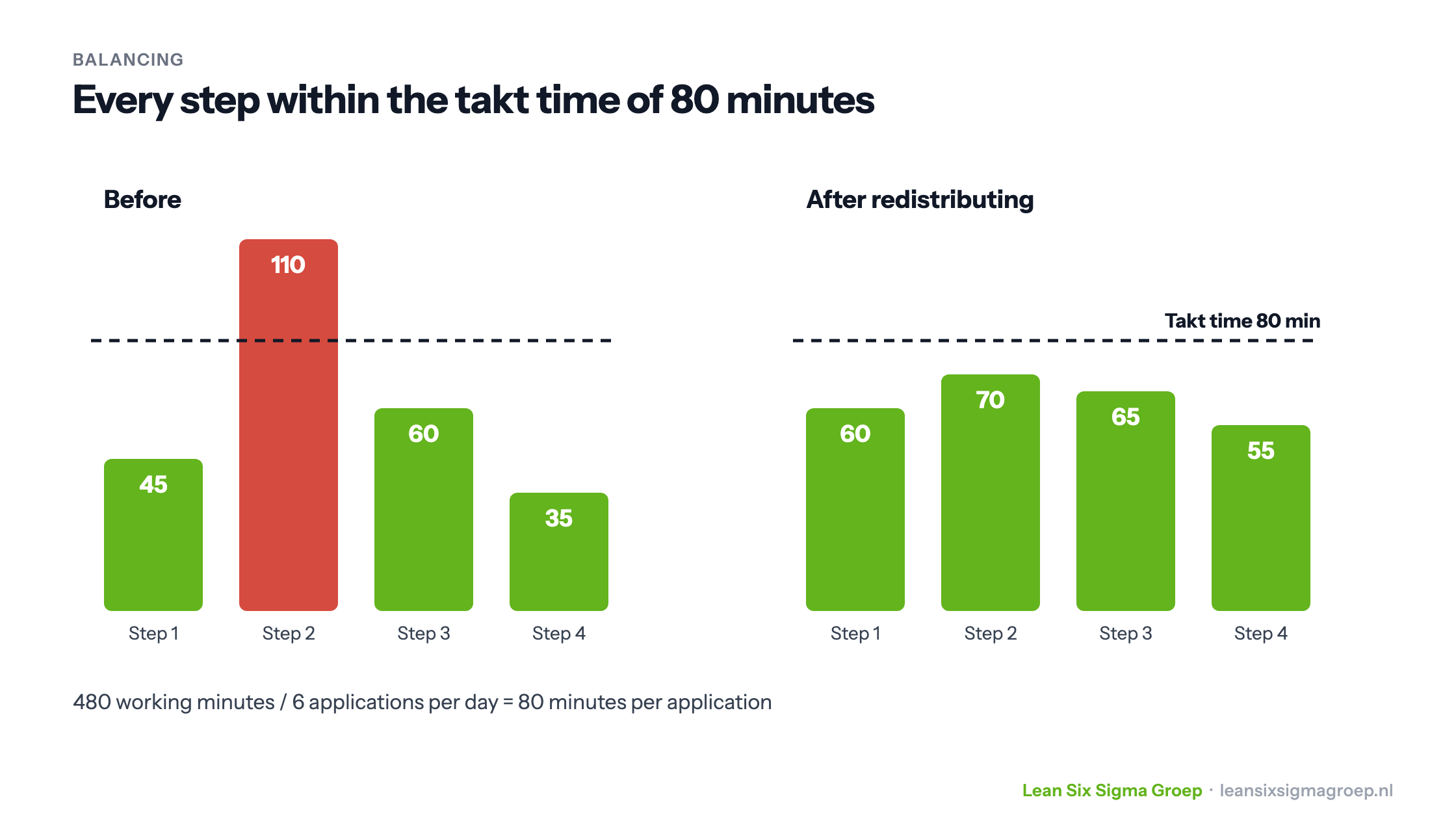
Takt time is the rhythm set by customer demand. You calculate it by dividing available working time by the number of requests. With 480 working minutes a day and 6 policy applications, takt time is 80 minutes: a policy must be finished every 80 minutes.
If a step takes longer than takt time, the process can’t meet demand and a pile builds up. In the example, step 2 takes 110 minutes. By redistributing tasks over the steps, or adjusting staffing, every step can stay within 80 minutes. The total work stays the same, but the process flows. See also one piece flow and Little’s Law.
The video with this article shows in three steps how to find a bottleneck in a process.
Want to learn how to tackle bottlenecks in your processes? Take a look at the Green Belt or Black Belt training course.
From theory to practice
Learn to apply this in practice
Topics like Bottleneck are applied directly to an improvement project from your own organisation in the Green Belt training.
Next start dates
Lean Six Sigma Green Belt training →Not ready for a training yet?