
A kata usually refers to the basic movements in Japanese martial arts, but it can also mean a basic form, routine or pattern of behaviour. The literal translation from Japanese is ‘way of doing things’.
Recognisable patterns of behaviour and clear expectations make it easy to spot deviations (problems). That makes them the basis for improvement: setting and reaching higher standards.
Kata can be divided into the Improvement Kata and the Coaching Kata. Together, these two routines make continuous improvement possible.
Why Kata?
Lean has had only limited success in many organisations, certainly when we compare them with the founder of Lean Management, car maker Toyota. That is not surprising in itself.
Many organisations copy Toyota’s tools and techniques, or the way Toyota introduced them. In doing so they copy the outcome, but not the journey towards it. And it is precisely that journey that makes the difference.
At Toyota, continuous improvement has become a habit: a routine and a fixed part of the culture. For them it is like breathing. Nobody thinks about it, but everybody does it.
For a long time it was a mystery how Toyota achieved this, until Mike Rother’s book Toyota Kata came out in 2009.
What is Kata?
In his book, Rother describes two kata, or routines, that make continuous improvement possible: the Improvement Kata to improve processes continuously, and the Coaching Kata to teach that way of improving.
The Improvement Kata
The Improvement Kata is a systematic routine for anchoring improvement in the culture. It is a skill, a way of thinking and doing, that you learn by practising a little every day. The Improvement Kata is covered in our Green Belt training.
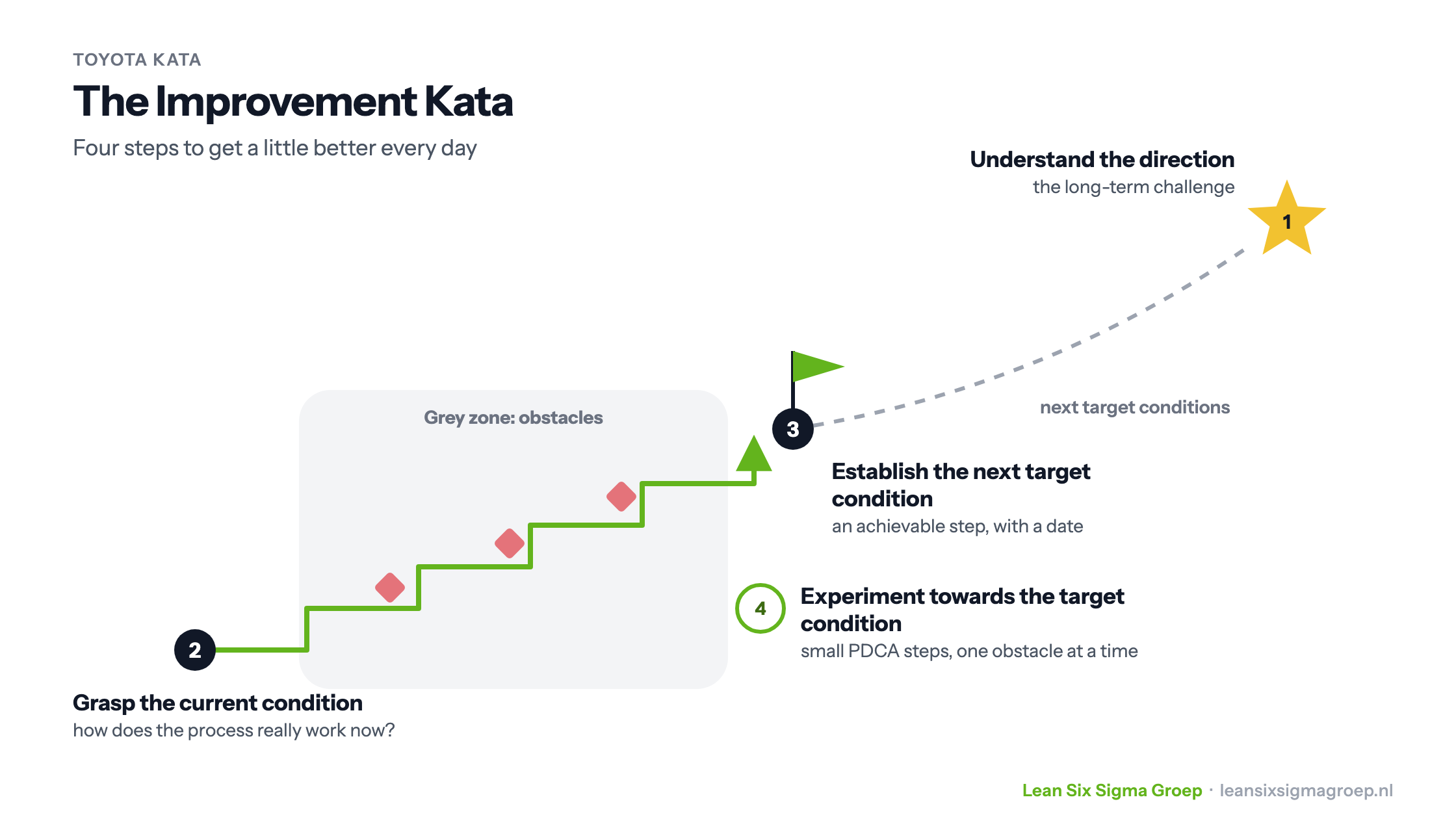
The Improvement Kata consists of four steps:
- Understand the direction: what is the long-term challenge?
- Grasp the current condition: how does the process really work now?
- Establish the next target condition: which achievable step do you take towards the challenge, and when do you want to get there?
- Experiment towards the target condition: move forward in small PDCA steps and tackle the obstacles one at a time.
The Coaching Kata
The Coaching Kata is the routine a coach uses to teach the Improvement Kata to a learner, for example a manager to an employee. The coaching cycles are a routine for daily management. In the Black Belt training we practise the Coaching Kata extensively.
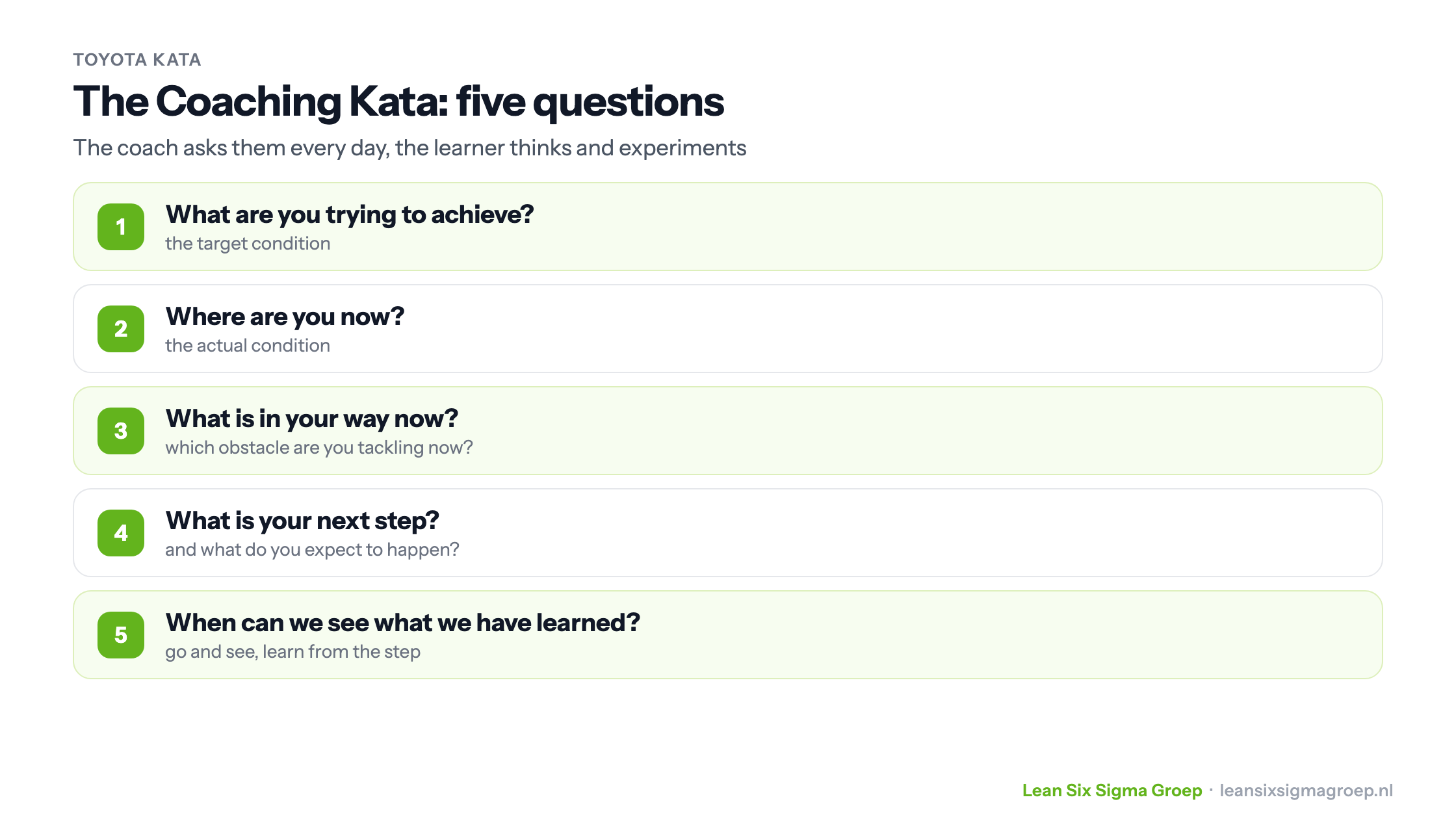
The Coaching Kata consists of five questions:
- What are you trying to achieve? (what is the target condition?)
- Where are you now? (what is the actual condition?)
- What is in your way now? Which obstacles are holding you back?
- What is your next step?
- When can we go and see what we have learned from the last step?
By practising the Coaching Kata again and again, improvement really becomes a routine: a habit and part of everyday work.
The key difference: the Improvement Kata focuses on the process you want to improve, the Coaching Kata on the learning of the person who is improving it. The coach coaches the learner, not the process (the coach-the-coach principle).
How does Kata link to Lean Six Sigma and the DMAIC cycle?
In a typical Lean Six Sigma project we go through the DMAIC cycle. A lot happens during such a project, not only ‘above water’ but also ‘below water’: the soft, change management side.
The steps of the Improvement Kata link well to the phases of DMAIC.
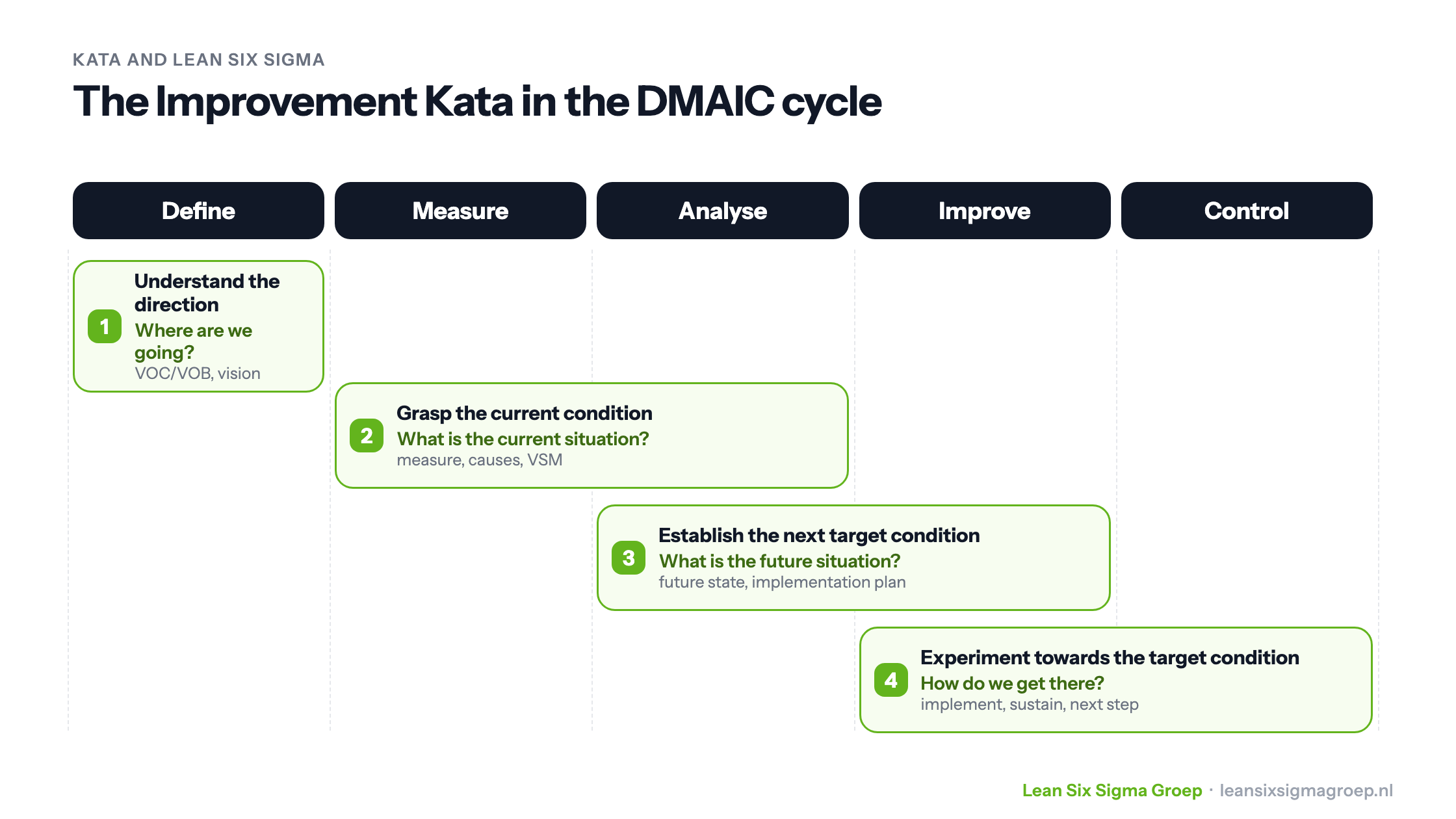
- Define: understand the direction. The Define phase starts with a broad problem statement. This is clarified by examining what the customer asks for and distilling the Voice of the Customer or Voice of the Business (VOC/VOB) from it. Linking to the organisation’s vision helps to choose the right projects. The overarching question: in which direction are we improving?
- Measure and Analyse: grasp the current condition. In the Measure phase you measure the current problem, and in the Analyse phase the causes come to light. These are often captured in a Value Stream Map (VSM) of the current situation. The overarching question: what is the current situation?
- Analyse and Improve: establish the next target condition. Based on the causes, you capture the future situation in a Future State and draw up an implementation plan for it. The overarching question: what is the future situation?
- Improve and Control: experiment towards the target condition. In the Improve phase you implement the improvements, and in the Control phase you sustain them and look at how to take the next step. The overarching question: how do we reach the future situation?