Inventory management from a Lean perspective revolves around one question: how little stock can you hold and still always deliver what the customer asks for? Stock costs money, space and attention, and hides problems. At the same time you sometimes need stock to stay able to deliver. This article shows how to find that balance.
Why inventory is a waste
In Lean, inventory is one of the classic wastes of TIM WOODS. Not because stock is always bad, but because too much stock costs a lot: tied-up money, storage space, products that become obsolete or spoil, and work that sits waiting. And stock hides problems: as long as there is enough, nobody notices a breakdown or a late delivery.
Inventory sits in different places: raw materials at the start, work in progress between process steps, and finished goods at the end. How fast that stock turns over differs greatly by sector: a supermarket turns its stock over much faster than a pharmaceutical company or a car manufacturer.
FIFO: first in, first out
FIFO stands for First In, First Out: the oldest stock goes first. Anyone who had a part-time job in a supermarket knows it: when restocking you put the new products at the back of the shelf, so the oldest are at the front. That way no old stock is left that can no longer be sold.
The FIFO lane
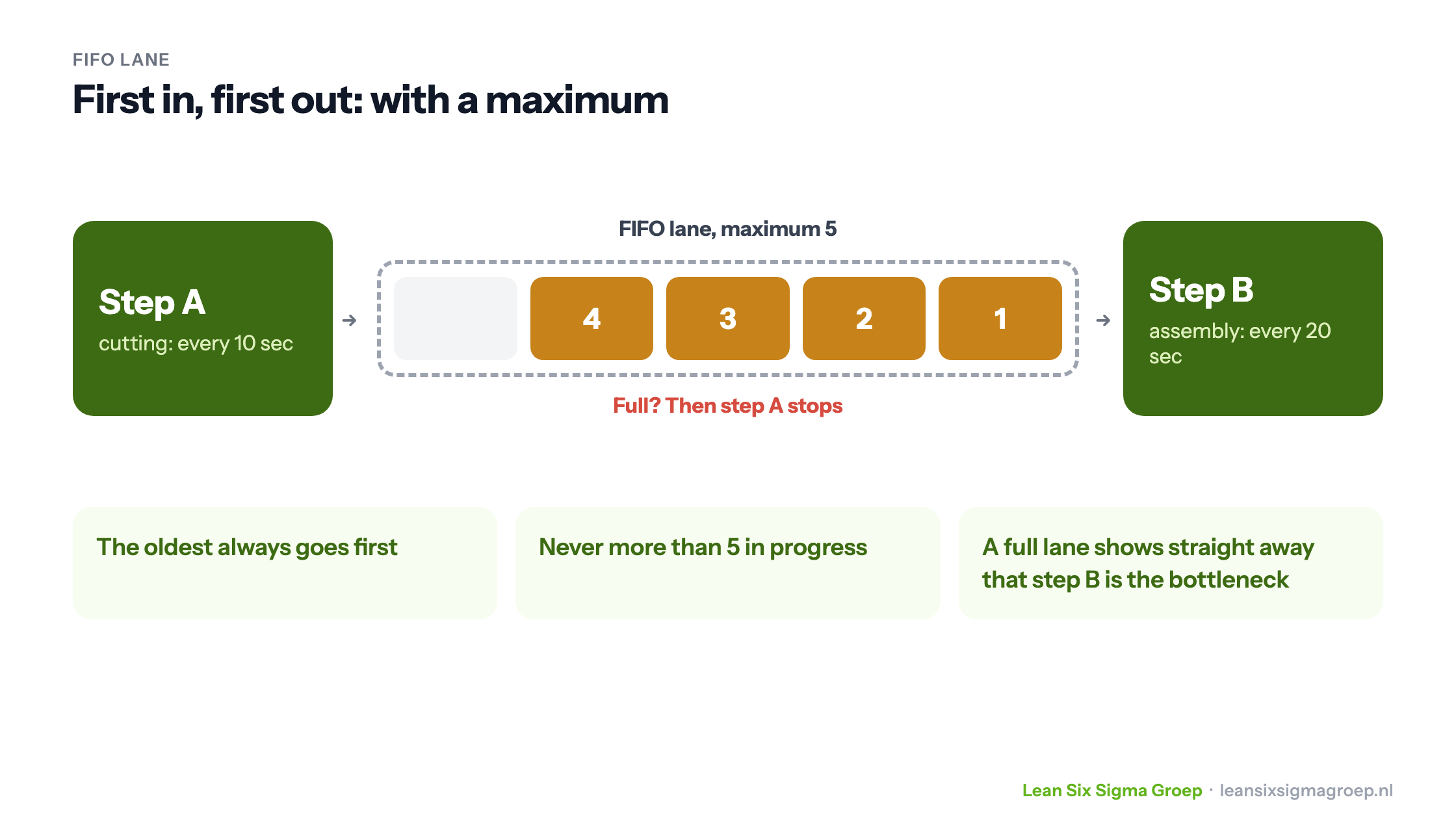
A FIFO lane goes a step further. It is a queue between two process steps, with a maximum. Work goes in and out in order of arrival, and when the lane is full, the step before it stops producing. You can see it in the image at the top of this article.
An example. Step A cuts a set of chair legs every 10 seconds, step B assembles a chair with them every 20 seconds. Without a limit, an ever-growing pile of chair legs builds up between A and B. With a FIFO lane of at most five, step A stops as soon as five sets are waiting, and only continues when space frees up. That keeps stock small, the oldest set always goes first, and you see immediately that step B is the bottleneck.
FIFO lanes are everywhere, not just in factories: tickets at the IT department, applications at an insurer, permits at a municipality. There too a maximum helps prevent an endless pile.
Reordering in time: the reorder point
For purchased material the question is: when do you reorder? For that you use the reorder point.
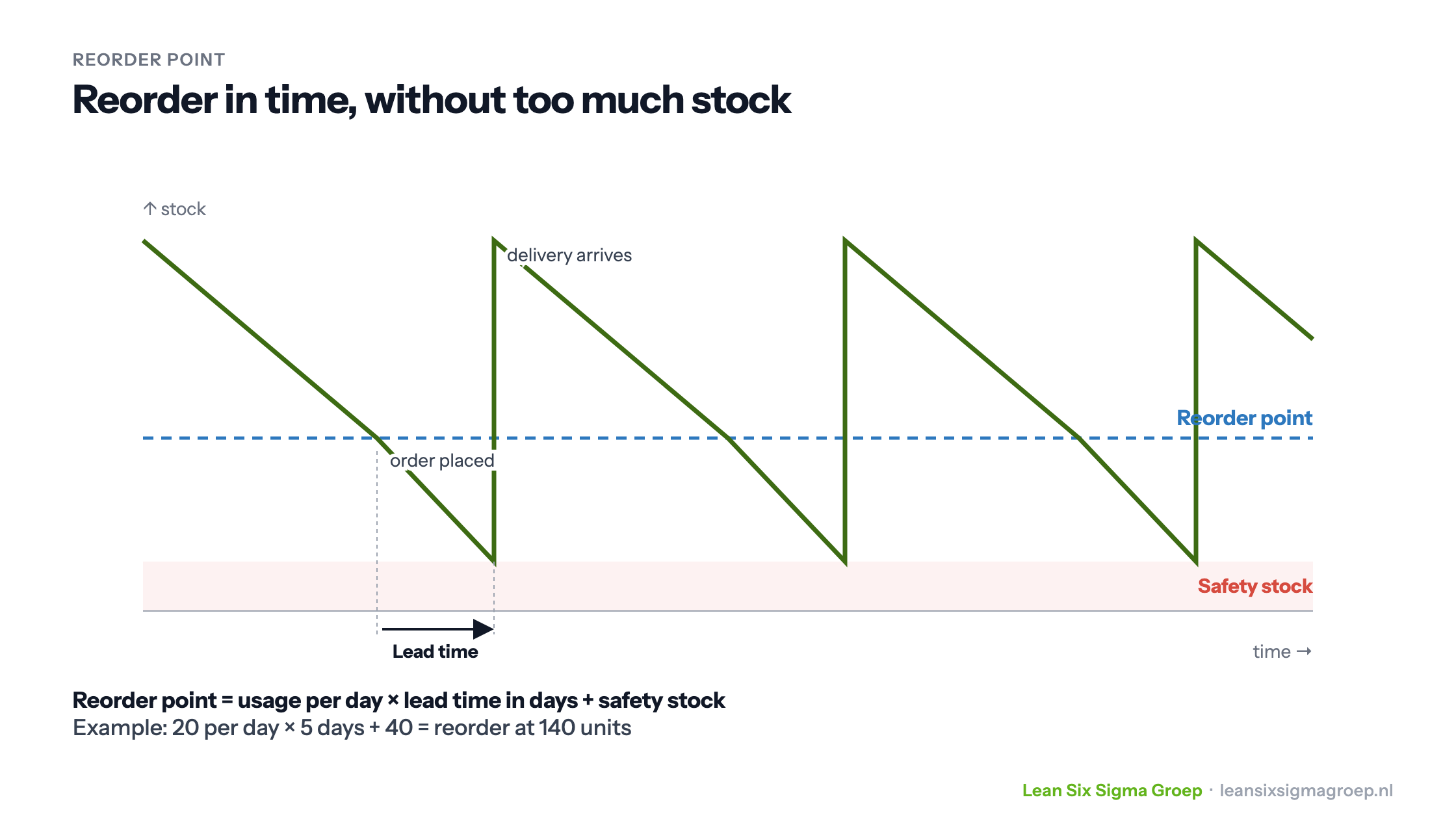
The reorder point is the stock level at which you place a new order: just enough to cover the lead time, plus a safety stock for unexpected peaks or a late delivery. If you use 20 units a day, the lead time is 5 days and you keep 40 units as safety stock, you reorder as soon as stock reaches 140 units.
The shorter the lead time and the more stable the usage, the lower the reorder point and safety stock can be. So that is where the gains are: not in ordering more sharply, but in shorter lead times and more even demand.
A simple form is the two-bin system, a form of kanban: there are two bins, and as soon as the first is empty you reorder. The second bin lasts until the delivery arrives.
Not every item deserves the same attention. With an ABC classification you divide items by value: the A items, often around 20% of items that together make up most of the value, are managed tightly. The C items, many cheap small things, can be handled more simply.
Just in Time
Where a FIFO lane is a solution at one point in the process, Just in Time is an approach for the whole chain: only make and deliver what is needed, when it is needed. That requires three things:
- Reliable suppliers who deliver frequently, in small quantities, on time.
- Stable processes with small batches, short changeovers and few defects.
- Even demand. Just in Time works by pulling on actual demand, not by producing ahead on a forecast. So large fluctuations need to be levelled first.
The COVID pandemic and the blockage of the Suez Canal in 2021 showed that long, tightly tuned chains are vulnerable. Since then many companies seek a balance: Just in Time where possible, and a deliberate buffer for critical parts with a long or uncertain lead time. See also the Bullwhip Effect.
Inventory and flow
The goal of Lean is not zero inventory, but flow: work and materials that move through the process without unnecessary waiting. So you limit stock by having good insight into the processes where it builds up. The Green Belt training course teaches you how to make processes visible and improve them.