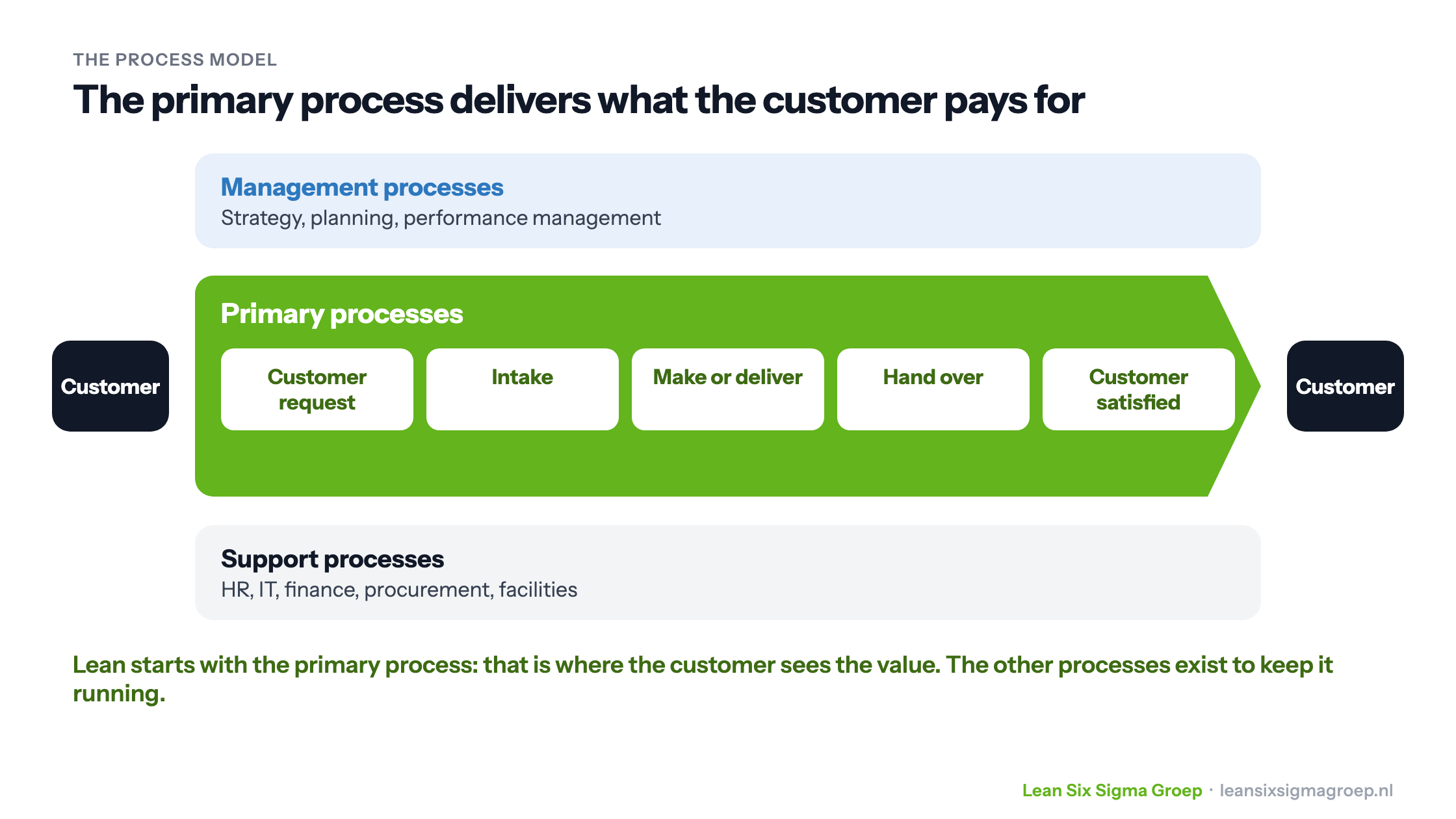
The primary process is the process through which an organisation delivers what the customer pays for: making the product, delivering the service or providing the care. That is where the customer sees the value, and that is where Lean starts. All other processes in the organisation exist to keep the primary process running well.
Primary, support and management
A common classification divides an organisation’s business processes into three types, as shown in the image at the top of this article:
- Primary processes run from customer request to customer result and deliver value directly to the customer.
- Support processes make sure the primary process can run: HR, IT, finance, procurement and facilities.
- Management processes give direction: strategy, planning and performance management.
Michael Porter made a similar distinction in his value chain (1985), with primary activities such as inbound logistics, operations, outbound logistics, sales and service, and support activities such as human resources, technology and procurement.
What does the primary process look like?
That differs per organisation.
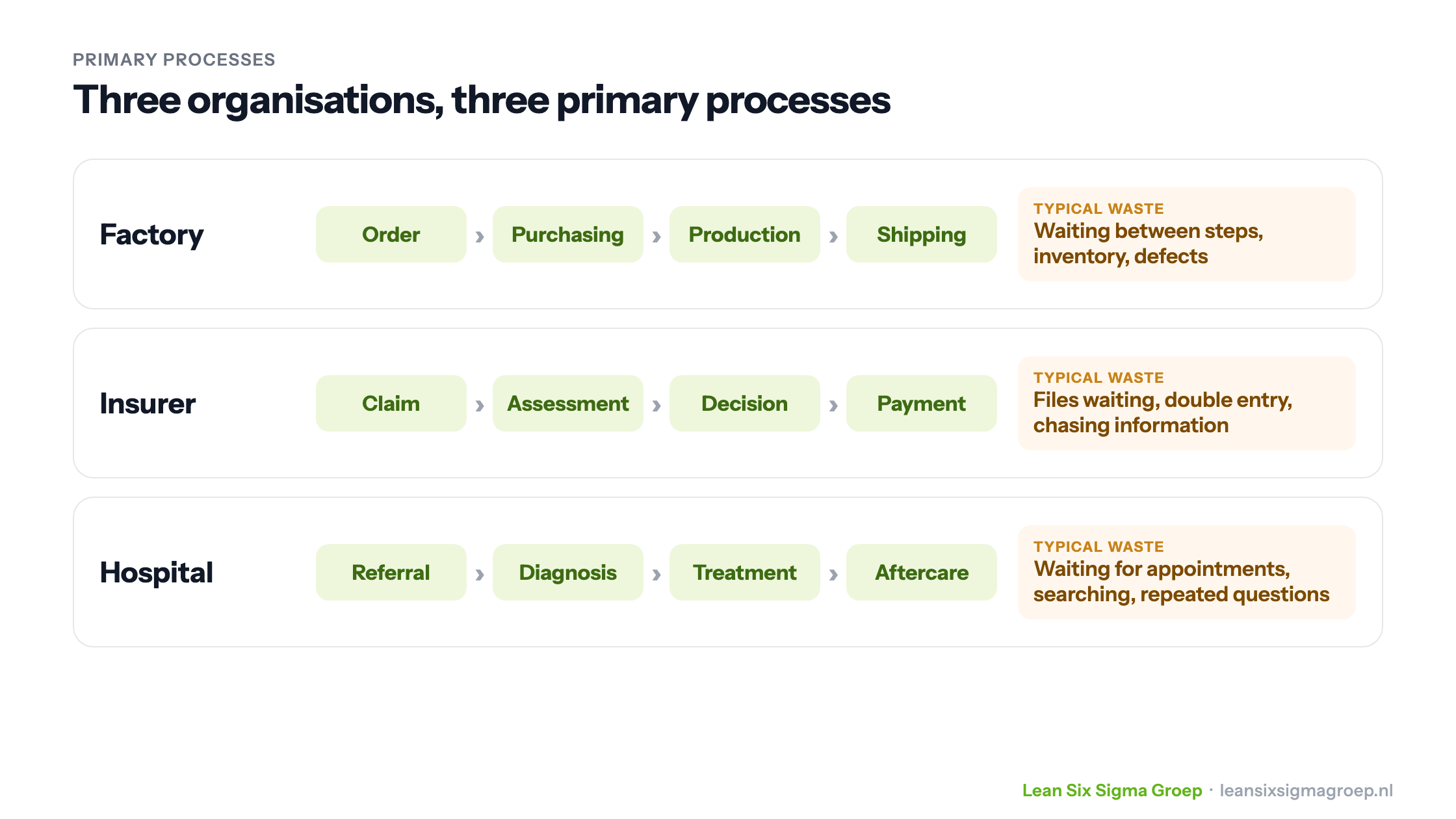
- In a factory it runs from order via purchasing and production to shipping.
- At a service provider, such as an insurer, it runs from claim via assessment and decision to payment.
- In healthcare it runs from referral via diagnosis and treatment to aftercare.
- In a project organisation, such as a construction company or consultancy, the primary process is delivering the project result to the client.
Below are three examples, with the waste you often find in them.
Applying Lean to the primary process
Lean looks at the primary process through the customer’s eyes. Which steps add value, and which don’t? In most processes the largest part of the lead time is waiting: a file lying on a pile, a patient in the waiting room, an order waiting for materials. That is where the gains are.
How to approach it:
- Map the process from customer request to customer result, for example with a value stream map. That shows where work waits and where errors arise.
- Remove waste: waiting, duplicate work, defects, inventory, unnecessary transport and searching.
- Create flow: work that moves on without interruption, without bottlenecks where everything piles up. With kanban you make work visible and limit it at the same time.
- Organise the workplace with 5S, so nobody has to search.
- Improve continuously with kaizen: small improvements by the people who do the work.
Only then look at the support processes, asking: does this help the primary process? A procurement procedure that takes three weeks, or an IT system in which staff have to enter data twice, slows down the primary process, even if it seems efficient in itself.
Most importantly: Lean is not a set of separate tools, but a way of looking. The customer comes first, waste is made visible, and the people who do the work improve it themselves.
Want to learn how to tackle improvements in your organisation? Take a look at the Green Belt or Black Belt training course.