
What is OEE?
OEE stands for Overall Equipment Effectiveness. It is a way of calculating how effectively ‘the equipment’ is used: devices, machines and production lines. In manufacturing companies, OEE is a widely used KPI, because it shows directly whether the production output can be achieved.
That is why it is often used to steer by. OEE comes from Total Productive Maintenance (TPM), which Seiichi Nakajima developed in Japan from the 1970s onwards.
How does Overall Equipment Effectiveness work?
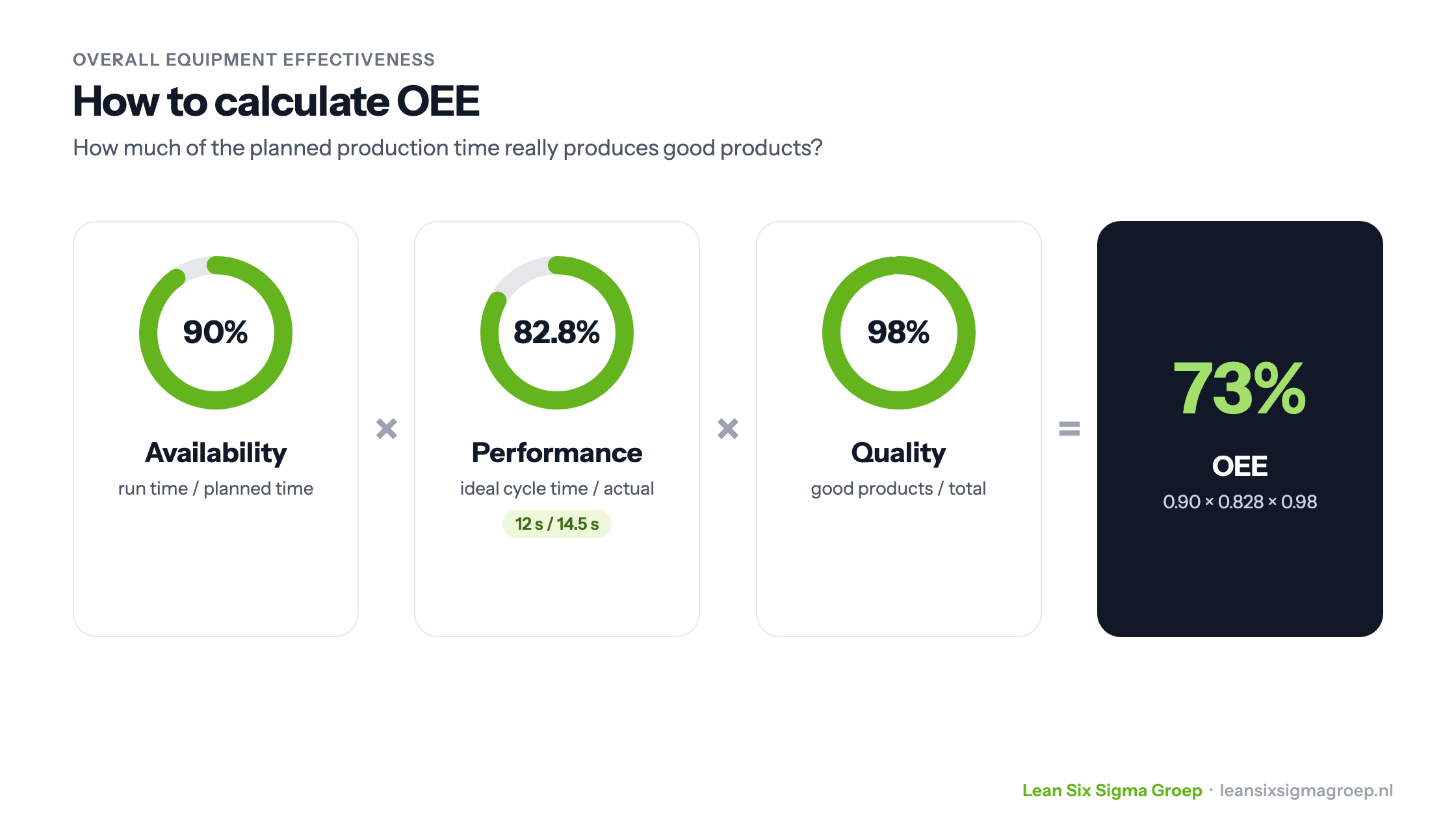
Overall Equipment Effectiveness (OEE) says something about the actual production yield compared with the (theoretical) maximum yield:
OEE = Availability × Performance × Quality
Availability
Availability is the actual production time compared with the time the machine was planned to produce. It is also one of the most debated parts of OEE.
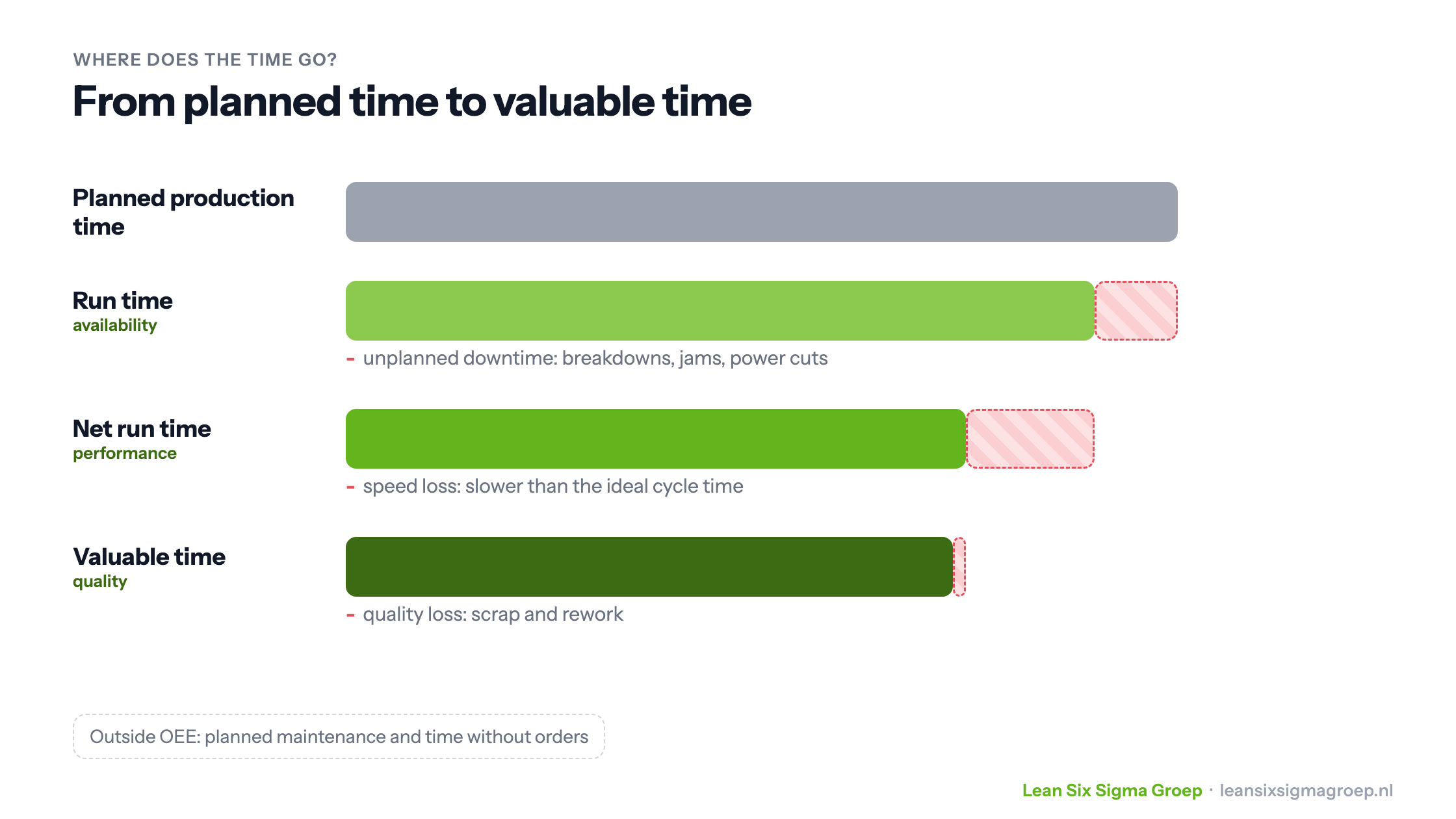
In general, you take the planned time minus the unplanned downtime. In other words: the percentage of time the machine is available. Unplanned downtime can be caused, for example, by technical breakdowns in the machine, products that are skewed and jam the line, or a power cut.
There is a direct link with the state of maintenance, though. To carry out maintenance, the machine has to be stopped. We call that ‘planned downtime’, and it falls outside the OEE calculation, but nothing is produced during that time either.
The same goes for time when there are no orders to produce: that also falls outside OEE.
Performance
Performance is about the utilisation of the equipment. It can consist of two components.
Speed: the speed at which the machine is running now compared with the speed it was bought for. Say the machine makes a new product every 14.5 seconds, while according to the manufacturer it should manage one every 12 seconds. Then performance is 12 / 14.5 = 82.8%.
Cavities: say a machine has a mould with 24 cavities that can (injection) mould products at the same time. For technical reasons, one of the cavities may be blocked off. Then performance on cavities is 23 / 24 = 95.8%.
Another example is the computing capacity of a computer, also called the ‘utilisation’ of the processor. If a processor has 4 cores, you can see in Windows under ‘Task Manager’ and ‘Performance’ what percentage of them is being used. Don’t be alarmed if it is very low.
Quality
Quality is the share of production that is right first time: usually the number of good products divided by the total number of products made. In the process industry, the composition of raw materials often changes during the process. There, you often work with the weight going into the process and the weight of good product coming out.
What can you do with OEE?
As mentioned, OEE is mainly a KPI in manufacturing organisations. It is an indicator that shows how well (or not) the plant is performing, and where improvements can be made.
That can be per machine, but also for the whole plant, as a weighted average of all the individual machines. OEE is mainly used as a steering tool to find out where things are going well and where they could be better. You would also like to measure this in service processes, but that is often a lot harder. Machines are easier to measure.
Points to watch with OEE
- Don’t turn it into a game of definitions: set your definitions and stick to them, for example the cycle time for performance. That ‘can’ be the manufacturer’s cycle time, which is usually also the speed the machine was bought for. If that is too ambitious compared with the current cycle time, it often only leads to disappointment and, worse, indifference: ‘we’ll never hit it anyway’. Set a target that is realistic and still challenges the team, and adjust it over time. It is the difference between being right (because the manufacturer says so) and being proven right.
- Record production information consistently: as we saw with availability, unplanned downtime can be defined in different ways. Operators are often asked to log when and why the machine is stopped, so it can be analysed afterwards. That logging does have to be reliable.
- Agree on what counts as scrap: take a colour change in injection moulding, done while the process keeps running. A number of shots are produced and caught in which the colours are still mixed, until the intended colour comes out. Are those products scrap, or are they part of a planned colour change? Agree a standard together: how many caught products are ‘standard’, and anything above it counts as scrap. In short: decide how you record it and stick to it.
- Speak one language: explain your way of measuring and logging clearly to everyone involved, from operator to process engineer. That way everyone looks at the same thing and you speak a shared language.
Getting insight into OEE
The video at the top of this article explains what OEE is and how you use it as a performance indicator for the overall effectiveness of a production machine or line.
Want to learn how to manage process improvements in your organisation? Read more about the Green Belt or Black Belt training and feel free to sign up.
From theory to practice
Learn to apply this in practice
Topics like Overall Equipment Effectiveness are applied directly to an improvement project from your own organisation in the Green Belt training.
Next start dates
Lean Six Sigma Green Belt training →Not ready for a training yet?