One piece flow means moving one product or case at a time through the whole process, instead of in batches. Each item goes straight on to the next step, without waiting for the rest of the batch to be finished. The result: much shorter lead time, less work in progress and errors you see straight away.
Batch or one at a time
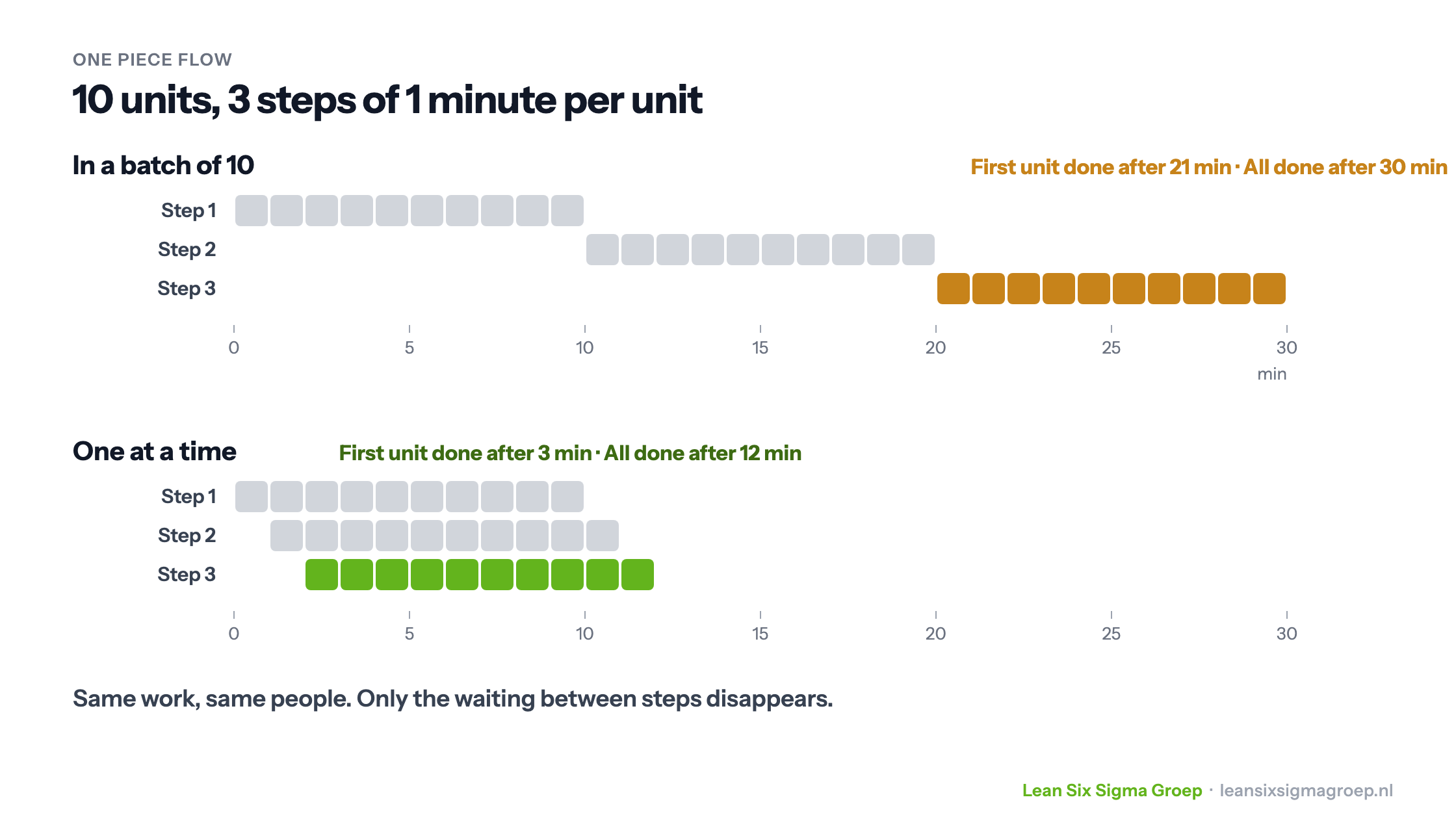
The image at the top of this article shows the difference. Ten units go through three steps of one minute per unit each.
- In a batch, step 1 first does all ten, and only then does the stack move to step 2. The first unit is done after 21 minutes, the whole batch after 30 minutes.
- One at a time, each unit moves on immediately. The first unit is done after 3 minutes, all ten after 12 minutes.
Nobody works harder, and it is the same people and the same steps. Only the waiting between steps disappears. That is exactly what Little’s Law predicts: less work in the process at once gives a shorter lead time.
It doesn’t only apply in factories. A kitchen that prepares each dish separately can take account of a steak that must be medium rare. A department that passes on requests immediately instead of collecting them per week answers customers days earlier.
Which wastes disappear?
One piece flow tackles a large part of the classic wastes:
- Waiting: products no longer wait for the rest of the batch.
- Inventory: there is much less work in progress between the steps.
- Transport and motion: no stacks to move, put down and pick up again, especially when steps are close together.
- Defects: an error in step 1 shows up in step 2 with the very next item, not only when a whole batch of a hundred is wrong.
- Overproduction: you make what is asked for, instead of a full batch because changeovers take so long.
Resource efficiency and flow efficiency
Many organisations steer on resource efficiency: keeping people and machines as busy as possible. One piece flow steers on flow efficiency: getting work through the process as fast as possible. Niklas Modig and Pär Åhlström put this in a matrix in their book This is Lean (2012).
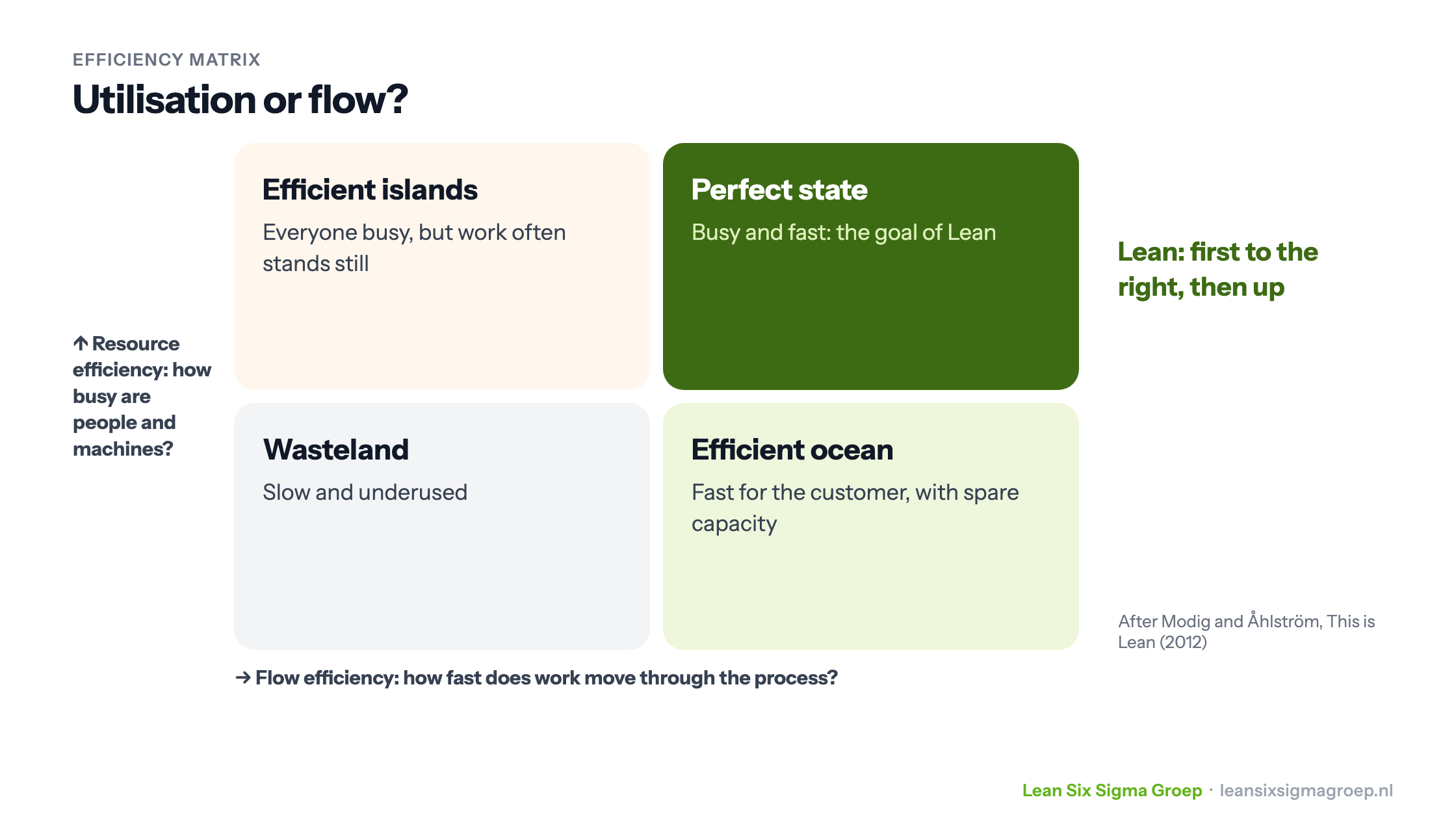
Steering only on utilisation leads to “efficient islands”: everyone is busy, but work often stands still between departments. Think of a patient with knee pain. The GP, the specialist and radiology each work efficiently, but the patient waits days for the GP, weeks for the referral and the scan, and months for a diagnosis. That is why Lean starts with flow and only then tackles utilisation.
That sometimes means someone has nothing to do for a moment. A fast food chain that cooks to order accepts that an employee occasionally waits, as long as every order reaches the customer within a few minutes. That is a deliberate choice.
What do you need for one piece flow?
- Short changeovers. If a changeover takes an hour, you automatically start working in batches. SMED shortens them.
- Steps of similar length. If one step takes much longer, a pile builds up there. Divide the work so that each step fits roughly within the takt time.
- Steps close together. For example in a U-shaped work cell, so the product moves on without transport.
- Quality at the source. Because there is no buffer, an error stops the process immediately. That is the point: it forces you to solve errors right away.
- Pull. A step only starts when the next step asks for it, as with Just in Time.
One piece flow is an ideal. Where it can’t be done, the smallest possible batch is the next best step.
Want to learn how to bring flow into your processes? Take a look at the Green Belt training course.