Just in Time (JIT) means exactly on time: not too late, but not too early either. You make or deliver exactly what is needed, when it is needed, in the quantity needed. That applies to parts, raw materials and semi-finished goods, but just as much to an approval of a proposal or a file going to the next department. It isn’t easy.
Just in Time and the Lean house
JIT was developed at Toyota, where Taiichi Ohno worked it out from the 1950s as part of the Toyota Production System. In the Lean house, Just in Time is one of the two pillars. The other is built-in quality, jidoka in Japanese.
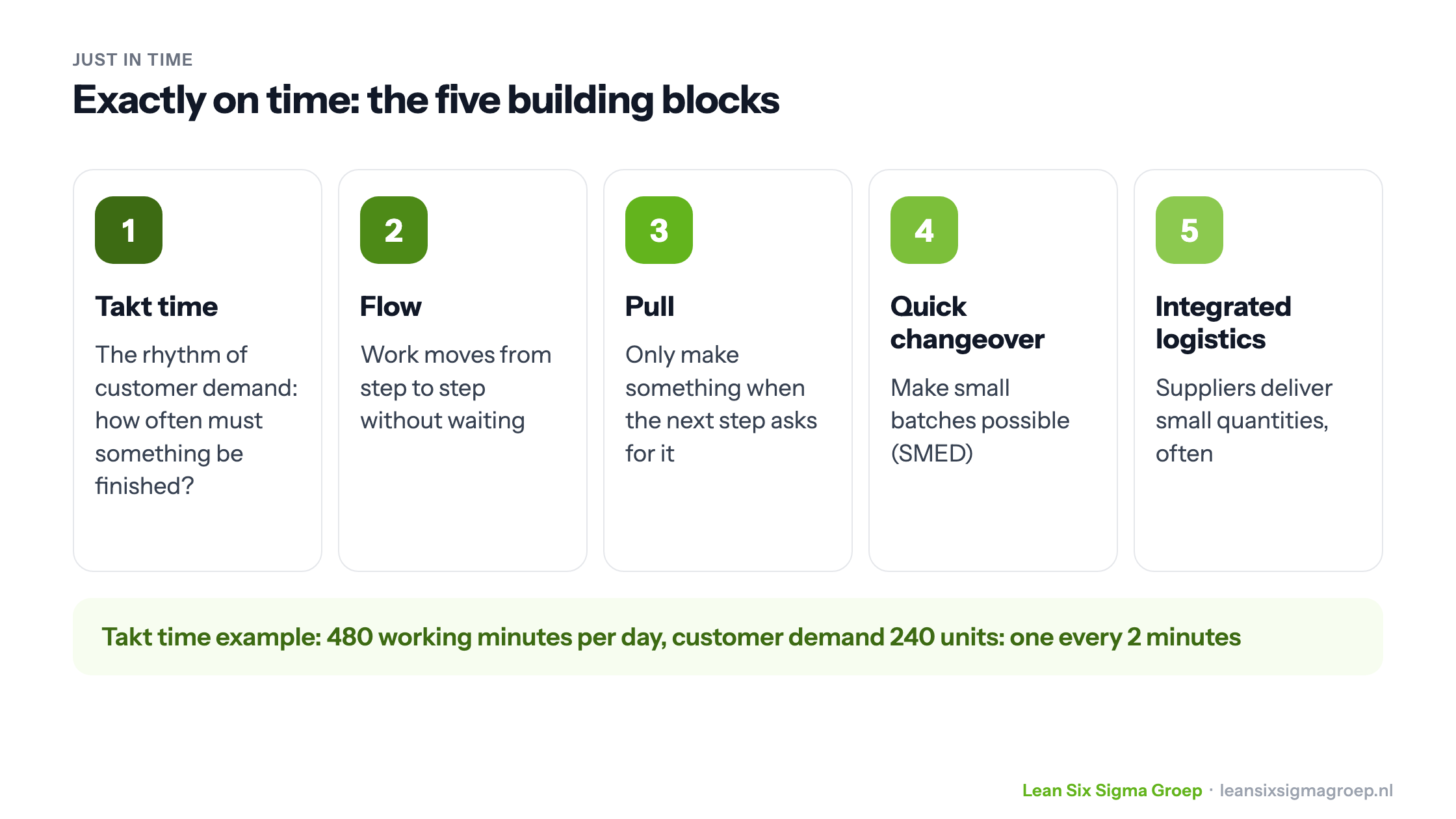
Just in Time rests on five building blocks, shown in the image at the top of this article:
- Takt time: the rhythm of customer demand. You calculate it by dividing available working time by customer demand. With 480 working minutes per day and a demand of 240 units, one must be finished every 2 minutes.
- Flow: work moves from step to step without interruption.
- Pull: you only make something when the next step or the customer asks for it, for example with kanban.
- Quick changeover: with SMED you make small batches possible, so you don’t need to produce for stock.
- Integrated logistics: suppliers deliver small quantities, often, exactly when needed.
Just in Time and flow
JIT is all about knowing what the customer wants and at what rhythm. That is essential for creating flow: an uninterrupted flow of your product or service, without standstill. You prevent standstill by finding waiting times and removing them as much as possible, for example by reducing stock between process steps.
Very concretely, in the office too: pick up a task as soon as it arrives, so your colleague further along can start on it quickly. Don’t wait until a pile has built up, but make sure you can handle small quantities straight away.
Less inventory makes problems visible
Inventory works like water in a river: it covers the rocks on the bottom. As long as there is a lot of inventory, you hardly notice breakdowns, long changeovers, errors or late deliveries. Lower the inventory, and those problems come to the surface.
This is one of the tools you learn to apply in the Green Belt training.
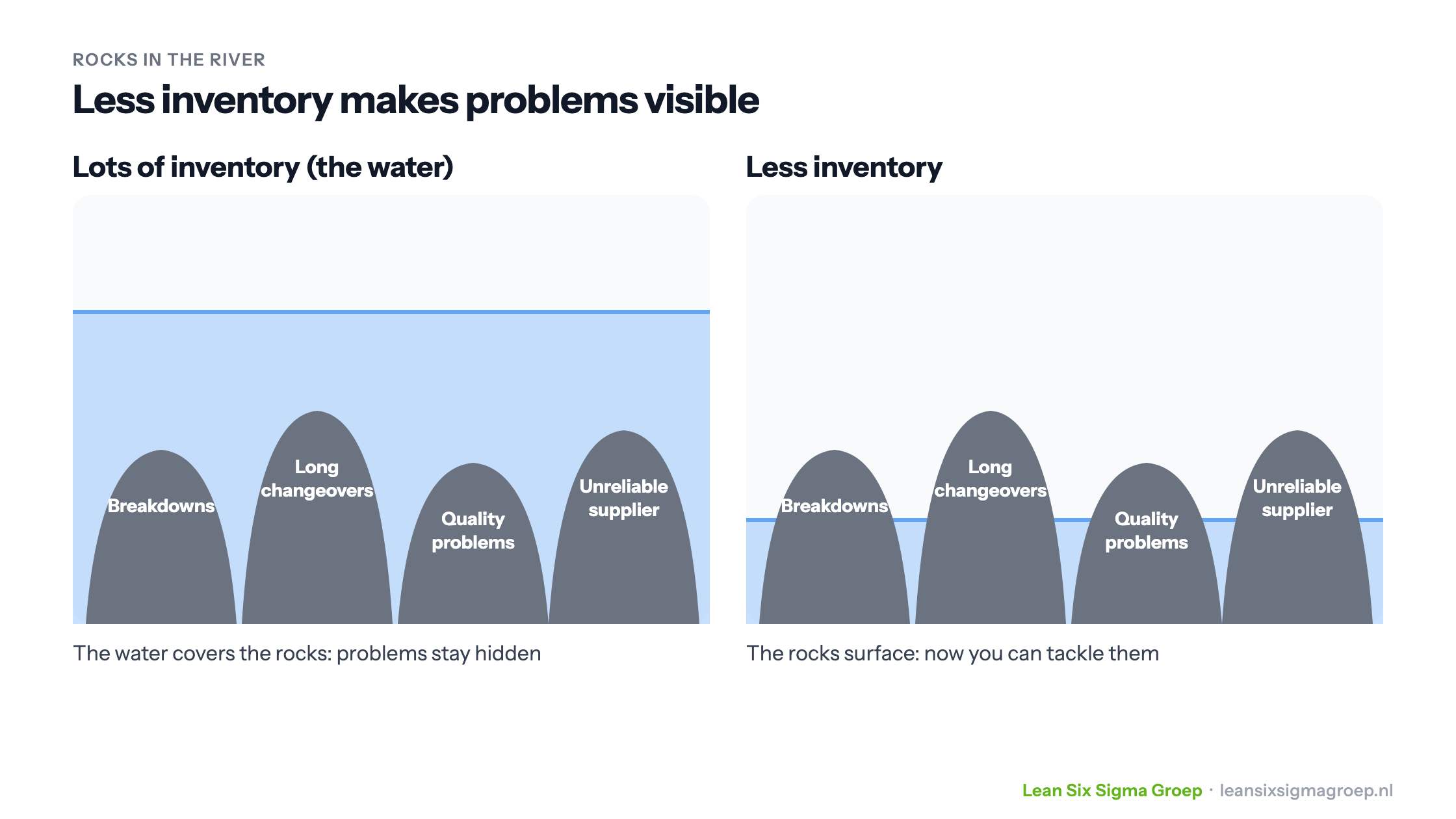
That is exactly the point: only when you see a problem can you solve it. So lower inventory step by step, solve the problem that becomes visible, and then continue.
Benefits and risks
Less inventory means less money tied up in working capital, shorter lead times and less administration. And because things are delivered and processed exactly on time, it immediately stands out when a machine or a colleague isn’t ready. That way you work step by step towards perfection, the ultimate goal of Lean.
JIT also makes a process more vulnerable to disruption. If one supplier drops out, production can quickly come to a halt, as many companies found during the chip shortage of 2021. So where needed, deliberately build in a small buffer, especially for parts with a long or uncertain delivery time.
Want to know how to apply Just in Time in your own work? Get in touch. We have been helping organisations apply Lean successfully since 2012.