Reliability Centered Maintenance (RCM) is a structured method for deciding, asset by asset, what maintenance is needed so that it keeps doing what it should. Not everything gets the same maintenance: the approach depends on what causes a failure and how serious the consequences are. The result is less unplanned downtime, higher OEE and no maintenance that adds nothing.
Origins in aviation
RCM comes from American aviation. In the 1960s, airlines discovered that more frequent and more thorough maintenance did not always lead to fewer failures. For the Boeing 747 (1968) a new maintenance programme was therefore drawn up, based on how components actually fail.
The name Reliability Centered Maintenance comes from Stanley Nowlan and Howard Heap of United Airlines, who described the method in 1978 in a report for the US Department of Defense. The British engineer John Moubray then made RCM known outside aviation, with his book and the RCM II variant (1991), which gave environmental consequences their own place alongside safety. Since 1999 the SAE JA1011 standard sets out the minimum criteria for an RCM analysis.
The seven questions
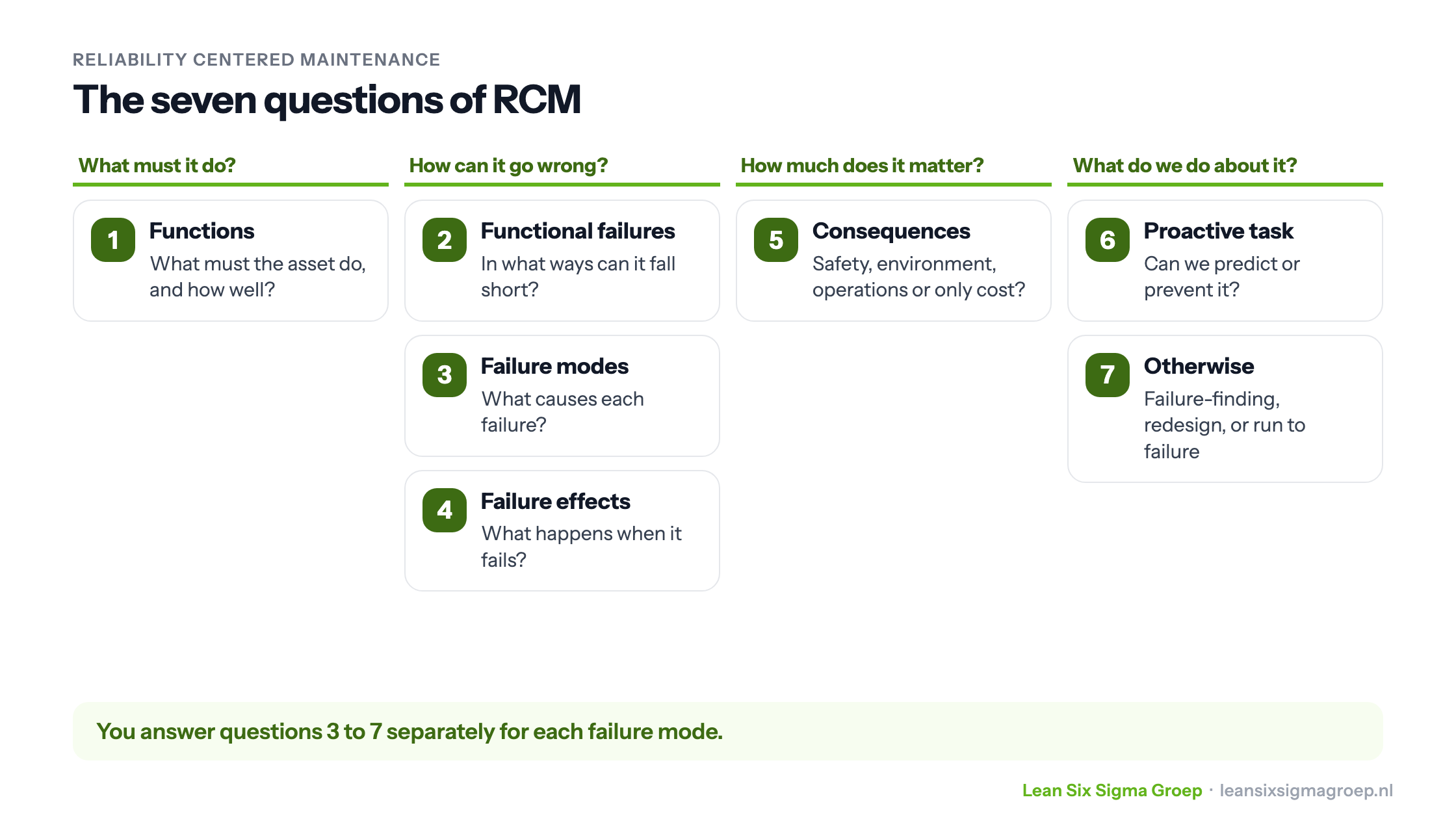
An RCM analysis answers seven questions for each asset, as shown in the image at the top of this article:
- Functions: what must the asset do, and to what performance standards? You distinguish the primary function from secondary functions.
- Functional failures: in what ways can the asset fail to fulfil those functions?
- Failure modes: what causes each failure? This is the most important step: you look for the real cause, so you can tackle it.
- Failure effects: what happens when it fails? What do you notice, and what does it take to restore it?
- Consequences: how much does it matter? RCM distinguishes hidden failures, safety and environmental consequences, operational consequences and cost only. A broken seat on an aircraft is annoying for the passenger; a defect in an engine affects safety.
- Proactive tasks: can you predict or prevent the failure, for example by inspecting, measuring or replacing parts in time? And is it worth it?
- If not: you look for hidden failures with periodic tests, change the design, for example by adding redundancy, or run the asset to failure if the consequences are limited.
You answer questions 3 to 7 separately for each failure mode. One asset can therefore produce dozens of analyses, which is why you focus RCM on the assets that matter most.
Why fixed maintenance often doesn’t work
Nowlan and Heap’s research showed that failures behave in six ways. Only a small share is age-related: the probability of failure increases as a component gets older.
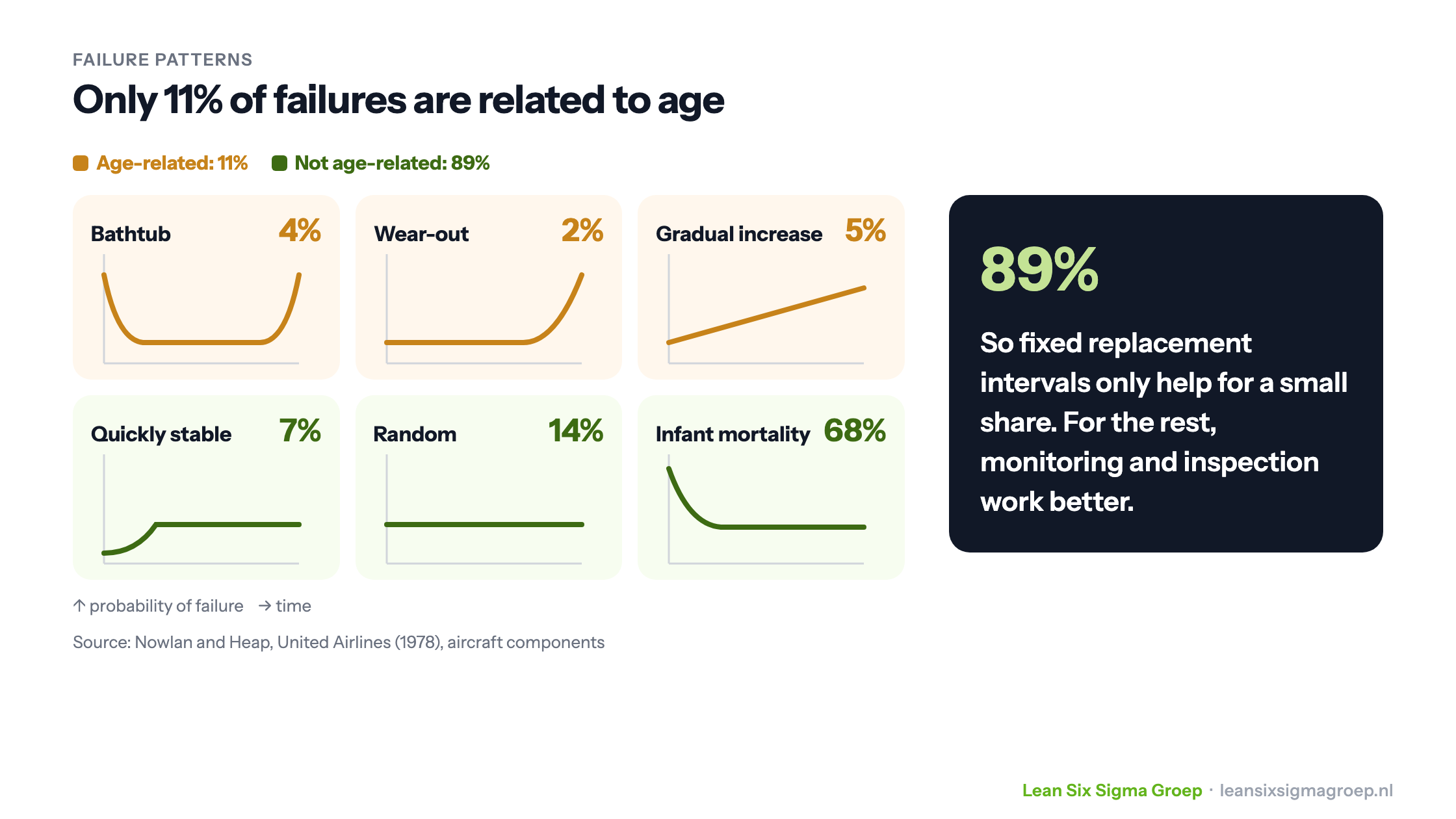
For the rest, the probability of failure is constant, or even highest shortly after installation or maintenance. Replacing such a component on a fixed schedule doesn’t help, and can even cause new failures. For those components it works better to monitor the condition, such as vibration, temperature or wear, and to intervene as soon as there are signs of failure.
The percentages come from 1970s aviation. Later research in other sectors found different distributions, but the lesson is the same: first look at how a component fails, and only then choose the maintenance.
RCM and Lean Six Sigma
In the seven questions you recognise the steps of DMAIC: first determine what the asset must do, then look for the causes of failure, and only then choose solutions. Questions 3 to 5 closely resemble an FMEA, where you also map failure modes, effects and severity. RCM is thus a way of applying Lean Six Sigma thinking to maintenance, and a good basis for Total Productive Maintenance.
Want to learn how to tackle improvements in your organisation? Take a look at the Green Belt or Black Belt training course.
The video with this article shows how RCM leads to more efficient and effective maintenance.
From theory to practice
Learn to apply this in practice
Topics like Reliability Centered Maintenance are applied directly to an improvement project from your own organisation in the Green Belt training.
Next start dates
Lean Six Sigma Green Belt training →Not ready for a training yet?