
Root cause analysis (RCA) is an umbrella term for a wide range of approaches, tools and techniques used to uncover the causes of problems. Some RCA approaches are more focused on identifying true root causes than others, some are more general problem-solving techniques, and others simply support the core activity of root cause analysis.
A ‘root cause’ is defined as a factor that caused a nonconformance and should be permanently eliminated through process improvement. The root cause is the core problem: the highest-level cause that sets off the whole cause-and-effect chain that ultimately leads to problems.
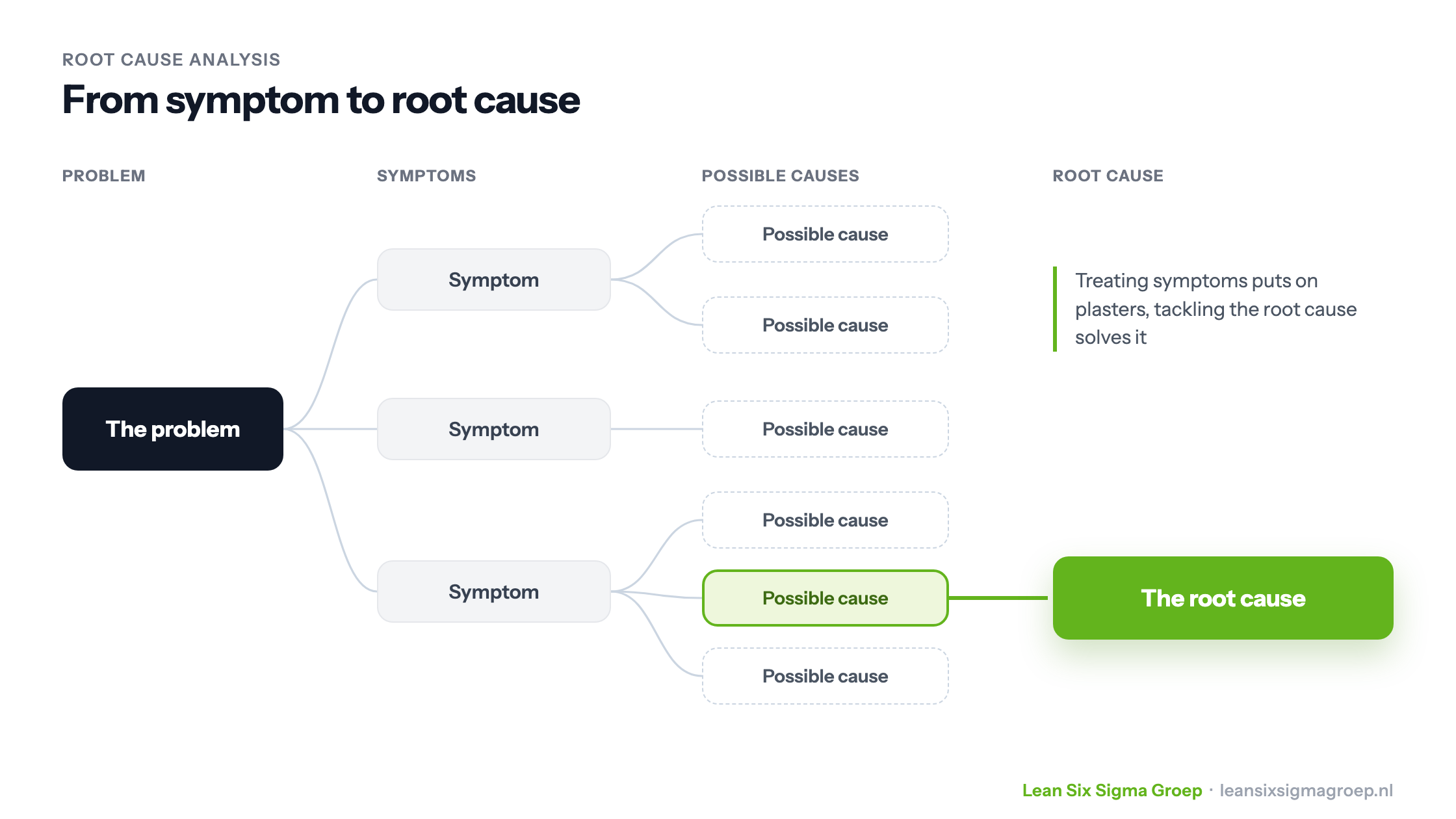
So how is it that you sometimes have a problem that just won’t go away, despite all the solutions you put in place? Endless attempts to improve speed, raise quality and cut costs, and nothing seems to work. With improvements like these, we often see organisations “putting on plasters” where what’s really needed is “stitches”.
They only treat the symptoms instead of actually looking for what is causing the problem. But how do you avoid treating symptoms, and how do you arrive at the right solution?
Uncovering the root cause
To avoid treating symptoms, you need to go looking for the root cause. We take this step after defining the problem and before we start coming up with solutions. Finding the root cause matters for eliminating your problem, because the root cause creates the problem through a chain reaction of different events.
And although a problem often has several root causes, you need to look for the biggest contributor(s).
Within Lean Six Sigma and Lean Agile, we use the 5 Whys technique to get to the root cause of a problem. As soon as someone offers an explanation for a problem, you ask why. And you do this five times, which brings you to the heart of the problem (see image 1).
This is one of the tools you learn to apply in the Green Belt training.
How does Root Cause Analysis work?
Nowhere was the technique applied as neatly as in the research of Donald H. Messersmith. This professor studied the deterioration of both the Lincoln and the Jefferson Memorial, and reached a surprising conclusion when he asked himself why five times.
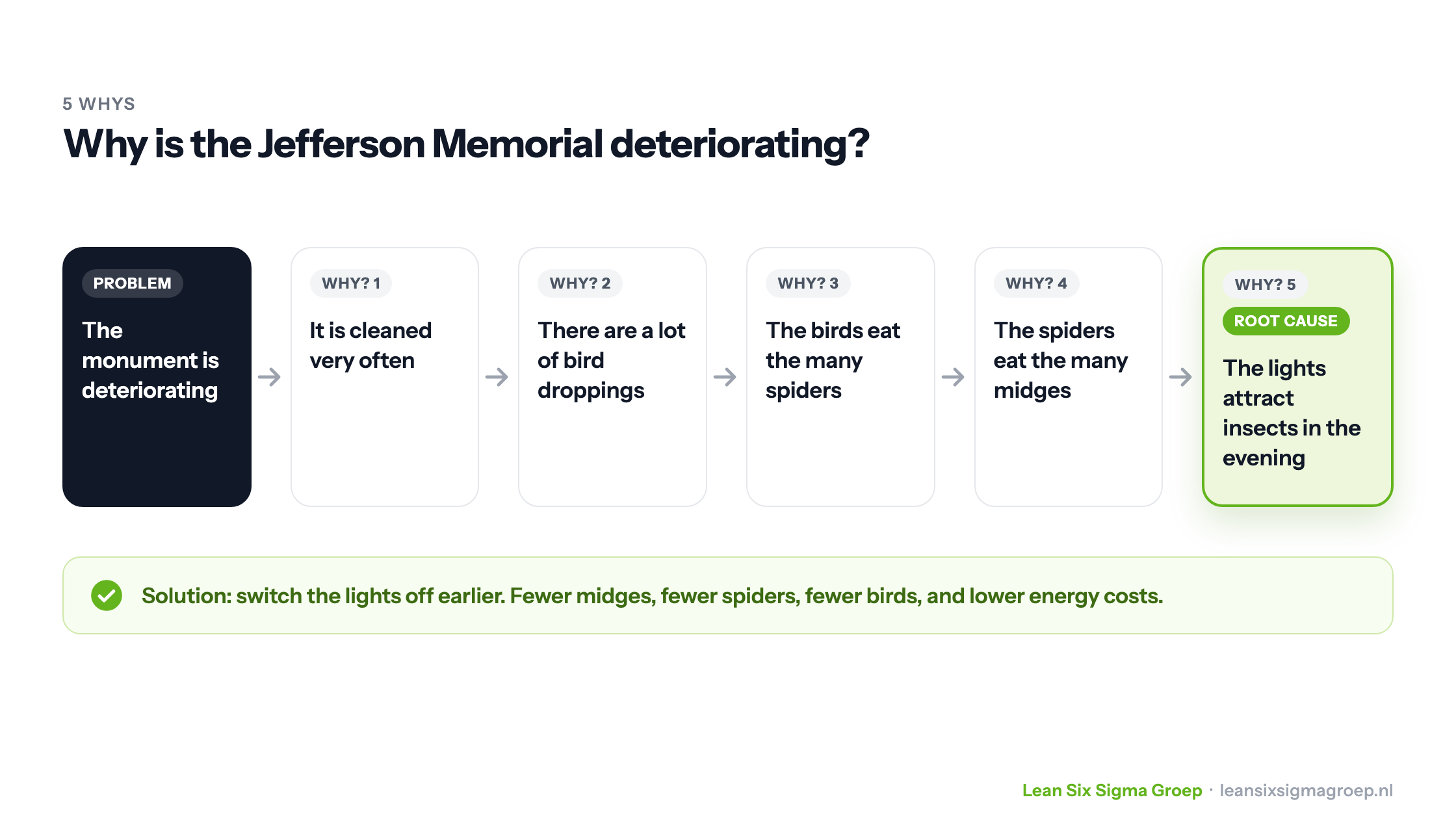
The problem: the Jefferson Memorial is deteriorating. Asking why five times leads to the cause.
- Why is the monument deteriorating?
Because it has to be cleaned very often. - Why does it need cleaning so often?
To get the bird droppings off. - Why are there so many bird droppings?
Because lots of birds come to the monument. They eat the many spiders living there. - Why are there so many spiders?
Because there are lots of midges, and the spiders eat them. - Why are there so many midges?
Because the monument’s lights attract insects in the evening. This is the root cause.
They could have “put on” all sorts of “plasters” by chasing the birds away in different ways: putting up scarecrows, playing ultrasonic sound, installing bird spikes. But in the end none of it would have made any difference, because the birds would have come back anyway for the abundance of food.
By switching the lights off earlier, not only did fewer midges turn up, and so fewer spiders and birds, but the organisation also saved money on its energy bill with this improvement.
That didn’t mean the midges were the only problem, by the way. There were other insects too, such as wasps and moths. Even so, the biggest contributor was the midge, and in the end there were far fewer of them.
How do you apply RCA?
In your improvement projects, you can use the 5 Whys during the various brainstorms you run to get to the causes. Every time someone gives an explanation for a problem, you simply ask: why (5x). Avoid answers that are too broad here; answers such as “poor management” or “late delivery” aren’t specific enough to tackle the problem.
The aim is to find out what is causing the poor management or the late delivery.
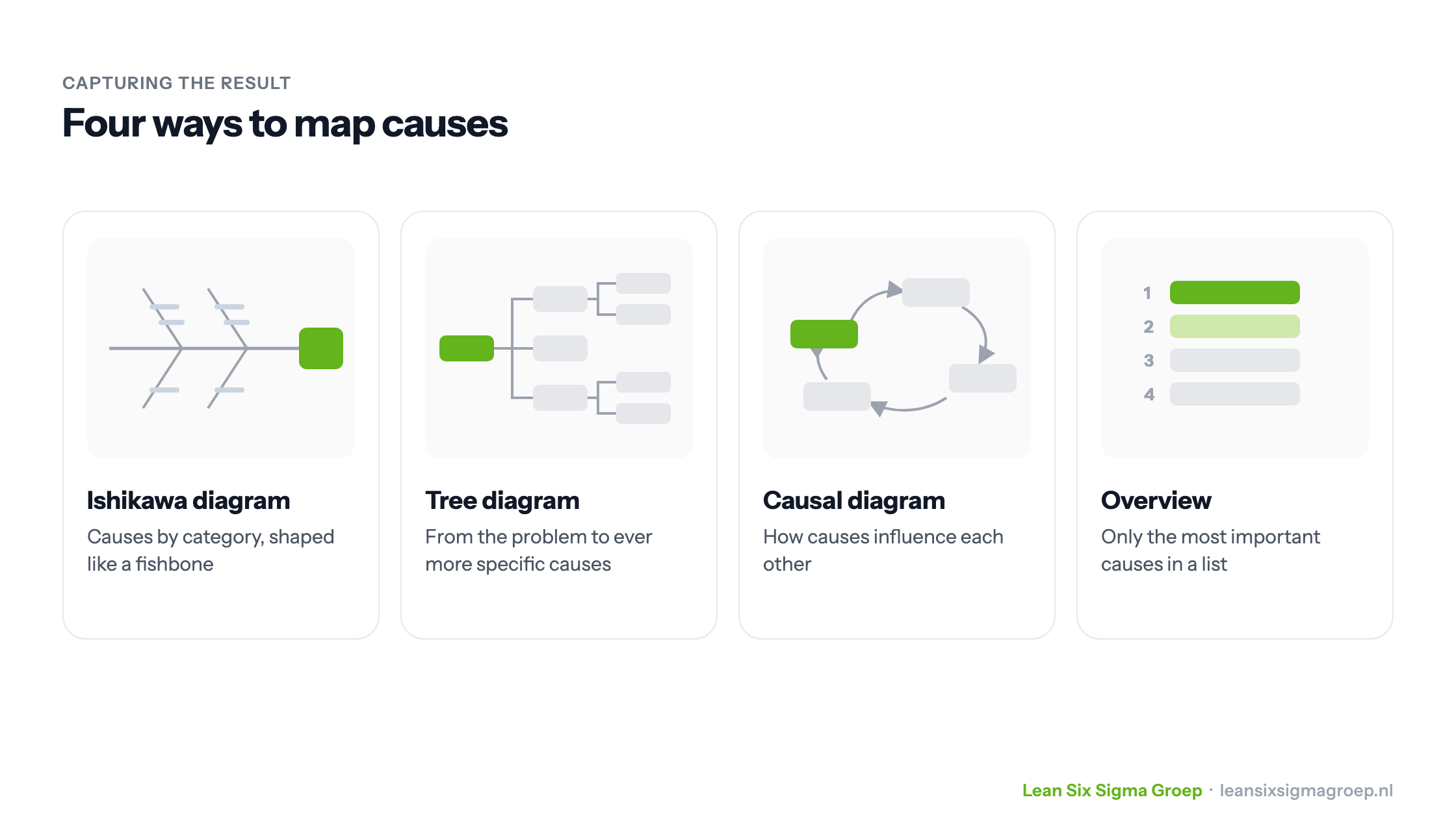
The outcome is often a completed Ishikawa diagram with multiple branches, a tree diagram, a causal diagram or an overview of just the most important causes.
From theory to practice
Learn to apply this in practice
Topics like Root Cause Analysis are applied directly to an improvement project from your own organisation in the Green Belt training.
Next start dates
Lean Six Sigma Green Belt training →Not ready for a training yet?