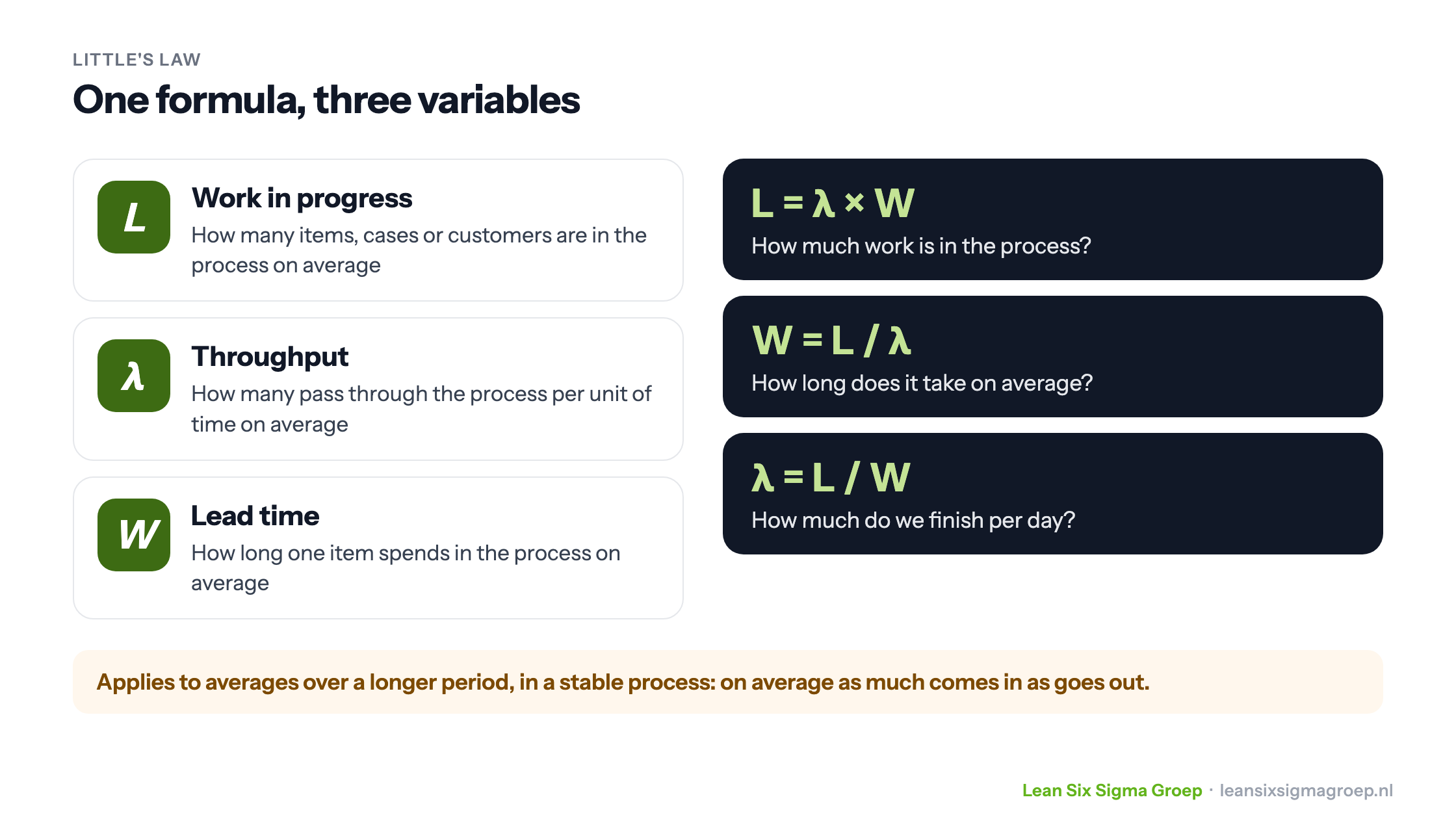
Little’s Law describes the relationship between three quantities in any process: work in progress (L), throughput (λ) and lead time (W). The formula is simple: L = λ × W. The key insight: with less work in the process at once, you get a shorter lead time at the same throughput.
The formula
The American professor John D.C. Little provided the mathematical proof of this formula, already used in queueing theory, in 1961. It has carried his name ever since. The image at the top of this article shows the three quantities and the three forms of the formula:
- L, work in progress: how many items, cases or customers are in the process at the same time on average.
- λ, throughput: how many pass through the process per unit of time on average.
- W, lead time: how long one item spends in the process on average.
If you know two, you can calculate the third. If there are 120 cases in the department and it finishes 20 a day, the average lead time is 120 / 20 = 6 days. Without having followed a single case.
When does the formula hold?
Little’s Law is remarkably widely applicable: it doesn’t matter what the process looks like, in what order work is picked up or how erratically it arrives. Two conditions do apply:
- It is about averages over a longer period. Over an afternoon or one busy week, the formula can be well off.
- The process is stable: on average as much comes in as goes out. If the pile of work keeps growing, the relationship no longer holds.
Also make sure you measure all three quantities in the same units and with the same boundaries: the same start and end point of the process, and the same unit of time.
Three examples
The formula works in a factory just as well as in healthcare or in an office.
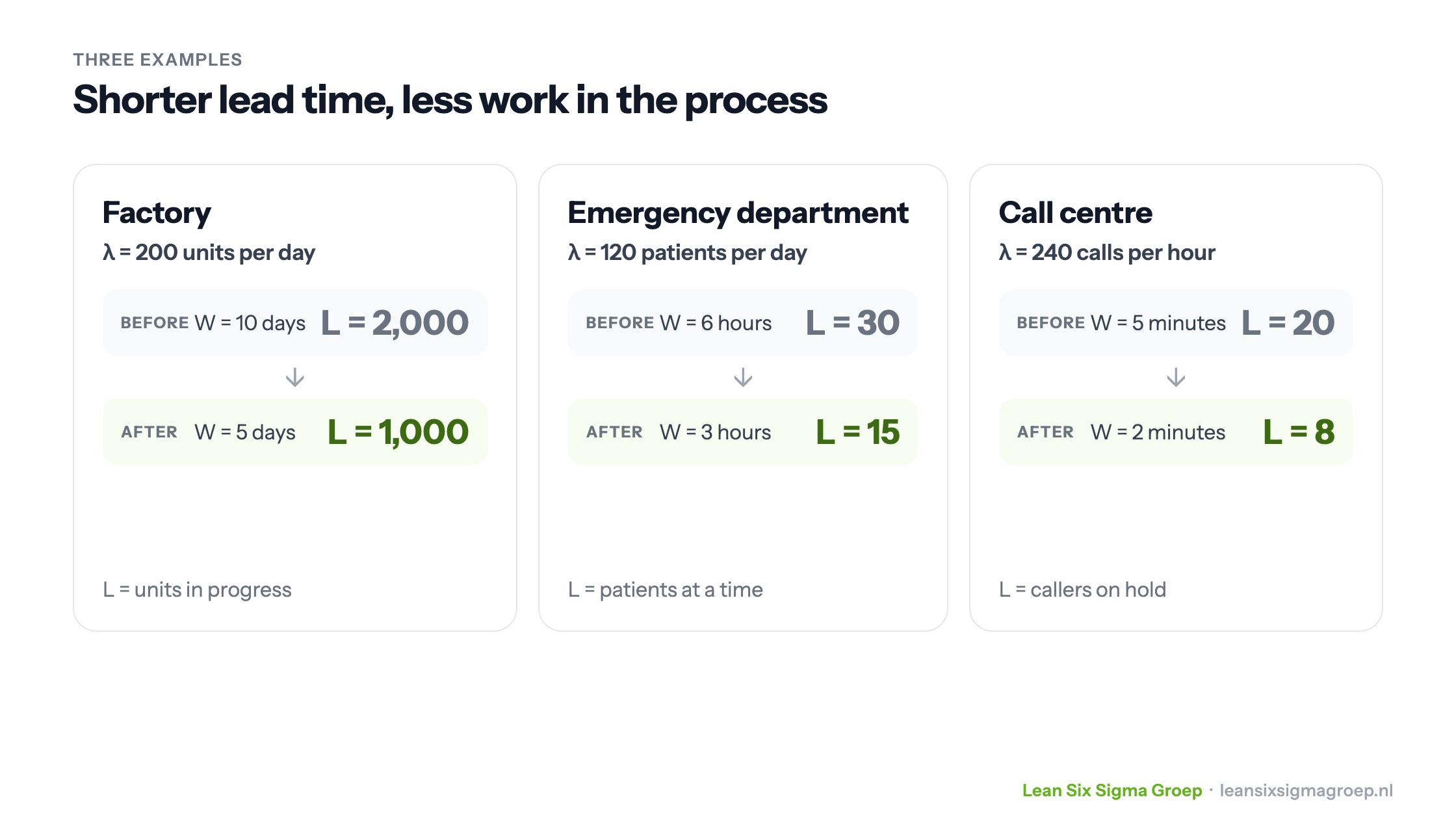
- Factory. A factory makes 200 parts a day, with a lead time of 10 days. So on average 2,000 parts are in progress. If the lead time can be halved to 5 days, for example by removing waiting time between steps, work in progress drops to 1,000. That saves space and money tied up in inventory.
- Emergency department. An ED sees 120 patients a day, who stay 6 hours (a quarter of a day) on average. So on average 30 patients are present at the same time. If the length of stay goes down to 3 hours, that becomes 15: less crowding, fewer beds and a calmer workplace.
- Call centre. A call centre receives 240 calls an hour, and callers wait 5 minutes (1/12 of an hour) on average. That means 20 people are on hold on average. With a 2 minute wait, that becomes 8.
Less work at once, shorter lead time
The formula works in two directions, and the reverse is often the most useful in practice: W = L / λ. Taking on more work at once than the process can handle makes lead time longer, without getting more done. Limiting work in progress shortens lead time, without anyone having to work harder.
That is why Lean and Agile work with a maximum amount of work at once, for example with a WIP limit on a kanban board, and aim for small batches and one piece flow. To increase throughput, you look at the bottleneck: it determines how much the whole process can handle.
The topic is covered in depth in the Green Belt training course.