Supply chain management is managing the whole chain from raw material to customer: suppliers, production, storage, transport and sales. The aim is for the customer to get what they want, on time and at the lowest possible cost, without large stocks or long waits building up anywhere in the chain. Lean Six Sigma, which started on the factory floor, fits it perfectly.
What is supply chain management?
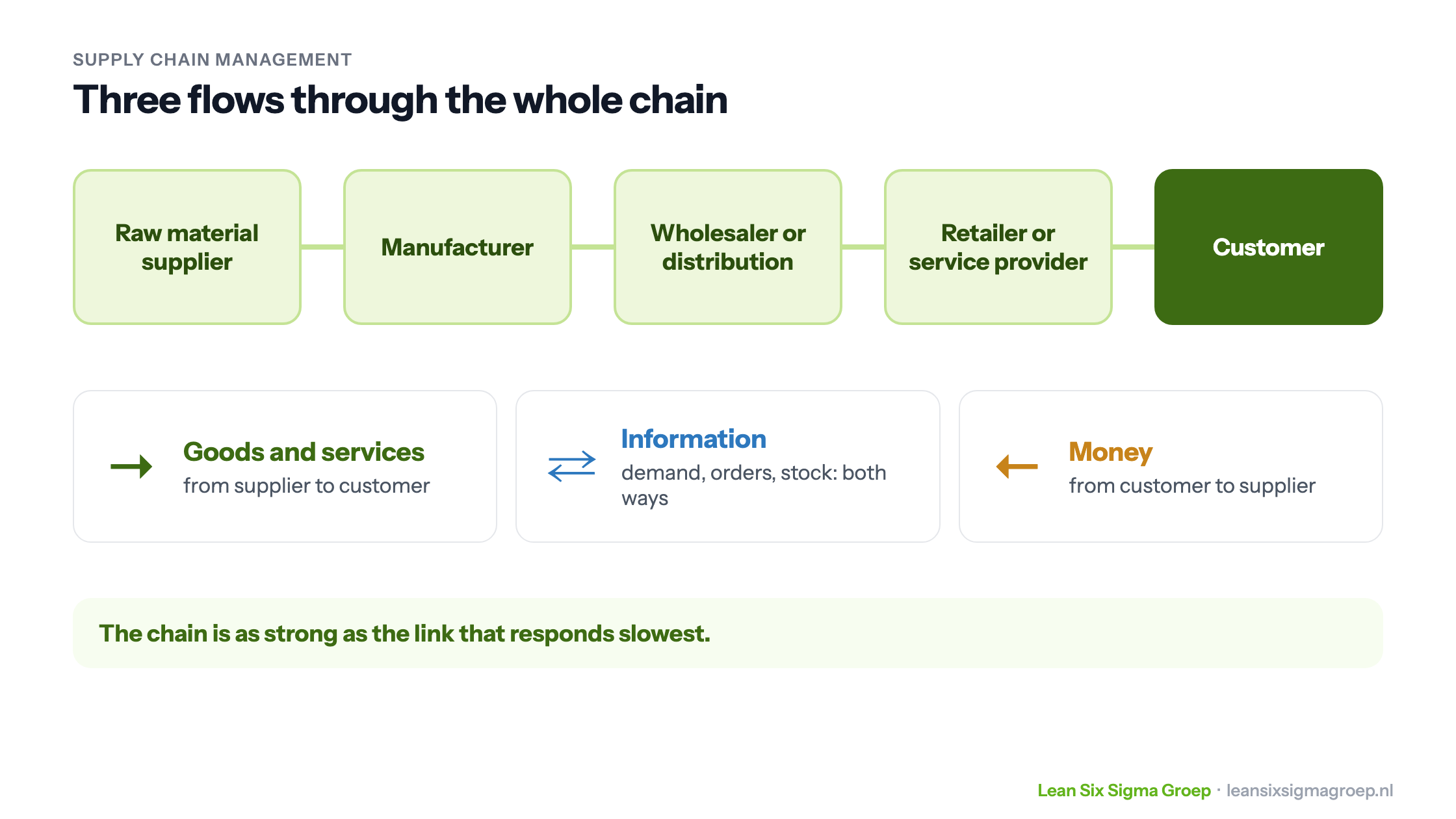
A supply chain is the series of organisations and steps that together bring a product or service to the customer. Three flows run through that chain, as shown in the image at the top of this article:
- Goods and services flow from supplier to customer.
- Information flows both ways: demand, orders, forecasts, stock levels.
- Money flows back from the customer to the suppliers.
Supply chain management is about aligning those flows, across the boundaries of your own organisation. That is the big difference from ordinary logistics: not just making your own warehouse efficient, but looking at the whole chain together with suppliers and customers.
Why the whole chain?
Every link that only optimises its own part can make the chain as a whole worse. A manufacturer running large batches because that is cheap per unit pushes stock on to the wholesaler. A retailer that over-orders at every uncertainty makes demand look more erratic to the supplier than it is. That amplifying effect is called the bullwhip effect: small fluctuations at the customer grow larger the further back in the chain you look.
A chain is therefore as strong as the link that responds slowest. If you want to shorten the lead time from raw material to customer, you have to look across the whole chain.
Lean Six Sigma in the chain
Lean and Six Sigma each ask the chain their own question, as shown below.
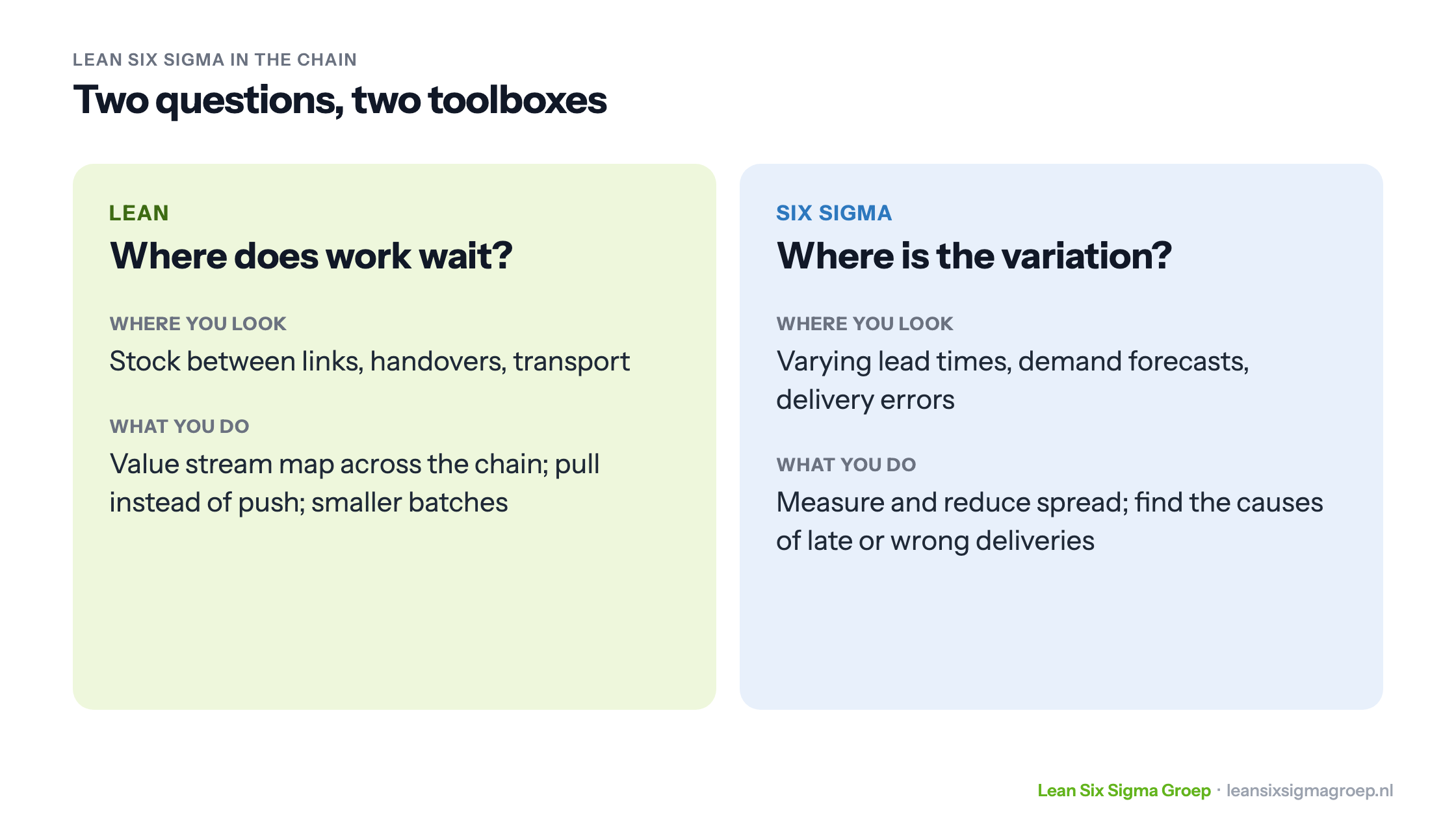
Lean: where does work wait?
In most chains the product spends most of its time neither moving nor being worked on, but waiting: in a warehouse, on a truck, for an order. Lean makes this visible with a value stream map across the whole chain, from supplier to customer. Then the familiar Lean principles apply:
- Pull instead of push: producing and delivering based on real demand, not a forecast. That is the core of just in time.
- Smaller batches and more frequent deliveries, so less stock needs to sit between the links. Read more about inventory management.
- Sharing information, so every link sees the real demand of the end customer instead of the orders of its direct customer.
Six Sigma: where is the variation?
Many problems in a chain are caused not by an average that is too high, but by spread: a supplier that sometimes needs two days and sometimes ten, a forecast that is variably accurate, orders that are occasionally picked wrongly. To absorb that spread, companies hold extra stock. Six Sigma tackles the cause: measure the variation, find its causes and reduce the spread. Less variation means less safety stock and more reliable delivery.
A different way of looking
The chain projects we support often hold great opportunities. But they require a different way of looking. Don’t look first at who does what, or at what you already know about your own part of the chain. Look at the process as a series of steps, and decide together with suppliers and customers who the end customer is and what they value. Back it up with data, and the bottlenecks become visible.
A choice that often comes up is which links you do yourself and which you outsource. Read more in outsourcing.
Want to learn how to analyse and improve processes in the chain? Take a look at the Green Belt course.