
FMEA stands for Failure Mode and Effects Analysis. FMEA is a risk analysis for finding causes and solutions. It is used to prioritise the defects that occur.
But the method is also used to test beforehand whether a solution leads to risks and/or failures. That leads to preventive action.
What is FMEA?
The FMEA, also known as an FMEA workshop, is a way to make the risks of each process step visible with a team of colleagues, analyse them and decide whether action (countermeasures) is wanted.
It is a systematic approach for discovering the possible ways in which a product or process can fail and how easily you can detect the failure and the effect of that failure, so that you can reduce the risk of it occurring, its effect or both.
With a team of colleagues, usually from different teams with diverse backgrounds and perspectives, you brainstorm which process steps in a process produce so-called ‘failures’. The input can come from customer experiences (complaints) or from the insights of employees who have to do ‘overprocessing’ (read: rework) to get the products and services to the customer.
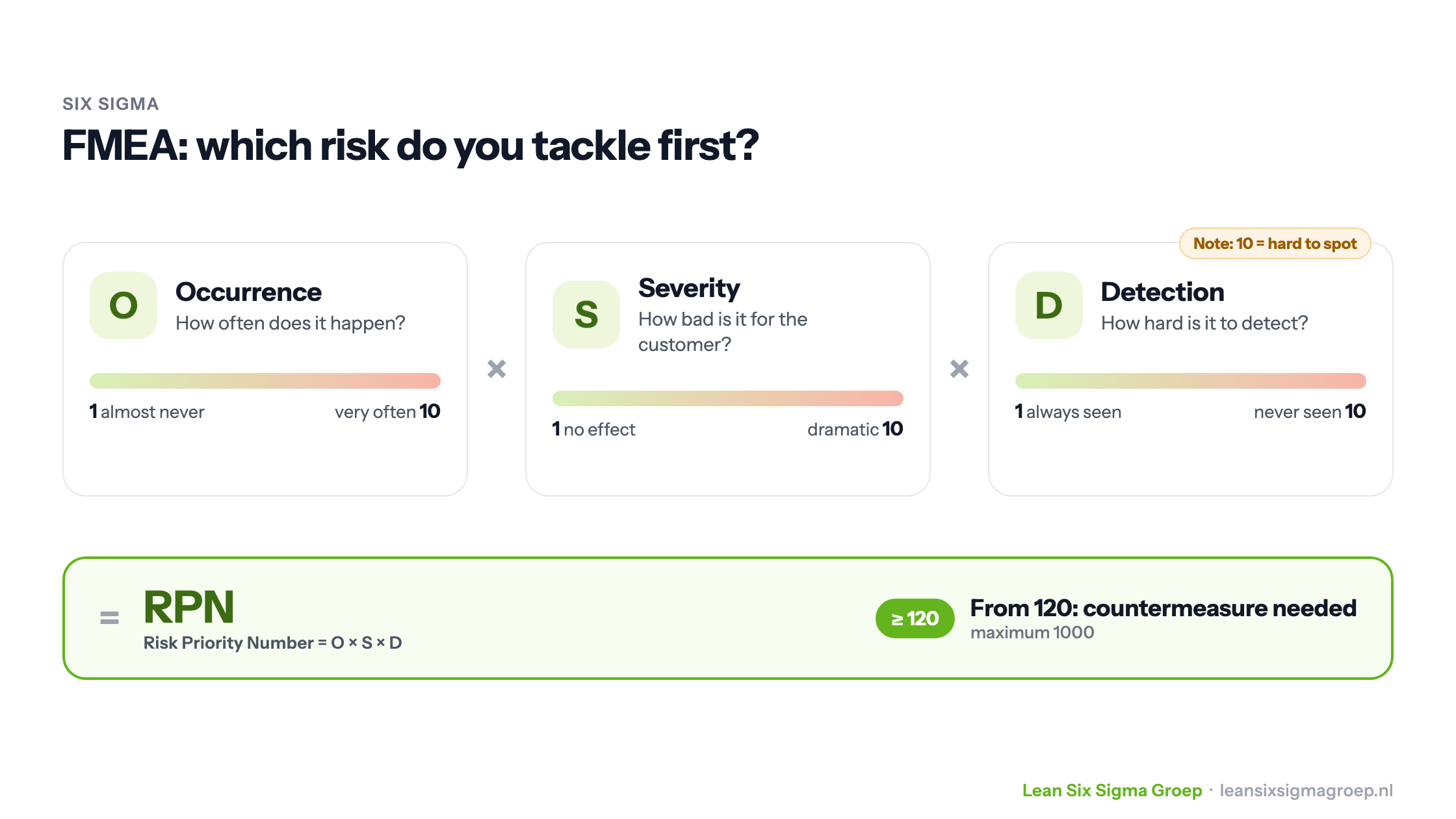
By scoring the severity of the possible failure, the frequency of the failure and the detectability of the failure, the so-called Risk Priority Number (RPN) can be calculated for every possible failure. This is an indicator that helps you set priorities for tackling the causes.
Each of the failures is then given an estimate in the form of a score:
- Occurrence: how often it happens
- 1 is not often, 10 is often
- Severity: how serious is it when this failure occurs
- 1 is not serious, 10 is serious
- Detection: how easy it is to notice before it goes wrong
- note: 1 is easy and 10 is difficult!!
FMEA approach and example
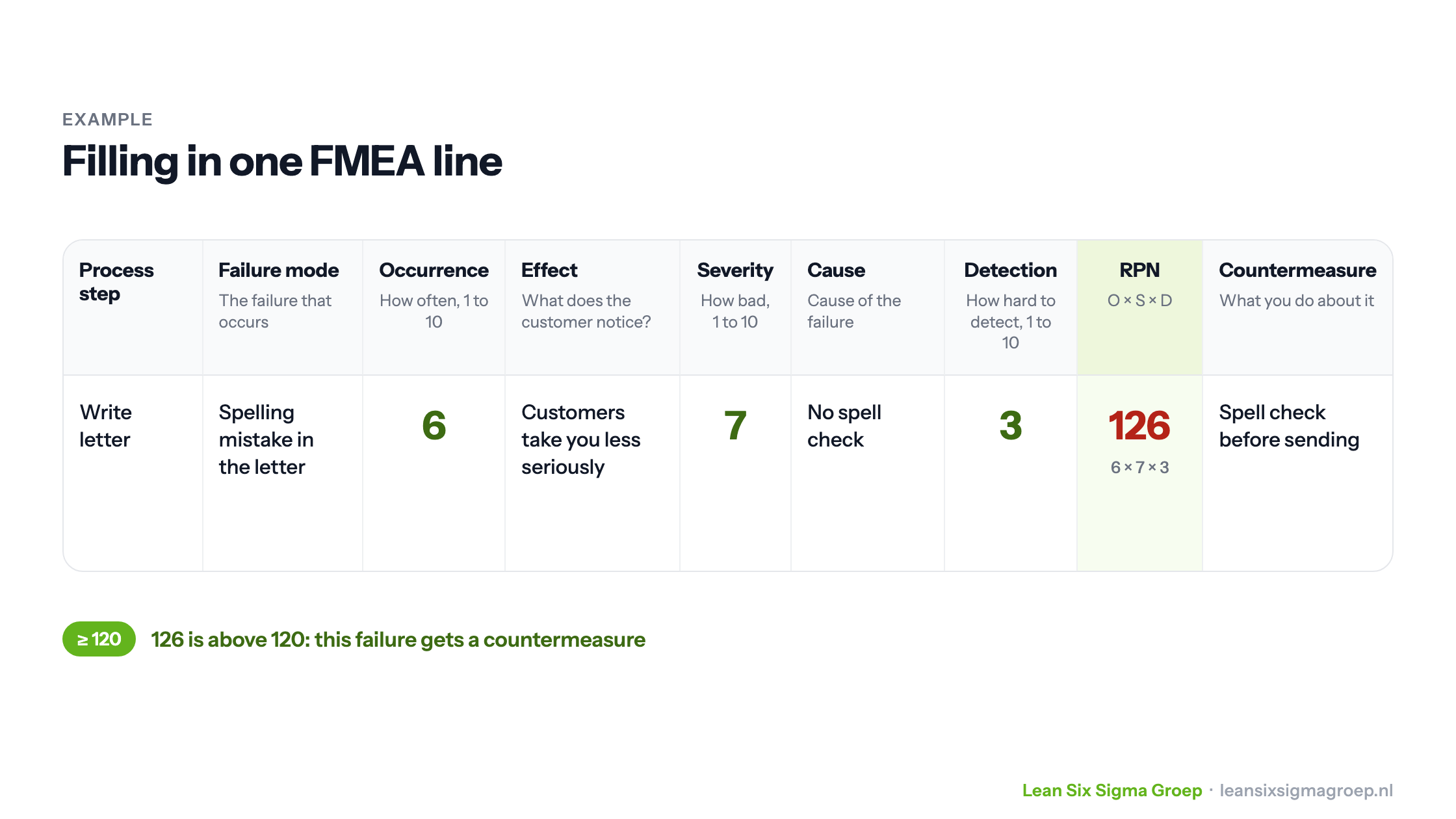
By filling in the table below with a team of the employees involved, you get an overview of the possible defects in one process, together with their priority in the form of the RPN. See the example below.
This is one of the tools you learn to apply in the Green Belt training.
Drawing up the FMEA takes a few steps:
- Identify all possible failures/defects (failure modes) in the process. Defects are those possibilities that do not meet the customer requirements.
- For each defect, each failure, you fill in the boxes from left to right.
- Occurrence (frequency): estimate how often the failure in question occurs when the process is carried out [score 1-10, 1 = almost never occurs, 10 = occurs very often].
- Severity: estimate the consequences of each failure mode and quantify the severity of these consequences for the customer [score 1-10; 1 = no effect, 10 = dramatic effect].
- Detection (detectability): quantify the likelihood that the failure is detected [score 1-10, 1 = failure is always recognised, 10 = failure is never recognised when it occurs].
- The risk priority number can now be calculated. The formula is: RPN = Occ * Sev * Det.
- The higher the RPN, the more risk.
- From a score of 120 an action/countermeasure must follow. It should be noted here that giving a score is not a science; it is a weighting or indication from the employees. You weigh up and estimate the severity, frequency and detectability.
Following the approach above, it is sensible to tackle the highest-scoring failure (highest RPN) first. A high score is a score above 120. But it is advisable to start with a lower-scoring RPN, a failure that is easy to solve or improve.
That way the team achieves success quickly and is motivated to take on the next improvement.
Application in Lean Six Sigma
A risk analysis can be used at various moments in your DMAIC approach. During the Define phase, the FMEA can be used to gain insight into which of the processes carried out in an organisation contain risks that stand in the way of the customer’s or the organisation’s interests.
That can show you which process you want to tackle first through an improvement project. In that way it forms an alternative or addition to Quality Function Deployment (QFD), which looks mainly at delivering customer value.
It can also be applied in the Measure phase, when relating process steps to KPIVs (key process input variables) linked to risks and when prioritising KPIVs. And in the Analyse phase, to understand the risks of an implementation. Finally in the Improve phase, to estimate the effectiveness of a control plan.
From theory to practice
Learn to apply this in practice
Topics like FMEA are applied directly to an improvement project from your own organisation in the Green Belt training.
Next start dates
Lean Six Sigma Green Belt training →Not ready for a training yet?