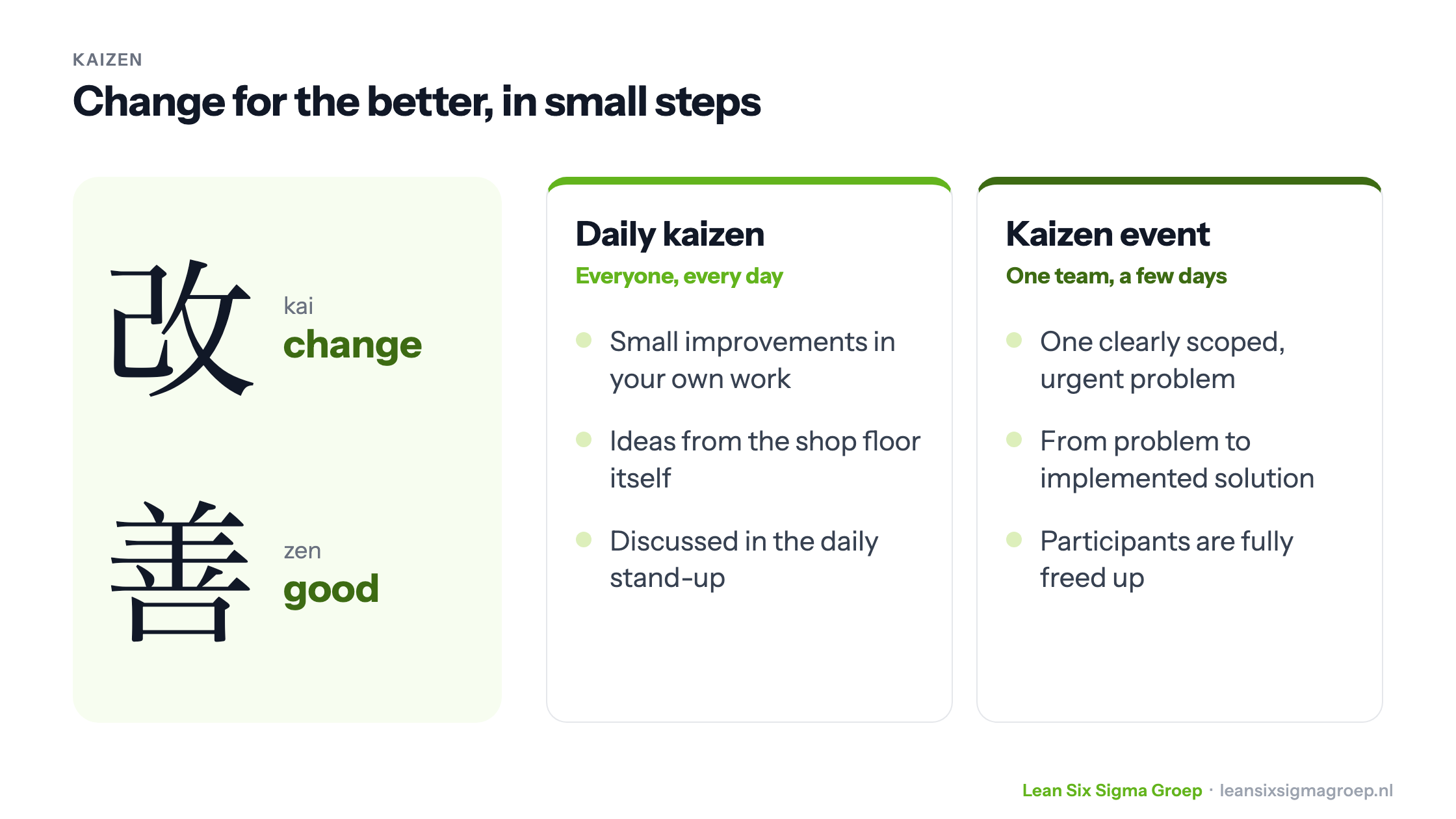
Kaizen is Japanese for “change for the better”: 改 (kai) means change and 善 (zen) means good. It stands for continuous improvement in small steps, by everyone in the organisation, every day.
Where does Kaizen come from?
Kaizen emerged in Japan after the Second World War and became a core part of the Toyota Production System. There, line workers are expected to stop the work as soon as something goes wrong, and to propose an improvement together with their supervisor. Masaaki Imai made the term known in the West in 1986 with his book Kaizen: The Key to Japan’s Competitive Success.
Kaizen is a daily activity with a purpose beyond improvement alone. Applied well, it also makes work more humane: it removes unnecessarily hard work, both physical and mental, and teaches people to see waste in a process and remove it.
The core of Kaizen consists of five elements:
- teamwork;
- personal discipline;
- good morale;
- quality circles: small groups that look for improvements together;
- improvement suggestions from employees.
Two forms: daily and as an event
Kaizen comes in two forms, shown side by side in the image at the top of this article.
- Daily kaizen: everyone improves their own work a little every day. Ideas come from the shop floor itself and are discussed, for example, in the daily stand-up. This is the basis of a culture of continuous improvement, often following the PDCA cycle.
- Kaizen event: a team tackles one clearly scoped problem in a few days, from problem to implemented solution. The aim is to cut costs, raise quality, shorten delivery times or increase customer satisfaction.
How a kaizen event runs
A kaizen event goes through the same steps as the DMAIC cycle, only in a few days instead of a few months. Below you can see what a five-day event can look like.
This is one of the tools you learn to apply in the Green Belt training.
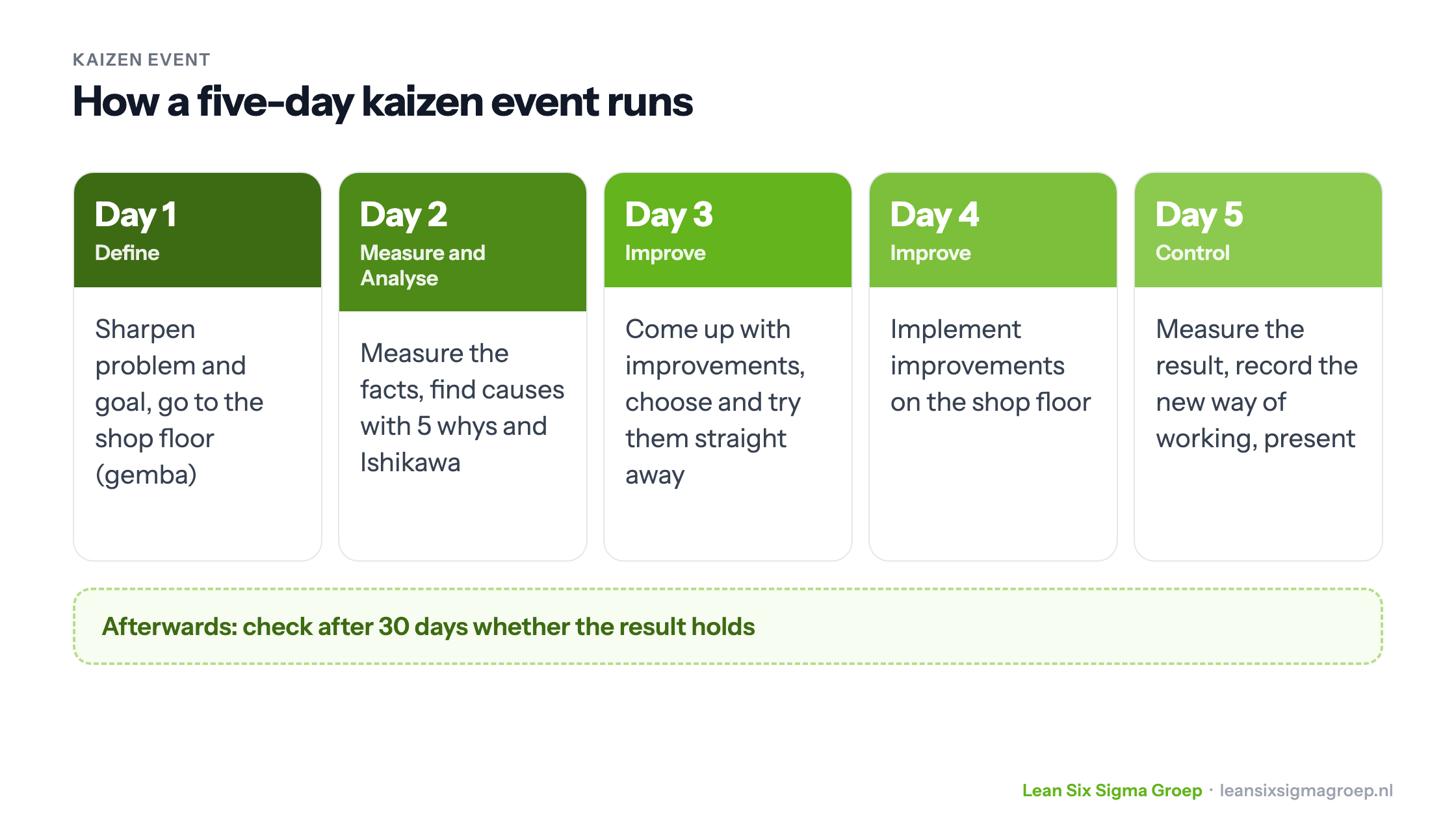
- Define the problem and the goal. What is the real problem, and what do you want to achieve? Make the goal as concrete as possible.
- Measure the facts. Go to the gemba, the place where the work happens. Map the process, for example with a value stream map, and collect data that makes the problem clear.
- Analyse the facts. Look for the causes. Keep asking with 5 whys and make, for example, an Ishikawa diagram. Choose the most important causes.
- Come up with improvements for those causes, and try them out straight away where you can.
- Implement the improvements. Put them in order, make a short implementation plan and carry it out.
- Check and sustain. Check whether the problem is solved, record the new way of working and communicate it.
Conditions for a successful kaizen event
- The problem is urgent and has a limited scope and complexity.
- Participants are fully freed up during the event.
- The team consists of people who work in the process.
- You zoom in on the way of working, at the level of individual activities.
- Look for smart solutions before spending money.
- Keep asking until you reach the real cause.
- Implement good solutions and don’t keep looking for the perfect one. Keep up the pace.
- A plan is only good if it can be implemented, and only successful if the result lasts. So look back after a month.
After an event, daily kaizen makes sure the improvement lasts and keeps growing.
Kaizen and Lean
Lean is a way of working centred on value for the customer and removing waste. Kaizen is its principle of continuous improvement: improvement is never finished. Where Lean provides the direction and the tools, Kaizen makes sure everyone works on it every day. With Kata you train that habit step by step.
If you work with a value stream map, you mark improvement points in it with kaizen bursts. You can use our free kaizen burst tool for that.
The video with this article explains Kaizen and continuous improvement.
From theory to practice
Learn to apply this in practice
Topics like Kaizen are applied directly to an improvement project from your own organisation in the Green Belt training.
Next start dates
Lean Six Sigma Green Belt training →Not ready for a training yet?