Publicatie
PDCA cycle
Implement successful improvements with the PDCA cycle. Learn how this continuous improvement method optimises your organisation.
 Krijn VrolijkBlack Belt Consultant
Published 5 min read
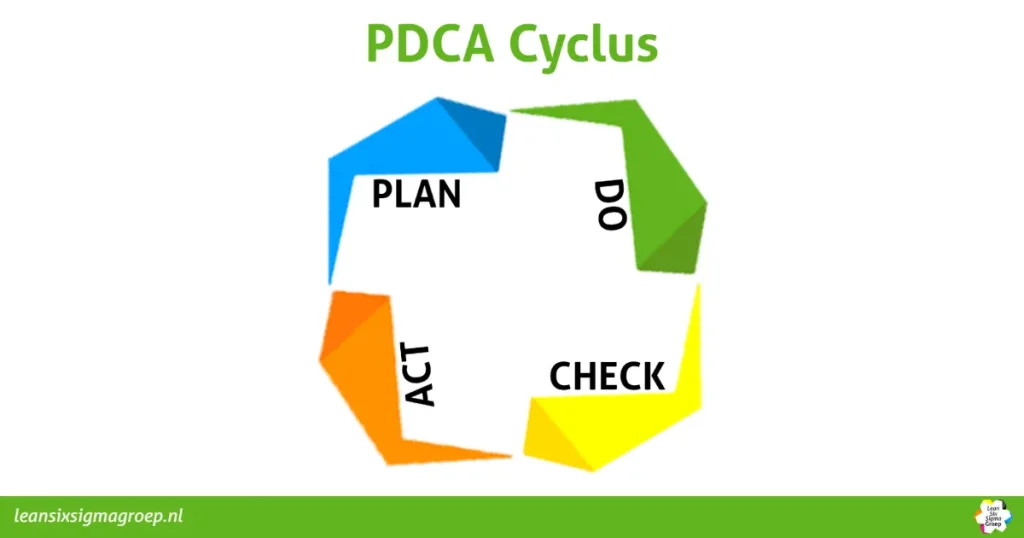
The PDCA cycle is a way of improving continuously using a fixed structure. The four letters of the PDCA cycle stand for the four phases you go through: Plan, Do, Check, Act. The PDCA cycle can be applied in any sector.
Deming circle
The PDCA cycle has its origins in Deming’s quality circle. This is a creative tool for quality management and problem-solving developed by William Edwards Deming. Deming based his circle on the improvement cycle of the physicist Walter A. Shewhart. It is an important part of Lean manufacturing and Six Sigma, but also of Agile transformations.
Meaning of PDCA
The circle describes four activities that apply to every improvement in an organisation: Plan, Do, Check and Act. Because the cycle is iterative, quality improvement stays on the agenda all the time. The order of the circle can be traced back to the scientific process described by Francis Bacon (Novum Organum, 1620): hypothesis, experiment, evaluation.
The four phases of the PDCA cycle
Suppose you work in an administrative department and the process from ‘supplier invoice received’ to ‘supplier invoice paid’ is not running well. Errors are being made and the lead time of the process is simply too long.
If we want to solve this problem with the PDCA cycle, we go about it as follows:
- Plan: We come up with a plan to solve the problem. This phase consists of a number of activities. We sharpen the problem we are going to tackle by mapping the current situation, identifying the causes and working out which countermeasures we are going to carry out. At the end of this phase we know how we are going to tackle the problem.
- Do: We carry out our plan. Do this in a controlled test set-up. Simple enough, right? At the end of this phase we have implemented the solutions we came up with.
- Check: We check whether our solution has delivered the desired result. Have we reached our goal? How do our process and our organisation respond to the countermeasures we implemented? At the end of this phase we have evaluated the new way of working.
- Act: Finally, it is important that you respond to the results from the previous phase. At the end of this phase you may need to make a few changes to the new way of working to secure the process. Use the measured results to adjust where they do not match the objectives.
You may even have to conclude that the new way of working unfortunately does not run as well as expected after all. And that is completely… fine! That is exactly what the PDCA cycle is so good for: creating a culture of continuous improvement. Because whether or not your initial problem has been solved, once you have completed a PDCA cycle the next step is always the same: start a new PDCA cycle.
Adding value iteratively
The PDCA cycle scales flexibly. You can apply it to a project of a few months, but you can also run through a PDCA cycle in a single day. It depends on the size and complexity of the problem you want to solve.
What matters most is that you have achieved something by the end of the cycle and have secured the new level of quality. Thanks to this iterative structure you keep building on the quality of your organisation, step by step.
Continuous improvement thanks to PDCA
Back to the finance department’s process for a moment. If the problem has not been solved, it is wise to start a new PDCA cycle. In other words: ‘Back to the drawing board!’ So: take another close look at the problem and draw up a plan of approach (Plan), implement different countermeasures (Do), check again whether this situation produces the desired results (Check) and take new actions if needed (Act).

If the problem was solved in the first PDCA cycle, you can start a new PDCA cycle for an entirely different problem. There is, after all, always something to improve.
In fact, you can see our 9-step plan reflected in the PDCA cycle. It is the backbone of our Green Belt training, in which you learn to improve processes.
Growth thanks to the PDCA cycle
The video below explains what the four phases of the PDCA cycle are. Discover how PDCA helps organisations analyse processes, implement improvements, measure results and make adjustments for continuous growth and optimisation.
Deming circle, PDCA cycle or PDSA: what is the difference?
The Deming circle and the PDCA cycle are the same model: the quality circle that W. Edwards Deming made popular, based on the work of Walter Shewhart. You will also come across it as the ‘Deming wheel’, ‘Deming cycle’ or ‘quality circle’. PDSA (Plan-Do-Study-Act) is a genuine variant. The difference is in the third step: in PDCA you check whether the result matches the expectation, in PDSA you first study the outcomes thoroughly before you adjust. That is why PDSA is often used in healthcare and in scientific research, where a deeper analysis is needed.
Deming’s quality circle in four steps
- Problem identification and planning: define the problem sharply and draw up an improvement plan with measurable goals.
- Implementation: carry out the plan on a small scale, as a controlled test.
- Evaluation: measure and analyse the results and compare them with the goal.
- Adjustment and standardisation: change what does not work and make what does work the new standard, for example in a standard operating procedure.
Then the circle starts again. It is precisely that repetition that makes PDCA the engine of continuous improvement: every round lifts the process a little higher.
Frequently asked questions about the PDCA cycle
Who invented the PDCA cycle? The basis is the improvement cycle of the physicist Walter A. Shewhart (1930s). W. Edwards Deming made it world-famous in Japanese quality management after the Second World War, hence the name Deming circle.
Where is PDCA used? In Lean, Six Sigma, ISO 9001 quality systems, healthcare, education and Agile teams. A Kaizen event and a sprint retrospective both follow, in effect, a PDCA round.
How does PDCA relate to DMAIC? DMAIC is the more extensive, data-driven variant for Six Sigma projects. PDCA is lighter and suited to day-to-day improvements on the shop floor.
From theory to practice
Learn to apply this in practice
Topics like PDCA cycle are applied directly to an improvement project from your own organisation in the Green Belt training.
Next start dates · Lean Six Sigma Green Belt training
Not ready for a training yet? Or .