
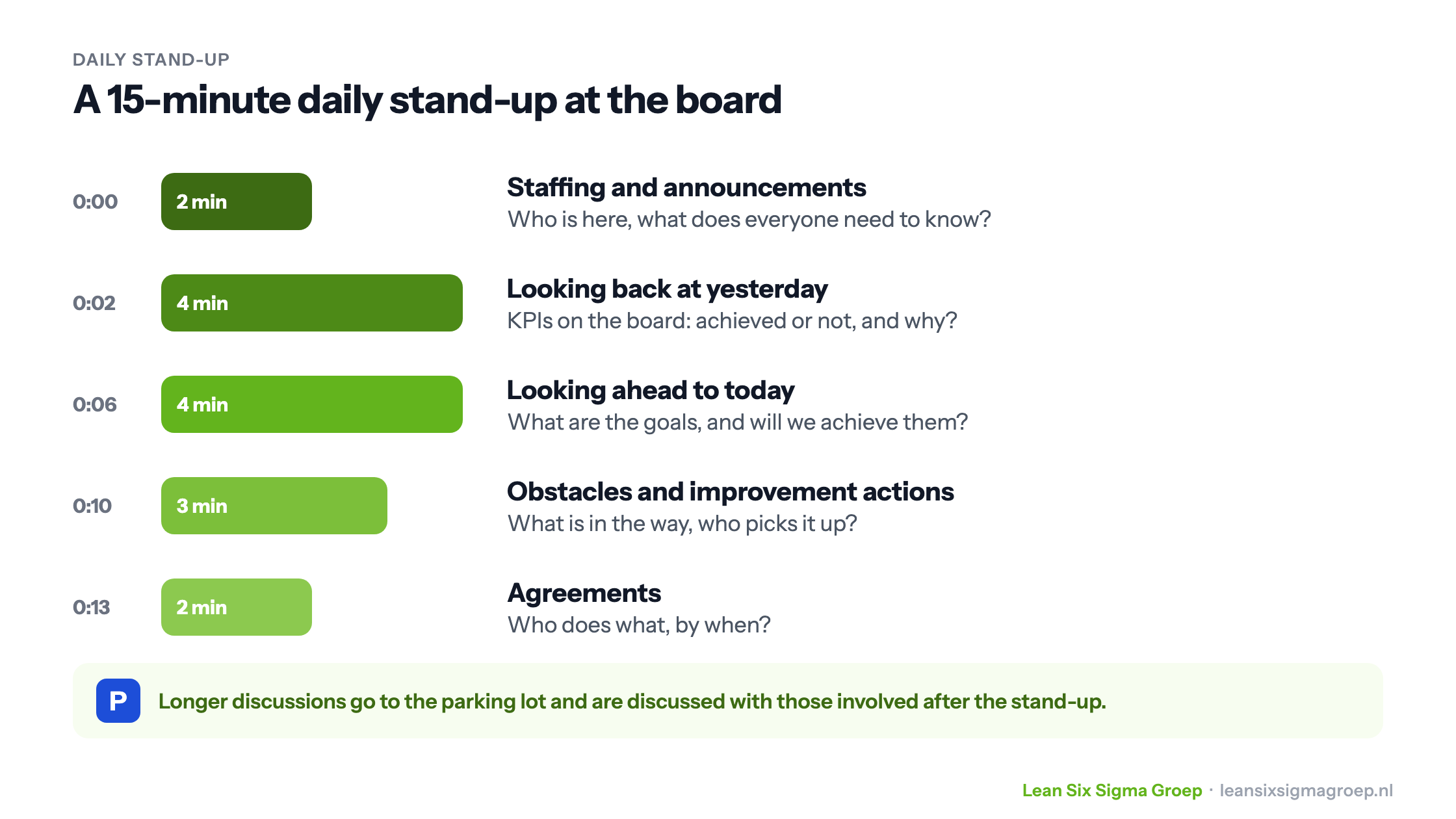
A daily stand-up is a short team meeting of no more than 15 minutes at the start of every working day. The team checks whether yesterday’s goals were met, what today’s goals are and what is getting in the way. That way you work on continuous improvement every day.
The image at the top of this article shows what those fifteen minutes can look like, item by item.
Characteristics of a daily stand-up
- Every day at the same time and place, at the board. That is how it becomes a habit.
- Standing up. That keeps the meeting short and the pace high.
- A fixed agenda that comes back every day.
- The chair rotates. That increases everyone’s involvement.
- It always goes ahead, even when team members are absent.
- No discussions. Anything that needs more time goes to the parking lot and is discussed straight after the stand-up, with only the people who need to be there.
The agenda
The agenda consists of fixed items:
- Staffing and announcements: who is here, and what does everyone need to know?
- Looking back at yesterday: were the goals met? What went well, what could be better?
- Looking ahead to today: what are the goals, and will we meet them with the people we have?
- Obstacles and improvement actions: what is in the way, and who picks it up?
- Agreements: who does what, and by when?
The team board
During the stand-up, the team stands at a board, also called a team board or improvement board. Someone fills it before the stand-up with the latest information: the KPIs and performance of yesterday or last week, the plan and the staffing. Improvement actions also get a place on the board, with who picks them up and by when, so they are not forgotten.
This is one of the tools you learn to apply in the Green Belt training.
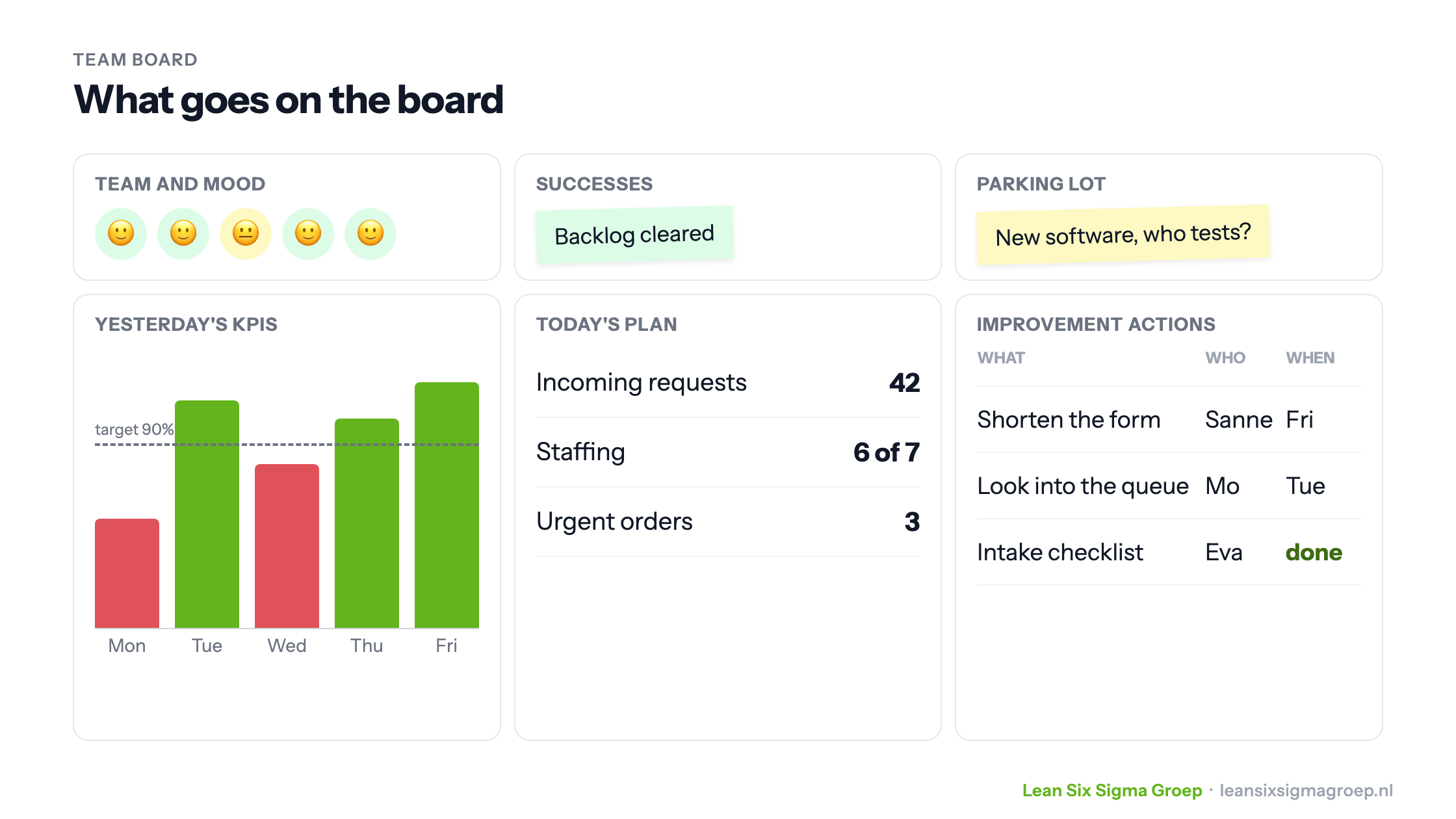
Keep the board simple and up to date. A board that nobody maintains becomes wallpaper within a few weeks. If KPIs are often red, tackle the biggest obstacle with an improvement cycle such as PDCA, or train the team in step-by-step improvement with Kata.
What does a daily stand-up deliver?
A daily stand-up increases employees’ involvement in their work:
- By talking briefly every day, everyone knows what the others are working on.
- The shared goal becomes clearer, which builds a stronger team spirit.
- Things that would otherwise go back and forth by e-mail are now settled face to face.
- It becomes more normal to ask each other for help.
- Problems come up the same day, instead of only once they have grown big.
Most importantly: everyone sees the shared goal of the team and the organisation, and works towards it every day. That makes the daily stand-up a fixed part of kaizen, improving every day.
Daily stand-up, weekly start and Daily Scrum
Besides the daily stand-up, many teams have a weekly start, in which they look a little further ahead at the goals and plan for the week. Teams that work with Scrum have the Daily Scrum: also no more than 15 minutes, in which the developers review progress towards the sprint goal and adjust their plan for the coming day. The idea is the same: align briefly and with focus every day.