Design Thinking is an iterative process for solving complex problems, also known as wicked problems. It puts the user and their needs first: Design Thinking is about understanding the people you are developing a product or service for.
Why Design Thinking?
It sounds logical to put the customer’s needs first, but in practice it often doesn’t happen. People are strongly inclined to think in patterns and assumptions.
It is extremely hard to set those assumptions aside and arrive at innovative solutions from a user’s needs. That is why Design Thinking is often called ‘outside the box thinking’: you break away from the usual ways of solving problems.
Design Thinking is both a way of thinking and working and a collection of practical methods that help you explore new alternatives and so arrive at better solutions.
This is one of the tools you learn to apply in the Green Belt training.
The five phases of Design Thinking
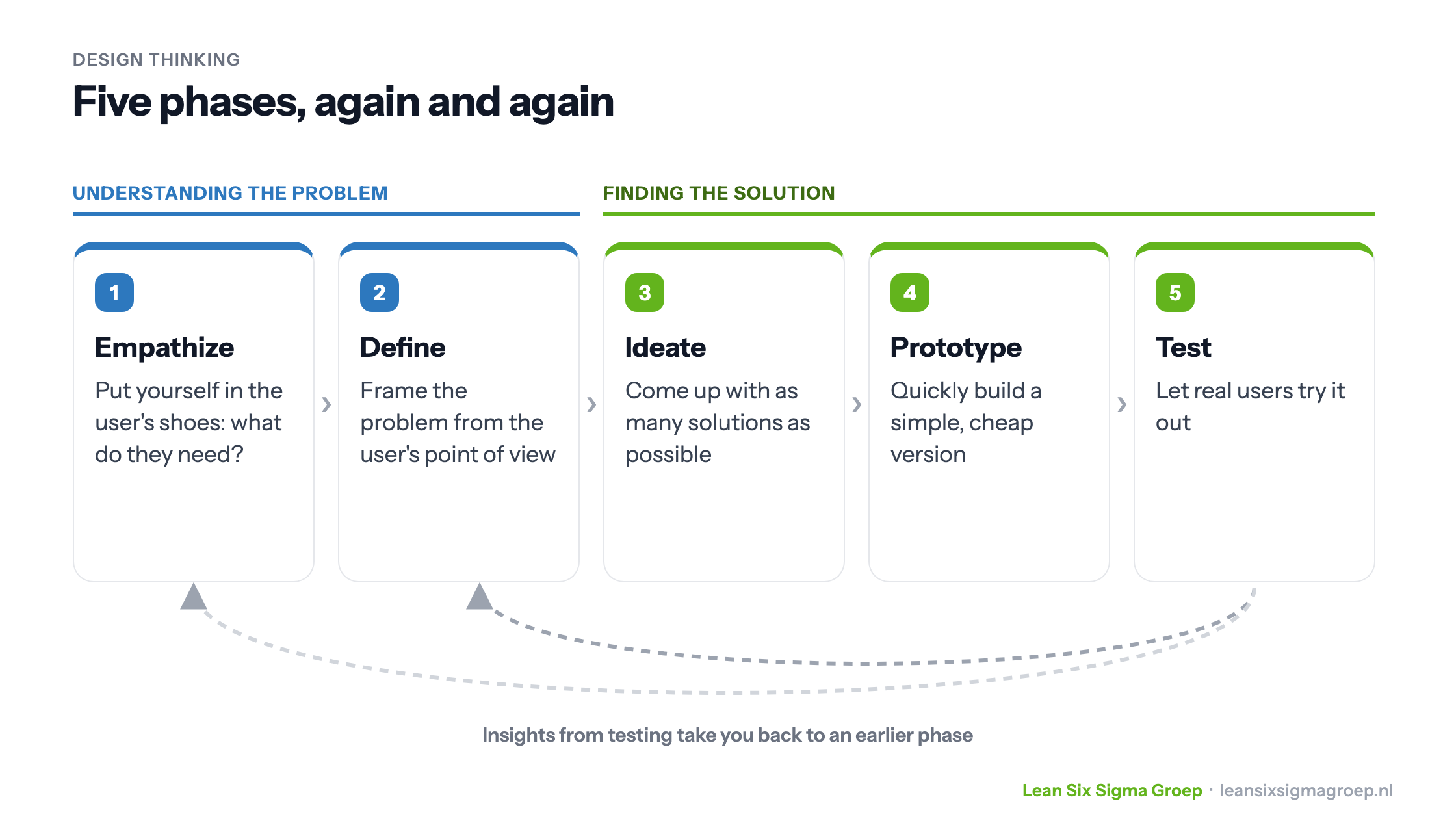
The best-known model, from the d.school at Stanford University, has five phases. The first two are about understanding the problem, the last three about finding the solution.
- Empathize: put yourself in your users’ shoes. Research their wishes and needs: what do they struggle with? In this phase you stay away from solutions and really get to grips with the problem.
- Define: define the problem. By interpreting the findings from the Empathize phase and recognising patterns, you formulate the user problem you want to solve. At the end of this phase you have a clear problem statement, framed from the user’s point of view. Then you can start coming up with solutions.
- Ideate: generate as many solutions to the problem as possible. Common techniques are brainstorming sessions, blue-sky thinking and ‘Crazy Eights’, in which you sketch eight ideas in eight minutes.
- Prototype: in this phase, learning and experimenting come first. Quickly make a few simplified, cheap versions of your idea, such as a paper sketch, a mock-up or a simple model. It is about something you can show and try out, not a description. This brings limitations and flaws to light early, so you can accept, improve, redesign or reject an idea. You get a picture of how users respond to the solution, in behaviour, feeling and thinking.
- Test: let real users try out the product or service. Although this is the last phase, it is often not the end. The results often lead back to an earlier phase, with insights to sharpen the problem statement or come up with new ideas. That makes Design Thinking an iterative process, in which you keep testing and experimenting together with the user until you have a good solution.
In short, Design Thinking helps you dig a little deeper and find new ways to improve the user experience.
In the video at the top of this article, Design Thinking pioneer Tim Brown of IDEO discusses the value of Design Thinking for solving complex challenges in his 2009 TED talk.
An example of Design Thinking: Airbnb
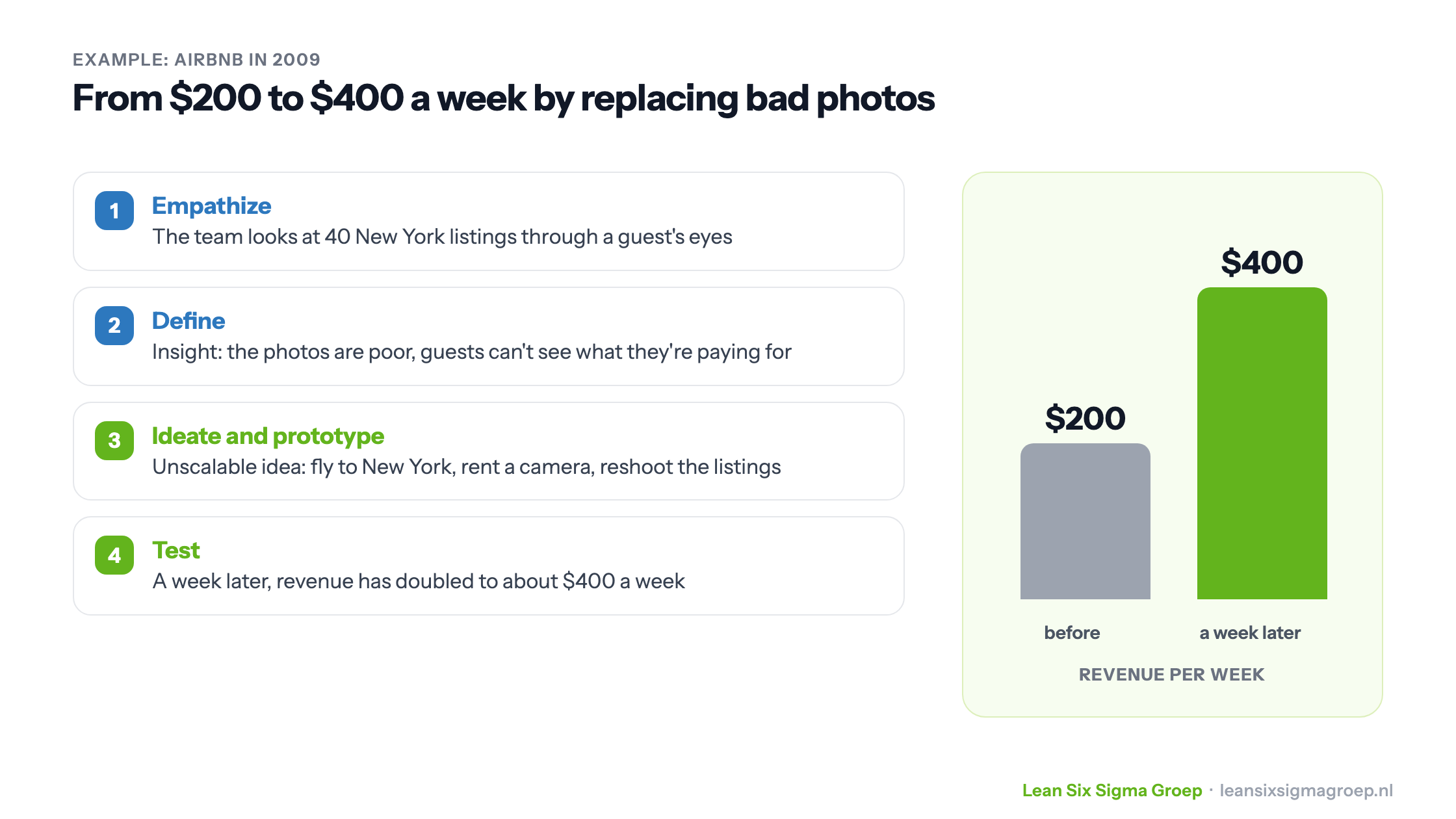
In 2009, Airbnb was on the brink of bankruptcy. Revenue was about $200 a week, split between three young founders in San Francisco.
One afternoon, the team sat down with Paul Graham of the startup programme Y Combinator to look at the New York listings, to understand what wasn’t working and why they weren’t growing.
After a while, co-founder Joe Gebbia had an important insight: “We noticed a pattern in these 40 listings. The photos were bad. People used their phone cameras or pictures from classified sites. It was no surprise nobody was booking: you couldn’t even see properly what you were paying for.”
Learning and experimenting
Graham suggested a completely unscalable, non-technical solution: travel to New York, rent a camera, spend time with the hosts and replace the amateur photos with beautiful high-resolution ones. The team took the next flight to New York and did exactly that.
There was no data to back up this decision. They just went and did it. A week later the results were in: revenue had doubled to about $400 a week. It was the first financial improvement in more than eight months. They knew they were onto something.
Gebbia later said the team initially believed that everything they did had to be scalable. Only when they gave themselves permission to experiment with unscalable ideas did they climb out of what they called the ’trough of sorrow’: the dip in which many startups get stuck.
From theory to practice
Learn to apply this in practice
Topics like Design Thinking are applied directly to an improvement project from your own organisation in the Green Belt training.
Next start dates
Lean Six Sigma Green Belt training →Not ready for a training yet?