Managing emotions is the ability to recognise and understand your own emotions and those of others, and to deal with them well. At work this is often forgotten: we prefer to keep things “businesslike”. But emotions can’t be pushed away, and they play a big part precisely in change and improvement projects.
“Let’s keep this businesslike.”
“Save your emotions for home.”
Sound familiar? Whether it is said out loud or not, this is how many organisations deal with emotions. It seems we are a little afraid of them: of other people’s emotions, and perhaps of our own too. We would rather control ourselves, and we expect the same of others: that they behave like a professional.
That doesn’t work, of course. And actually we shouldn’t want it to.
Three reasons to give emotions room at work
1. Emotions behave like toddlers
If they want attention and don’t get it, they start whining. They cling to your trouser leg, jump in front of you, or throw themselves screaming on the supermarket floor. Emotions do that too, though usually less visibly. The longer you ignore them, the more energy it costs: in thoughts that distract you from the conversation, in a headache that lasts all afternoon, in sleepless nights. Suppressing your emotions structurally can lead to physical and mental complaints, and eventually to burnout.
2. Emotions provide useful information
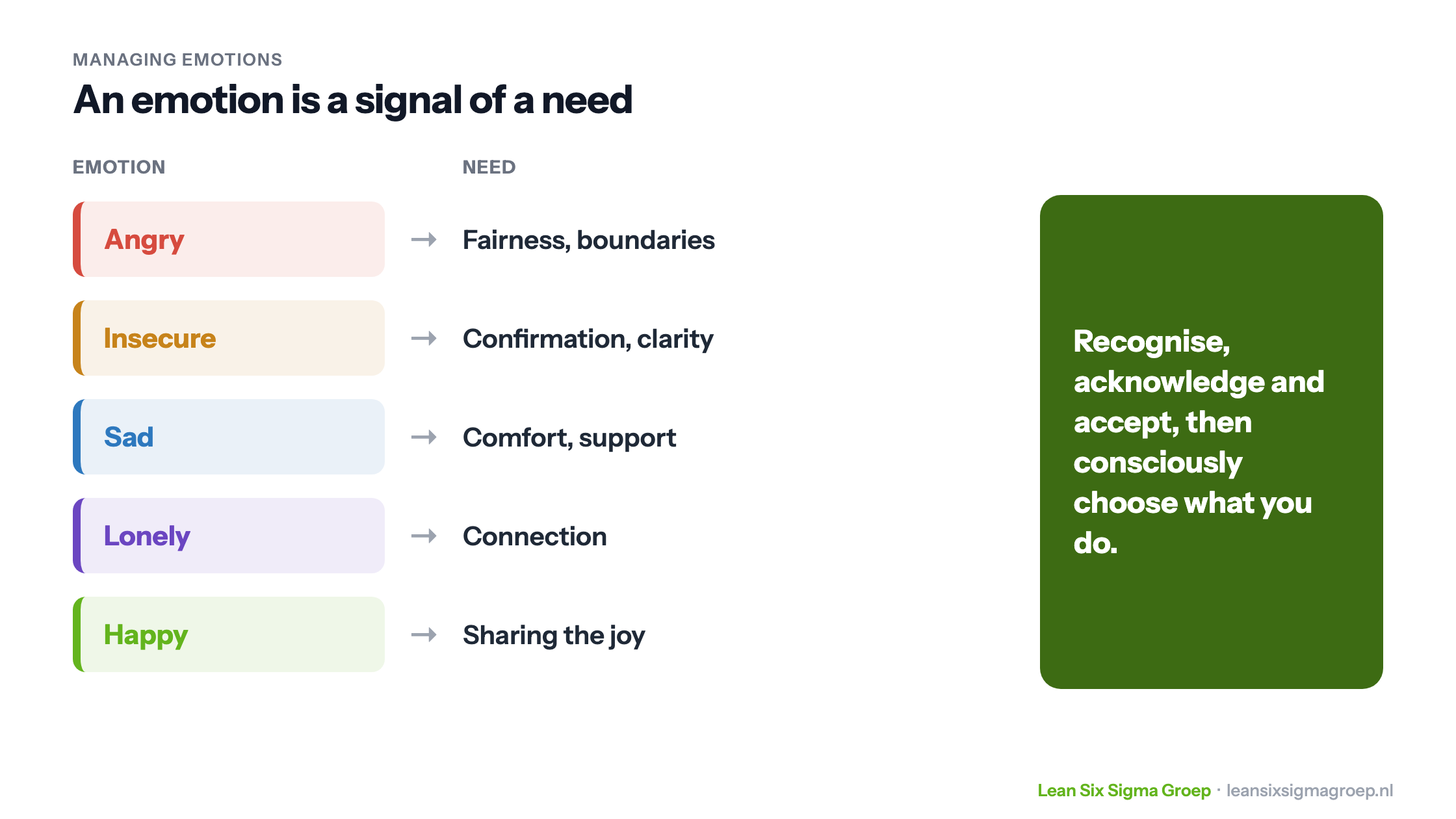
An emotion is a signal of a need, as shown in the image at the top of this article. We get angry when something seems unfair, insecure when we seek confirmation, sad when we need comfort, lonely when we miss connection, and happy when we want to share our joy. Those who learn to recognise, acknowledge and accept their emotions know better what they need, and can shape their work accordingly.
3. Emotions give meaning to work
A life without emotion is flat and colourless. However rationally we approach our work, we are all driven by the meaning we find in what we do. Emotions give depth to our experiences at work and to our relationships with colleagues.
More room for emotions doesn’t mean chaos with crying and shouting people. On the contrary: it is an environment where you may feel everything, but consciously choose how you behave.
Emotional intelligence
The psychologists Peter Salovey and John Mayer introduced the concept of emotional intelligence in 1990: the ability to perceive, understand and regulate emotions. Daniel Goleman brought it to a wide audience in 1995. The good news: it is not a fixed trait. You can develop it, through practice.
Giving emotions a place
We often find emotions difficult because they take a place that doesn’t suit them. They sit at the wheel and determine our behaviour, when a seat in the back would have been better. As a result we sometimes regret things afterwards, and others are taken aback. That is not the emotion’s fault, but how we deal with it. Seeing the emotion as information lets you then choose how to respond. That is called emotion regulation, and it works in four steps.
This is one of the tools you learn to apply in the Green Belt training.
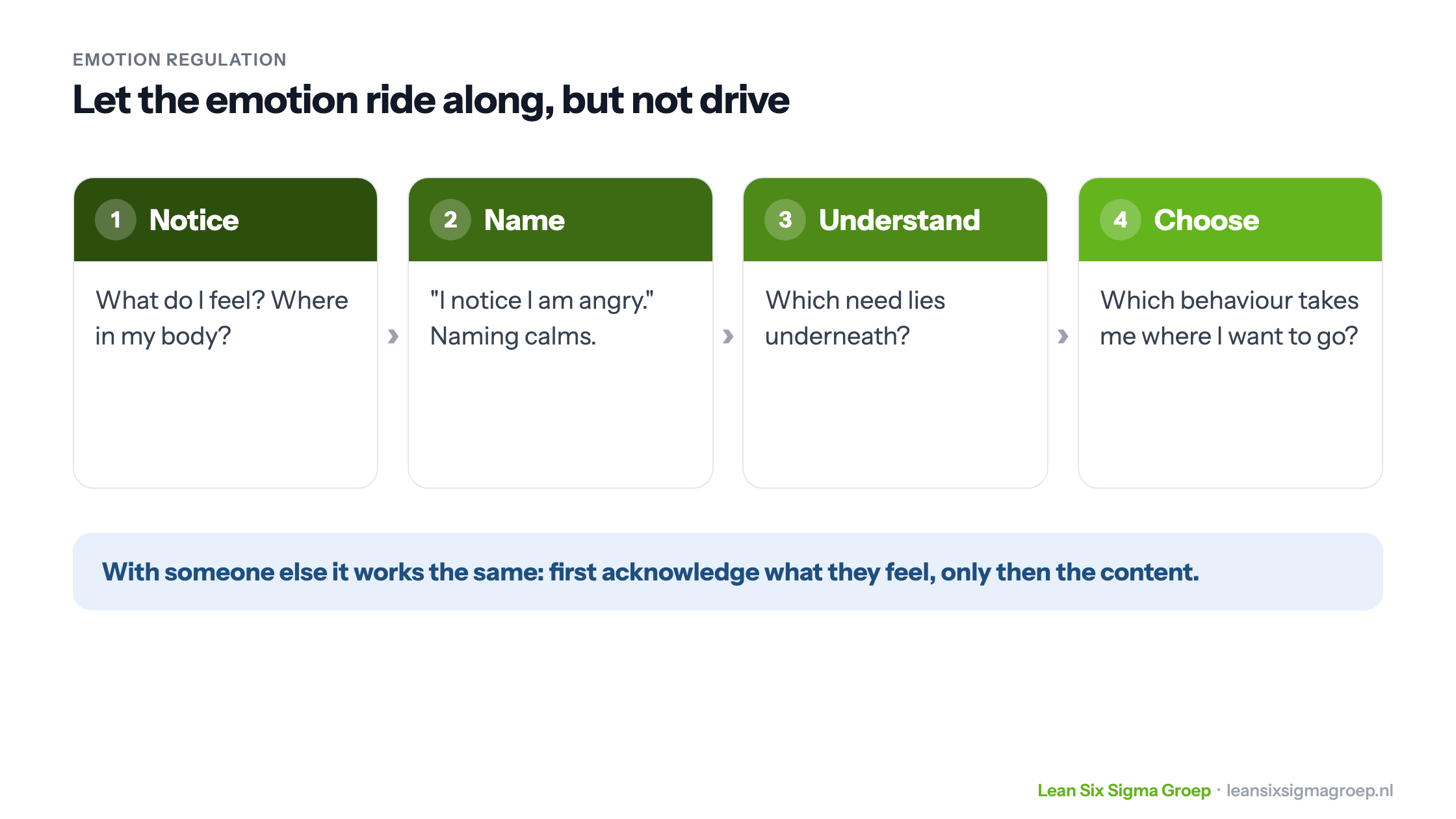
- Notice. What do I feel, and where do I notice it in my body?
- Name. “I notice I am angry.” Research shows that naming an emotion already calms it a little.
- Understand. Which need lies underneath?
- Choose. Which behaviour takes me where I want to go?
Giving emotions room therefore doesn’t mean stomping down the corridor or carrying a box of tissues all day. It means noticing what is going on, in yourself and in the other person, seeing it as information, and acting on it consciously. That brings you closer to yourself, and therefore to others.
Emotions and change
Every improvement project changes something about people’s work, and that triggers emotions: uncertainty, opposition, sometimes relief or enthusiasm. Dismissing those emotions as “resistance” means missing the information they contain. First acknowledge what someone feels, and only then discuss the content. Read more in change management and Lean leadership.
A team in which people dare to say what they feel and think, without fear of the consequences, also improves better. Amy Edmondson calls this psychological safety.
Want to know more?
Read more about what an Agile Coach does: guiding people through change with empathy, before, during and after it.