Stakeholders can make or break an improvement project. Whether a change works depends not only on the quality of the solution, but also on its acceptance: the change management side. A stakeholder analysis maps who has influence, how those people feel about the change, and what it takes to bring them along.
How not to do it: a personal experience
Still blushing, I will give an example of how not to do it. Perhaps for amusement, but mostly as a lesson.
I was running an improvement project at a bank. The aim was to contribute to more satisfied employees, partly because they perform better. On an earlier project I had come across a nice tool for measuring, analysing and improving employee satisfaction. Hastily, as it later turned out, I decided to introduce it at the bank too.
I had not asked the department managers who would have to work with it for input, let alone involved them. I only met most of them on the day I presented the tool to them. You can guess the outcome: mainly resistance. The managers wondered, rightly as I now know, why they, as important stakeholders, had not been involved. I have rarely felt so uncomfortable, but I learned a valuable lesson.
What is a stakeholder?
The definition I use in training: stakeholders are all the people who influence the change, or are affected by it. So not only the sponsor and the managers, but also the employees who will work differently, other departments, customers and sometimes the works council.
A stakeholder analysis in four questions
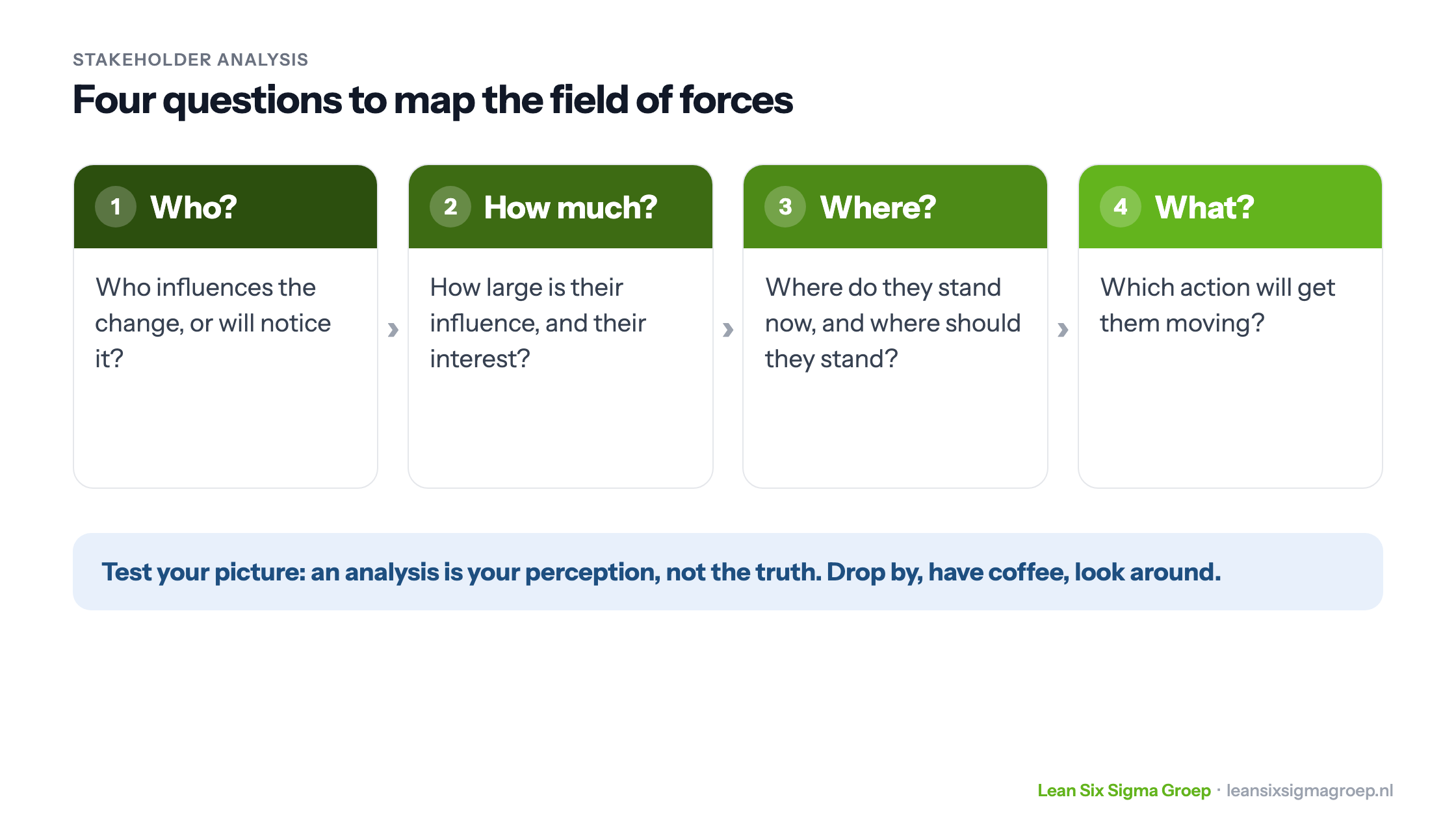
A stakeholder analysis answers four questions, as shown in the image at the top of this article:
- Who? Who influences the change, or will notice it? Better to make the list too long than too short.
- How much? How large is their influence, and their interest? Place them in an influence-interest grid, as explained in stakeholder management. Those with high influence and high interest you involve closely.
- Where? Where does each stakeholder stand on the change now, and where do they need to stand for it to succeed? The overview below makes that visible.
- What? Which action will move them from where they are to where they need to be?
This is one of the tools you learn to apply in the Green Belt training.
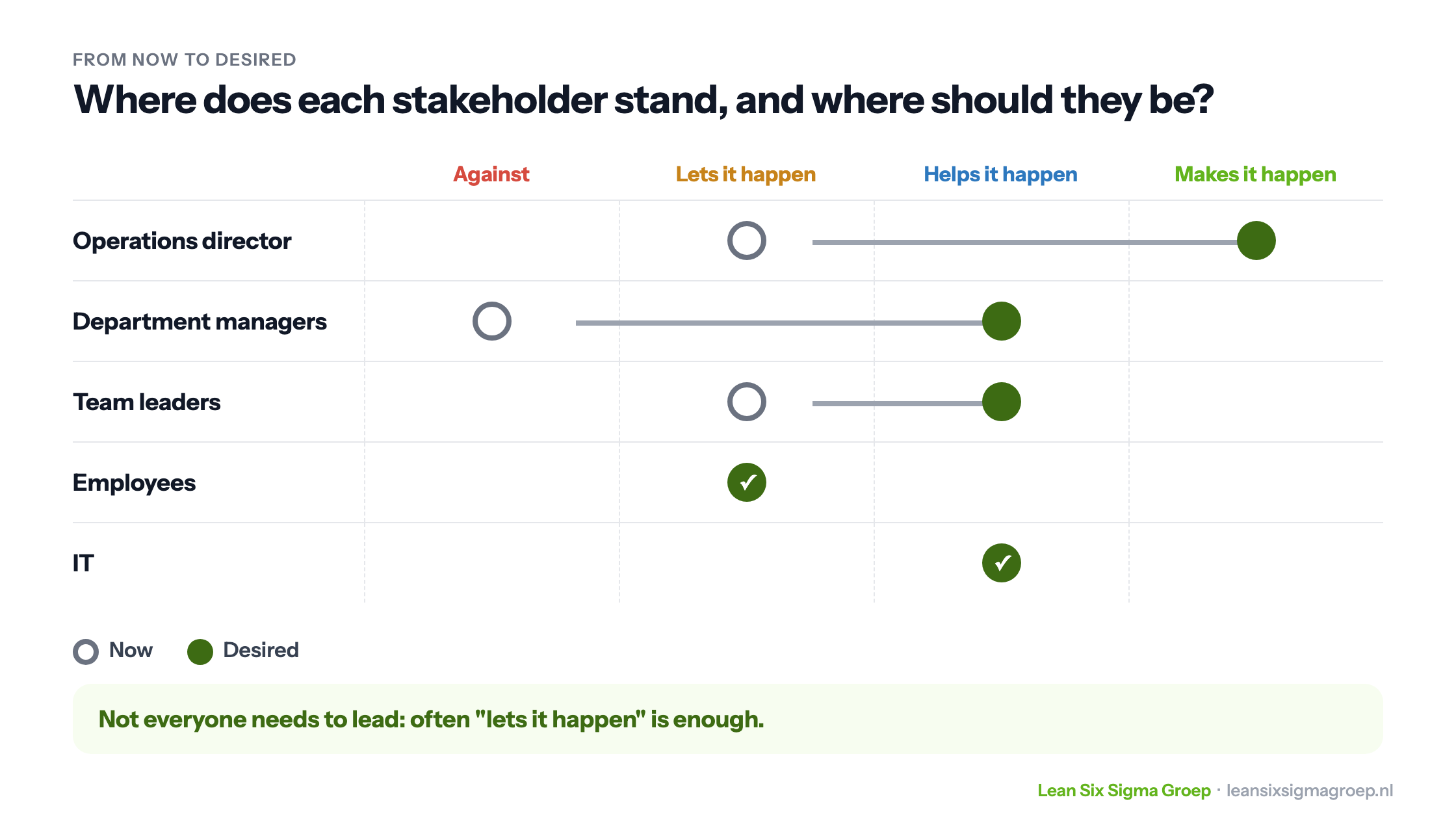
Not everyone needs to lead the way. For most people it is enough that they let the change happen. Focus your energy on the gap between now and desired, and above all on those with a lot of influence.
A stakeholder analysis requires knowing the ground: how do things really work in the department where the change takes place? A Gemba walk helps. Go and see where the work happens beforehand, sense the atmosphere and the relationships, watch and listen.
3 tips for a stakeholder analysis
1. Test your picture
A stakeholder analysis is often a perception: how you think someone feels about the change. That is your truth, not the truth. So test it. Have a chat, go for coffee, and look at behaviour rather than assumptions.
2. Find out what kind of resistance it is
Not all resistance is resistance. A useful distinction: people don’t know (they lack information), can’t (they lack skills or resources) or don’t want to (they disagree or see a disadvantage). Each kind needs a different approach: informing, training or having the conversation.
Resistance on content, from people who disagree with good arguments, has more than once proved very welcome to me. It often makes the solution better.
3. You don’t have to solve everything yourself
A good analysis shows not only opponents but also supporters. Use them. If one director seems against and the other in favour, let the second talk to the first. They probably talk anyway, they work at the same level, and one may accept something more easily from the other than from you. It saves you time as well.
Keep doing it
You don’t make a stakeholder analysis only at the start of a project. Few things are as changeable as an opinion: supporters can cool off, and opponents can become your biggest promoters. So revisit it regularly.
Managing stakeholders is not just an obligation. It is also enjoyable and instructive to explore the objections others have to your improvement project. That way you are even better prepared for the next change.