
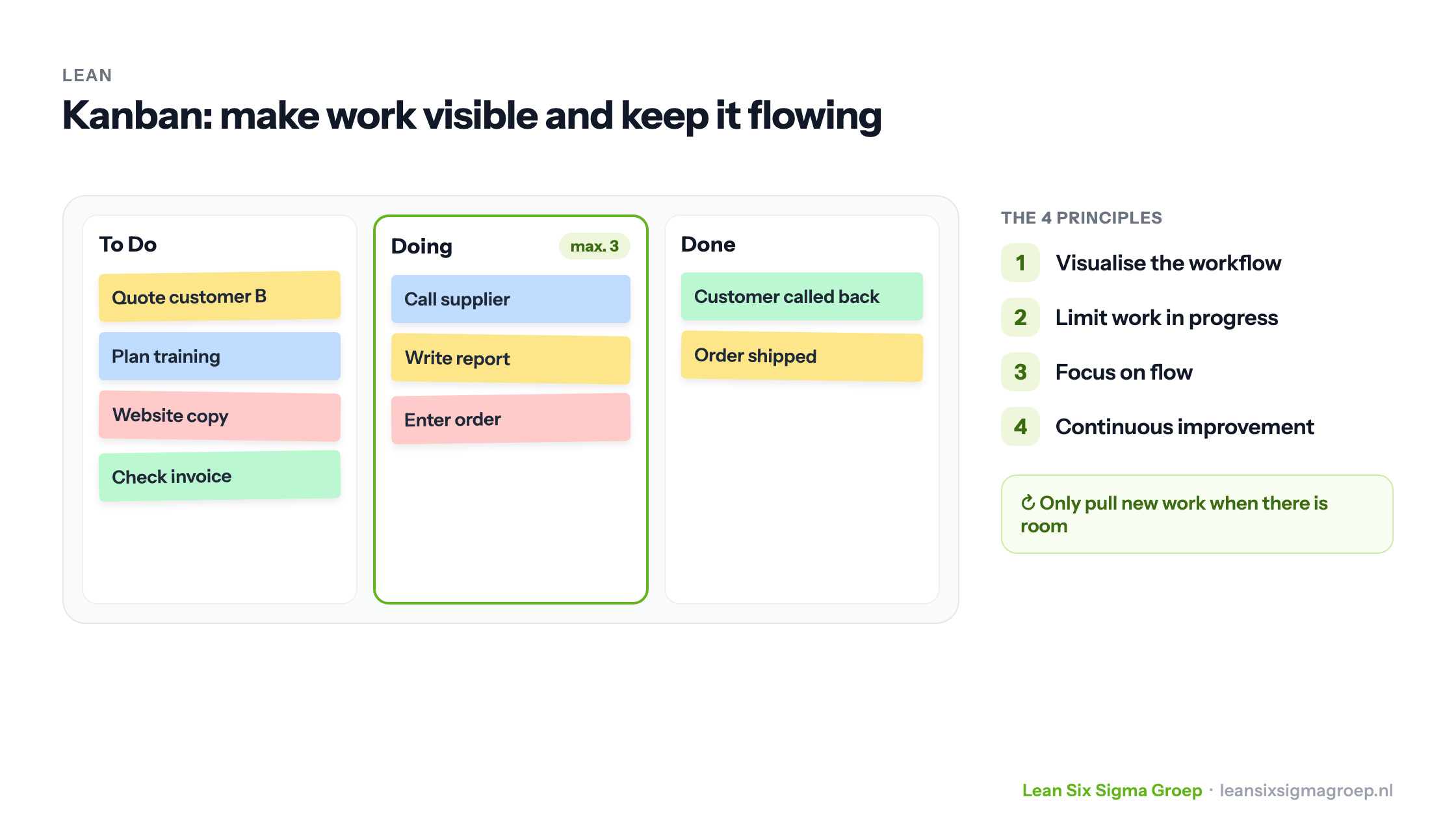
Kanban is a visual system for managing work as it moves through a process. The Kanban method visualises both the process (the workflow) and the actual work passing through that process. The aim of the method is to identify and resolve potential bottlenecks in the process, so that work can flow through it cost-effectively at an optimal speed or throughput. It is a concept used in Lean manufacturing and just-in-time production.
Even if you have never taken a Lean training course, there is a fair chance you already use Kanban. A Kanban system (from the Japanese kan, ‘visual’, and ban, ‘card or board’) is a way of signalling, in the most logical manner possible, that something needs to happen.
The origins of Kanban
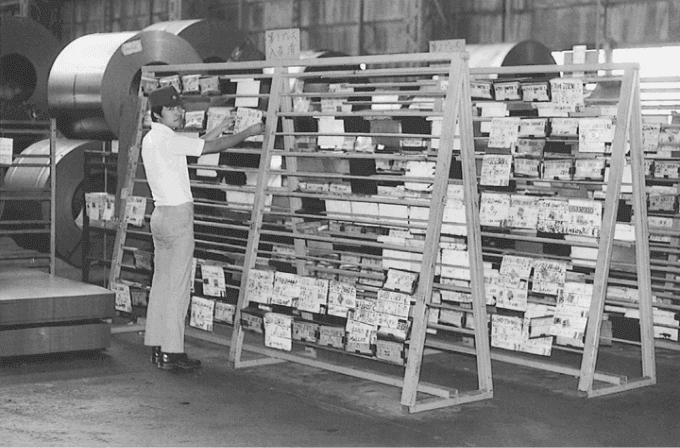
 Like so many Lean tools, Kanban was invented on the assembly line at Toyota. The first Kanban system was developed by Taiichi Ohno (industrial engineer and businessman) for Toyota automotive in Japan. In the mid-1950s, crates of parts were delivered there to the workers in the process who assembled the cars. Because of shortages (of almost everything, so soon after the Second World War), there was a pressing need to keep inventory in the production process low. The crates were therefore filled with only a few parts, but from several different suppliers.
To avoid burdening those suppliers and the organisation itself with needlessly complicated ordering processes, the Kanban card was invented. This card, attached to the outside of the crate, stated exactly how many of which parts each supplier had to put in the crate. The crates therefore contained not only the exact number of parts, but also precisely the right mix.
This method also let the worker in the production process see how long it took to use up the crate, have it refilled and get it back. That was valuable management information about turnover rate, and therefore about the use of working capital, which, you guessed it, was also in short supply.
What is the Kanban method?
The 4 core principles of the Kanban method are:
- Visualise the workflow
- Limit work in progress
- Focus on flow
- Continuous improvement
Although the Kanban method was introduced by Taiichi Ohno in manufacturing, it was David J. Anderson who first applied the concept to IT, software development and knowledge work in 2004. David built on the work of Taiichi Ohno, Eli Goldratt, W.
Edwards Deming, Peter Drucker and others to define the Kanban method, using concepts such as pull systems, queuing theory and flow. His first book on the subject, “Kanban: Successful Evolutionary Change for Your Technology Business”, published in 2010, is the most comprehensive definition of the Kanban method.
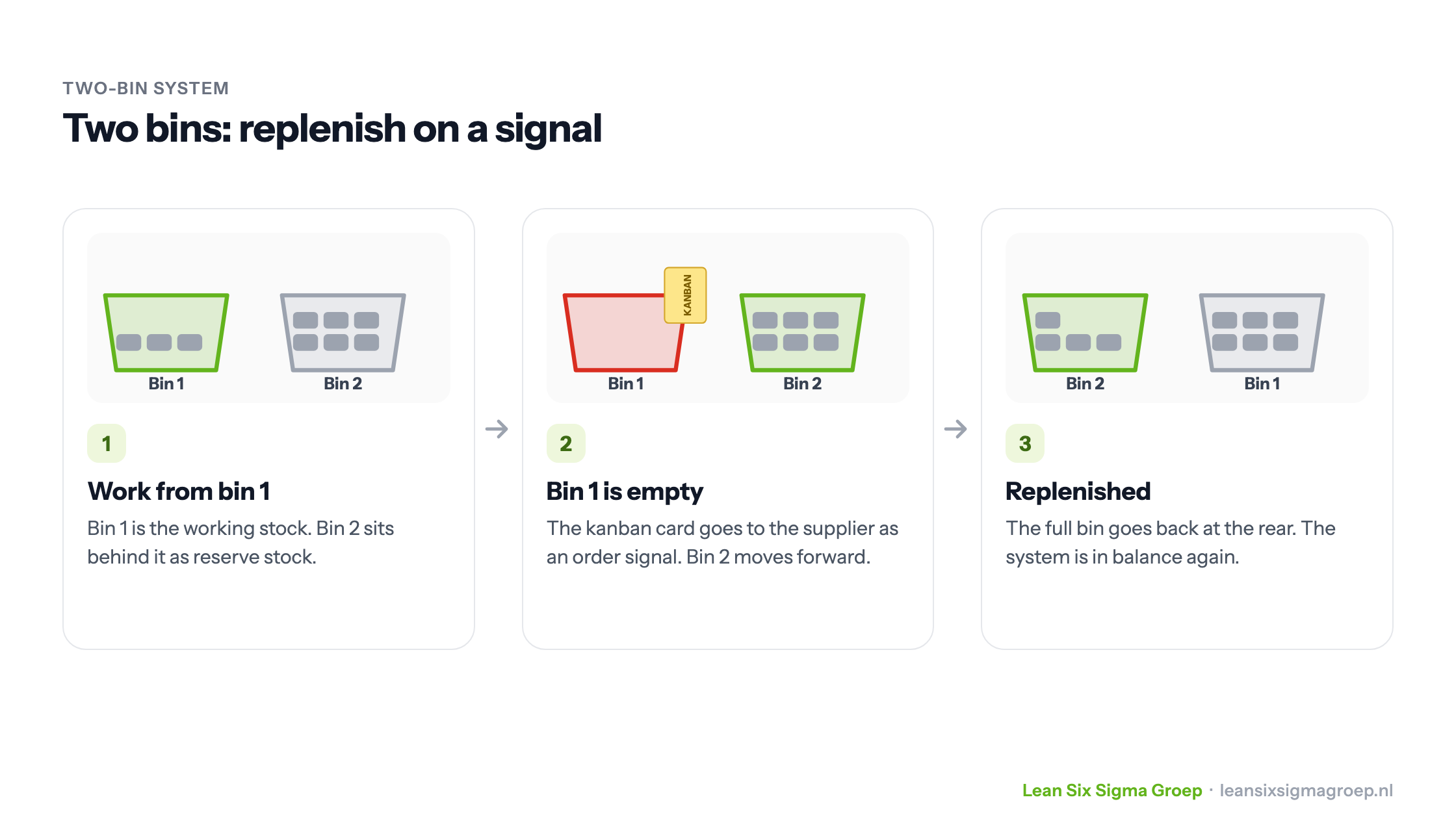
Kanban is used in various forms. One form of Kanban is the two-bin system. The first bin holds the working stock used for production.
The second bin holds a reserve stock. As soon as the first bin is empty, the Kanban is taken out of the bin and used as the signal to replenish. The second bin now moves forward.
Once replenishment has taken place, the system is back in balance. As soon as the second bin is empty, replenishment starts again using the Kanban card that always stays in the bin.
Kanban has been developed further and is now also used in digital form to give signals (for example in Trello).
How does the Kanban board work?
The first step in introducing Kanban is visualising the workflow. This is done with a Kanban board made up of a simple whiteboard and sticky notes (Post-its) or cards. Each card on the board represents a task.
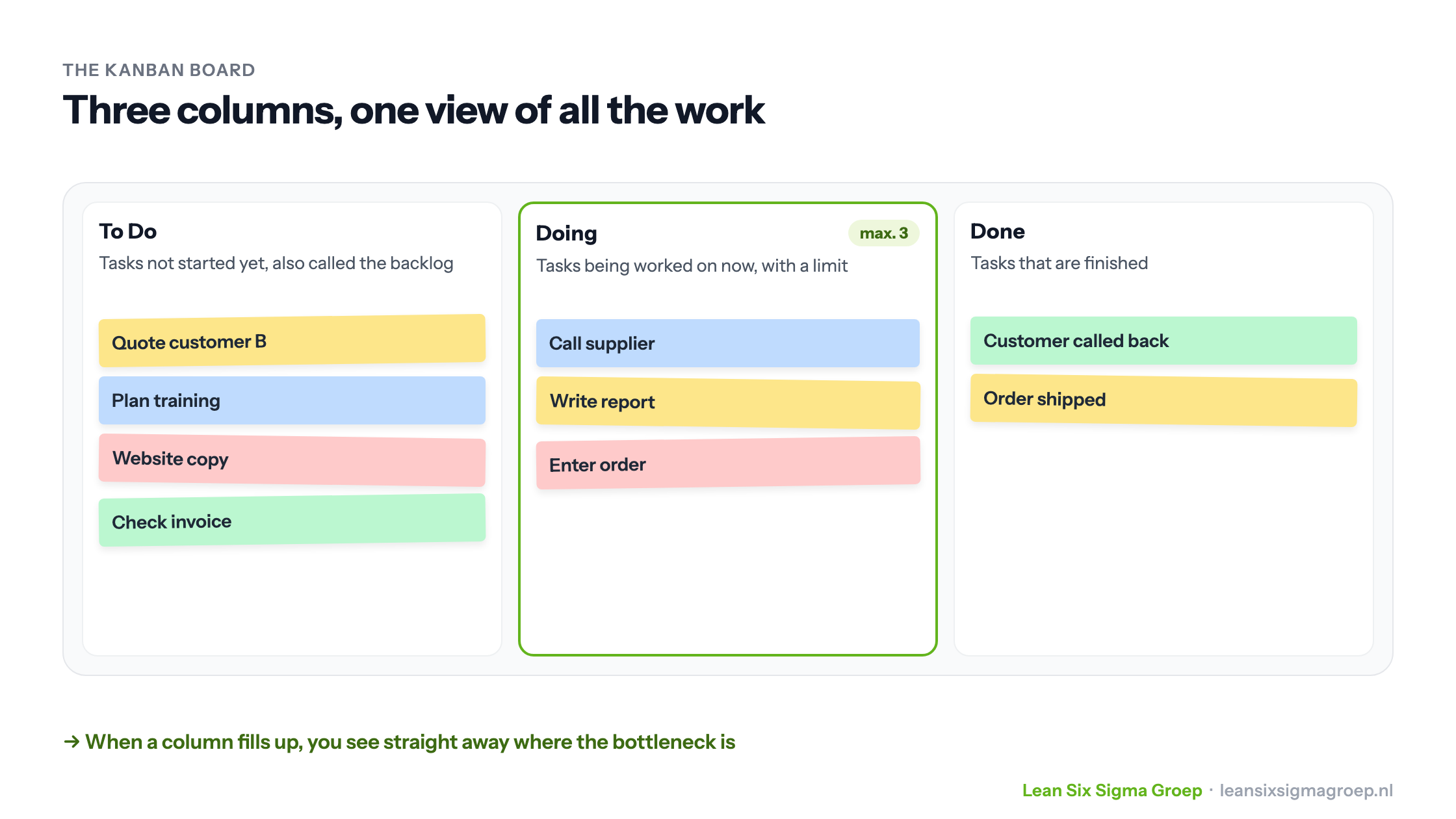
A classic Kanban board has three columns, as shown in the image above:
“To Do”: this column holds the tasks that have not yet started (also known as the “backlog”).
“Doing”: holds the tasks that are in progress.
“Done”: holds the tasks that have been completed.
This simple visualisation alone creates a great deal of transparency about how the work is distributed and where any bottlenecks lie. Kanban boards can, of course, show elaborate workflows, depending on how complex the workflow is and on the need to visualise and examine specific parts of it to identify bottlenecks and remove them.
The concept of FLOW
At the heart of the Kanban method is the concept of “flow”. This means the cards should move through the system as evenly as possible, without long waiting times or blockages. Anything that hinders the flow should be examined critically.
Kanban has various techniques, metrics and models, and when these are applied consistently they can lead to a culture of continuous improvement (kaizen).
The concept of flow is crucial. By measuring and improving flow metrics, you can dramatically increase the speed of your delivery processes, while shortening cycle time and improving the quality of your products or services by getting faster feedback from the customer, internal or external. These metrics are covered in depth in the book “Actionable Agile” by Dan Vacanti.
Kanban, Agile and Lean
The Kanban system is a concept related to Lean and just-in-time (JIT) production, where it is used as a scheduling system that tells you what to produce, when to produce it and how much to produce.
Where are Kanban systems used?
The beauty of Kanban is that it can be applied to any process or method. Whether you already use Agile methods such as Scrum, XP and others, or more traditional methods (waterfall, iterative and so on), you can apply the Kanban system on top to improve processes gradually, reduce cycle time and improve flow.
Along the way, you are on the path to continuous delivery of features, products or services.
Kanban in manufacturing
Kanban has its origins in manufacturing environments, and it is still used there to this day, albeit increasingly with the help of workflow management systems. The Kanban system lets production teams visualise the production flow and make sure every stage runs smoothly. With Kanban, teams can identify bottlenecks, shorten lead time and improve overall efficiency.
Kanban in logistics
In the logistics sector, Kanban can be a valuable tool for streamlining the workflow. It can be used to optimise inventory management and shorten order lead times. By implementing a Kanban system, logistics companies can better forecast demand for materials and products and make sure there is enough stock available to meet customers’ needs.
Kanban in software development
Kanban has had a major impact on the software development sector. A Kanban board lets development teams track tasks visually and see their progress through different stages, such as “to do”, “in progress” and “done”. This helps to identify bottlenecks and optimise the workflow.
What’s more, by assigning limits to each column, teams can manage their workload better and prevent overload.
Kanban in marketing
Kanban can also be applied effectively in marketing. Marketing teams can use Kanban to manage campaigns and projects. The Kanban board can be used to track the progress of various marketing activities, such as creating content, designing ads and planning events.
This lets the team set clear priorities and make sure every task is completed on time.
All in all, Kanban enables every principle of the Agile Manifesto and helps deliver the products and services your market actually needs. Rooted in the principles of Lean, Kanban provides a pull mechanism. Whether you use Lean, Scrum or other Agile techniques or methods, Kanban helps improve processes for better performance of teams and organisations.