Change management is the discipline of preparing, equipping and supporting people so they can carry out a change successfully. Because whether a change succeeds ultimately depends on the behaviour of the people going through it.
Ask anyone whether they are open to change, and the answer will probably be: “Of course, standing still means falling behind.” So how is it that so many change programmes fizzle out? We often look for the cause in the tools (the new system doesn’t work), in management, or in the consultancy that “never really understood our culture”.
People make or break it
What all those explanations have in common is that they are about people. Whether a change succeeds is decided by the human factor. From a new work instruction to a complete culture change: people’s behaviour is the yardstick.
Every change and every person is unique. Even so, decades of research show that you can help people move from the current to the new situation. Change management offers a structured approach for that.
History of change management
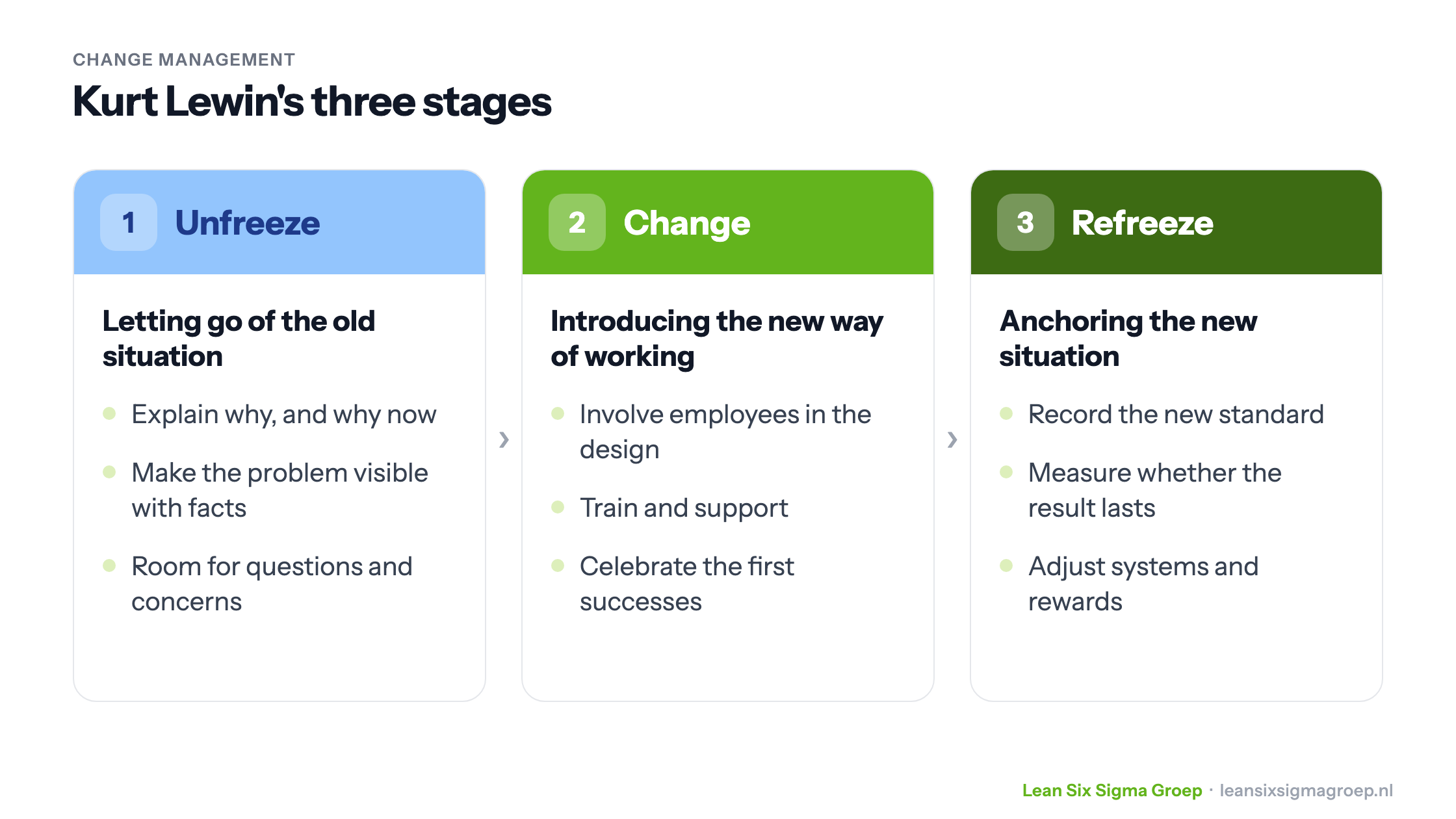
As early as the 1940s, psychologist Kurt Lewin described change in three stages: unfreeze, change and refreeze. The image at the top of this article shows them, with what you can do in each stage. Lewin mainly looked at how people and groups go through change, not yet at organisations as a whole.
As a discipline for organisations, change management only emerged in the 1990s. Globalisation and rapid technological development made managing change crucial. Books such as John Kotter’s “Leading Change” and Spencer Johnson’s “Who Moved My Cheese?” were widely read. At General Electric, Jack Welch set major changes in motion in those years, and had his leaders develop methods to guide change across the whole company.
When the discipline emerged, there were three main schools of organisational change:
- Lean, focused on efficiency and removing waste;
- business process reengineering, focused on radically redesigning processes and structures;
- sociotechnical systems, focused on how people and organisation work best together.
Knoster’s model for managing complex change
Knoster’s change model, based on Mary Lippitt’s Managing Complex Change model (1987), shows that a successful change needs a number of conditions: a clear vision, the right skills, incentives to take part, sufficient resources and an action plan. If one is missing, you see it in behaviour. Without vision there is confusion, without skills anxiety, without incentives resistance, without resources frustration, and without an action plan a false start.
So from the behaviour you see, you can reason back to what is missing. Like any model it is a guide: practice is messier, and every organisation and team is different. Keep observing behaviour, without judgement, and look for the underlying need.
How do you bring employees along?
An organisation often comes up with a good solution, but doesn’t bring employees along enough. Then the change fails after all. The effect of a change is the quality of the solution times its acceptance (E = Q × A). Acceptance is just as important as quality.
What you can do to increase acceptance:
- create a sense of urgency;
- give employees a say and create ambassadors;
- pay attention to employees’ emotions;
- make sure every management layer supports the change;
- give employees the knowledge and support they need.
A sense of urgency
Employees need to understand why things are changing, and why now. That last question matters especially when a problem has existed for a long time: why tackle it now, and not last year or next year?
Be transparent. Explain why the change was chosen, without a marketing gloss, and be honest about what you do and don’t know yet. Change is unsettling, but open communication builds trust, and that increases acceptance.
Creating urgency takes time. Nobody feels the need after a single information session. So repeat the why regularly, even after the change has been made.
A say and ambassadors
Change is most unsettling when you feel you have no say in it. So give some employees a say, preferably early in the process, so they can help shape it. You can also involve them later, when testing the solution.
People who have a role in the change feel ownership, and that increases acceptance. These employees can also act as ambassadors on the shop floor. An explanation of what the new work looks like often lands better from a colleague than from a manager. The why and how of the change itself should come from the manager.
Attention for emotions
A change is also a farewell: you let go of how things are and have to get used to something new. The change curve below shows the stages people often go through. It is derived from the stages of grief described by Elisabeth Kübler-Ross.
This is one of the tools you learn to apply in the Green Belt training.
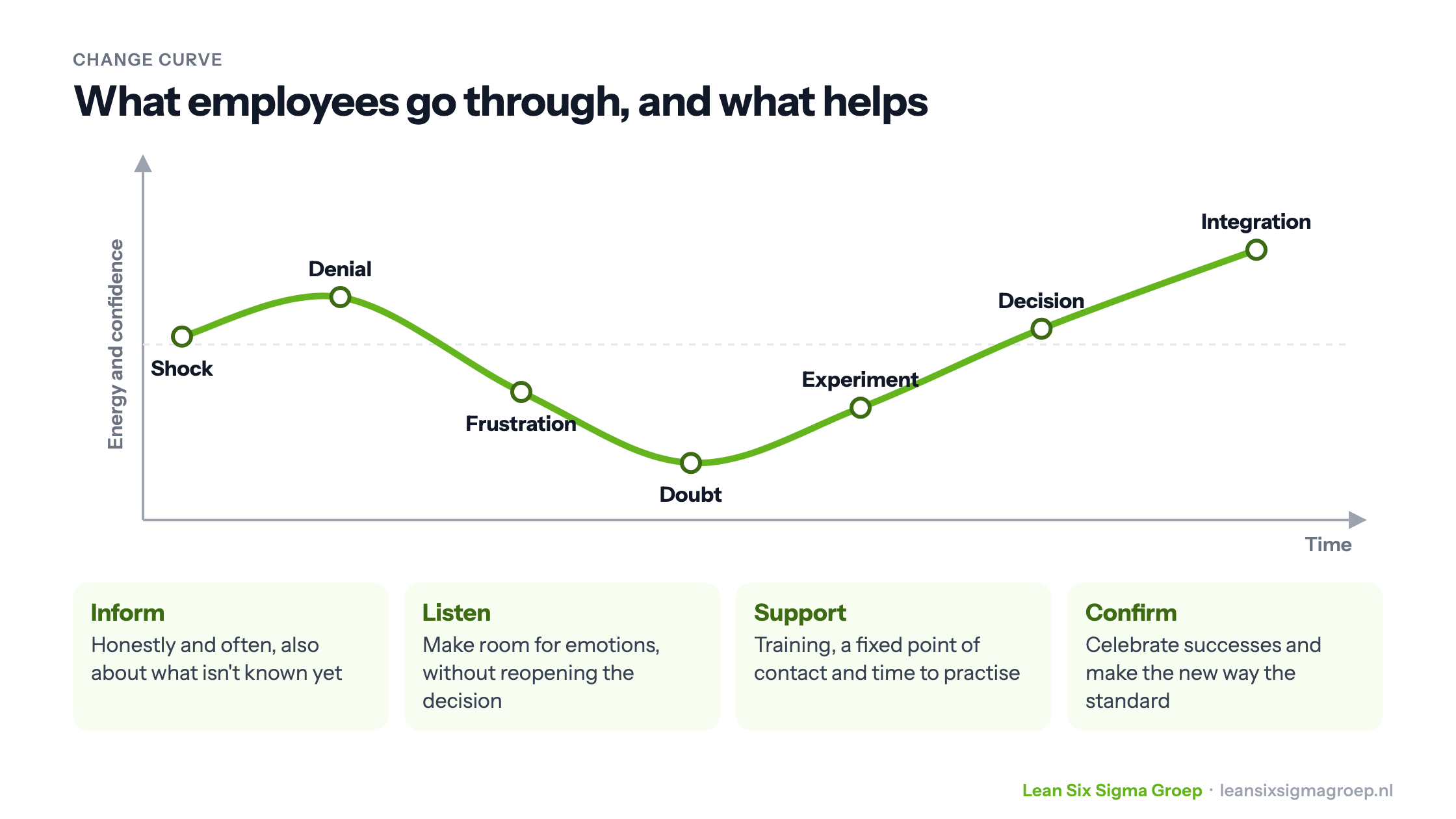
Everyone goes through this curve, but in their own way. Some go faster, others slower, and sometimes someone takes a step back.
Remember that as a change leader or manager you are ahead on the curve: you knew earlier. So don’t expect employees to be at the same point yet. Each stage calls for a slightly different approach, but always make time for employees’ emotions. Don’t go along with them, but stay clear that the change will go ahead.
Support from every management layer
A change only succeeds if management at every level visibly supports it:
- Communication: update teams regularly, positive but honest.
- Sponsorship: support the change even when it costs your own department time or money. Not just saying it is good, but acting on it.
- Coaching: make time to guide employees, including through resistance.
If one management layer fails to support it, the change stalls from that level down, unless employees already see the benefits themselves.
Knowledge and support
Make sure that at implementation employees have the knowledge to work the new way, and that there is a place to go with questions and comments. Knowing what to expect removes uncertainty, and with it some of the resistance. A fixed point of contact also shows that their input is valued.
Good luck with your change
This list is not complete, but the common thread is clear: people want to be informed about, and involved in, the who, what, where, why, when and how of the change. For a large programme, use Kotter’s eight steps.
From theory to practice
Learn to apply this in practice
Topics like Change management are applied directly to an improvement project from your own organisation in the Green Belt training.
Next start dates
Lean Six Sigma Green Belt training →Not ready for a training yet?