Outsourcing is contracting work out to an external party. That can be a whole business process, such as customer service or payroll, or part of one. It can save money and free up room for the core, but it also often goes wrong. The basis for successful outsourcing is a standardised process, and Lean steering helps keep the outsourced work under control afterwards.
What is outsourcing?
With outsourcing, an external party does work the organisation previously did itself, or could have done itself. When it concerns business processes such as customer contact, administration or purchasing, it is called Business Process Outsourcing (BPO). Other forms are outsourcing IT or production. When it happens far away, it is called offshoring; in a nearby country, nearshoring.
A classic example is a customer service desk at a call centre abroad. I have had good experiences with call centres in Suriname and India myself. From friends and acquaintances I also hear less enthusiastic stories, and nine times out of ten they are about a lack of expertise and the language barrier.
What do you outsource?
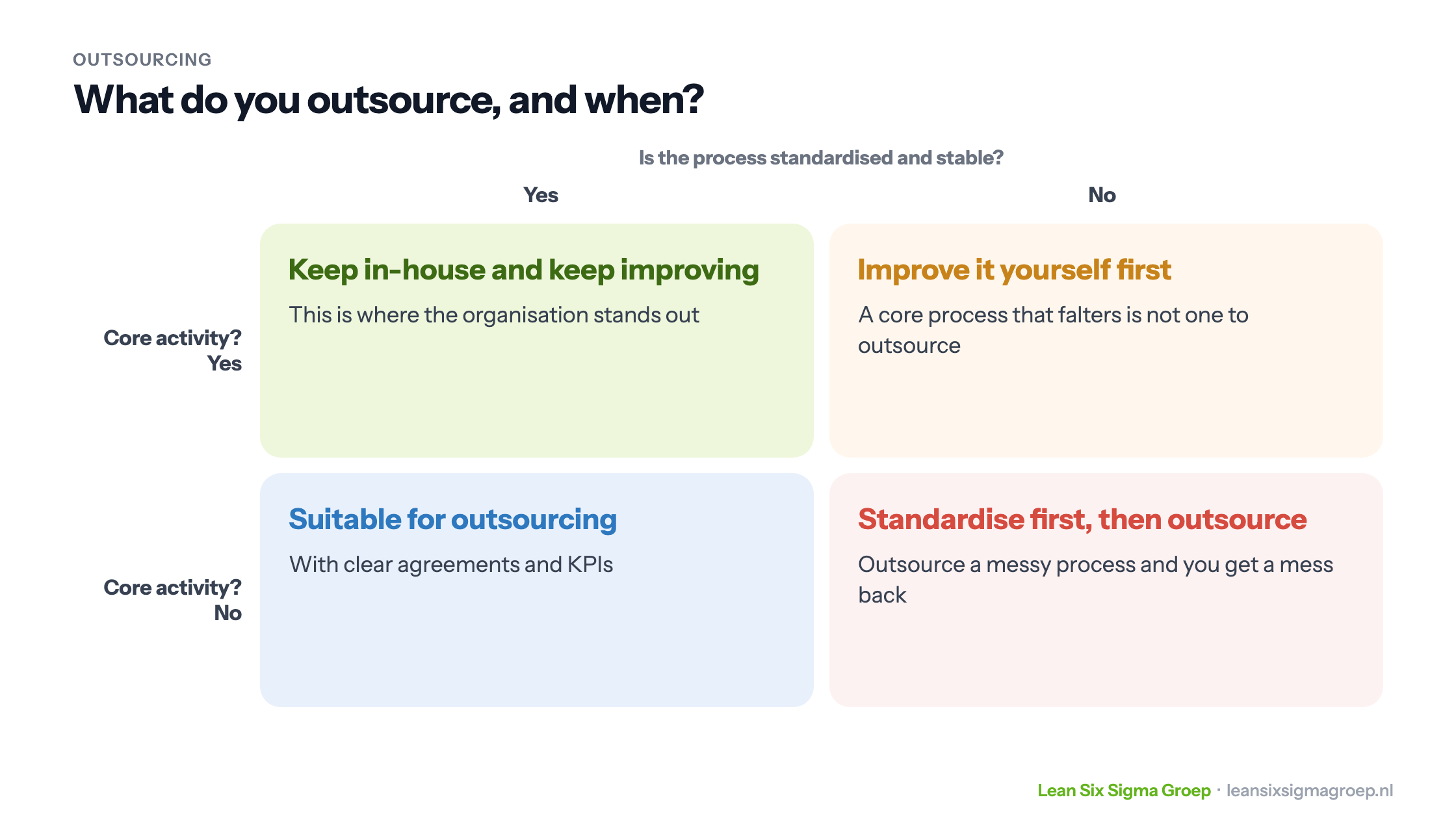
The first question is not how to outsource, but what. Two questions help, as shown in the image at the top of this article:
- Is it a core activity? Work through which the organisation stands out is best kept in-house. Outsourcing means losing that knowledge over time.
- Is the process standardised and stable? A process that doesn’t run well doesn’t improve because someone else does it. Outsource a messy process and you get a mess back, and pay for it too.
Standardisation is the basis
Outsourcing is different from throwing work over the wall. Before you outsource, it must be clear how the work is done, what good looks like and how you measure it. Document the process, for example in an SOP, and agree on quality and speed. Then comes steering, and that is where Lean Agile steering helps, with the five building blocks shown below.
This is one of the tools you learn to apply in the Green Belt training.
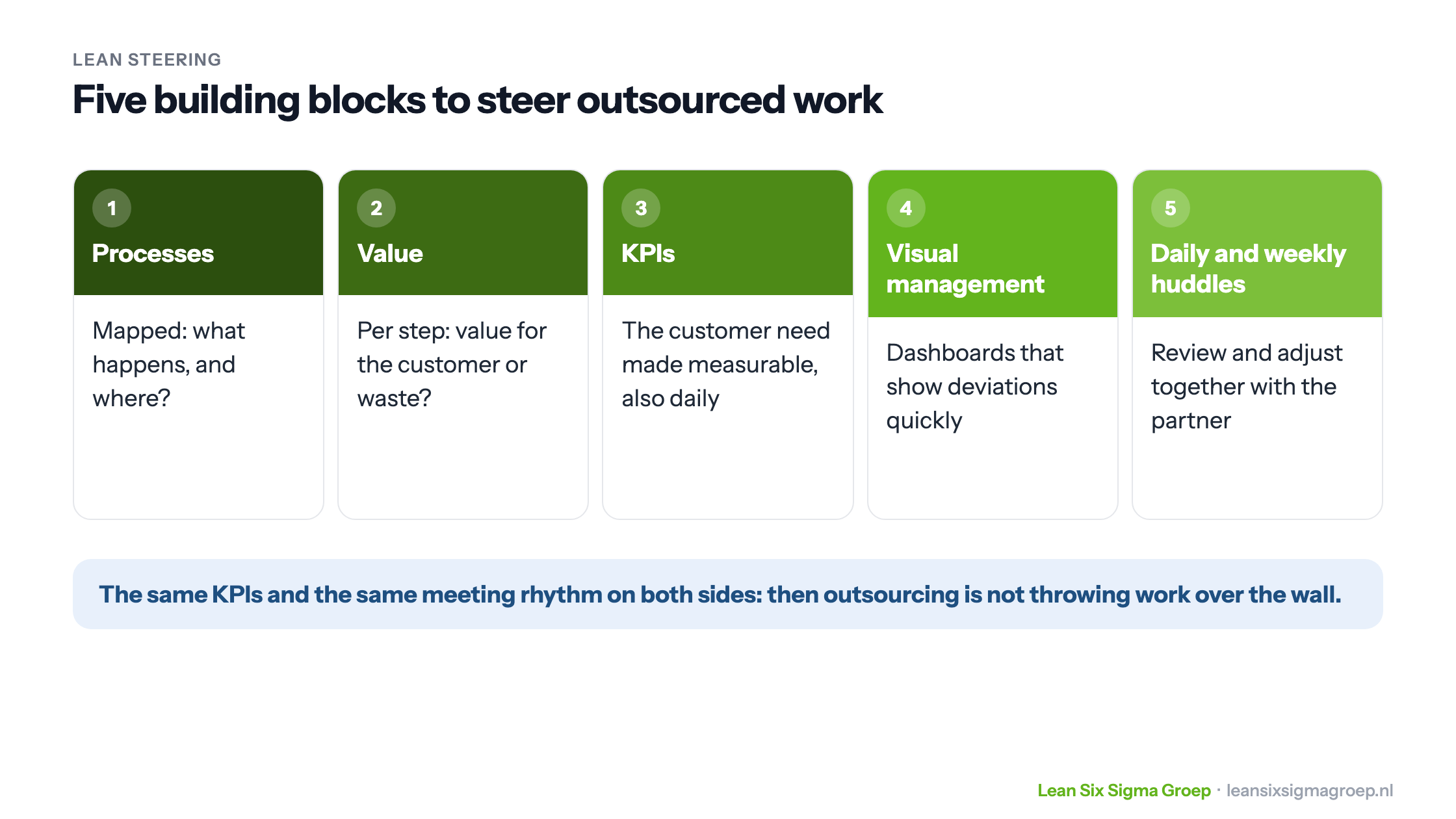
- Processes: knowing which processes there are, and who does which part.
- Value or waste: knowing per process step whether it adds value for the customer, or is waste.
- KPIs: making the customer need measurable. Short-cycle KPIs answer the question: when has an employee done the job well at the end of the day?
- Visual management: charts and dashboards that show how the KPIs develop, so deviations are corrected in time.
- Daily and weekly huddles: monitoring alone is not enough. Discuss the figures regularly, together with the partner, aiming to do a little better for the customer each time. Read more about daily stand-ups.
When the organisation and the outsourcing partner work with the same KPIs and the same meeting rhythm, it remains one process, even though the people work for different companies.
Advantages and disadvantages of outsourcing
Advantages
- Lower costs: outsourcing work to a party or region where it can be done more cheaply often yields considerable savings.
- Specialisation and focus: the partner specialises in the work, and your own staff can focus on the core.
- Handling peaks: an outsourcing partner can often scale up and down faster. That prevents long lead times and overload.
Disadvantages
- Knowledge is lost: staff lose sight of the outsourced part of the process.
- Cultural and language differences: misunderstandings arise more easily, and information is misread.
- Resistance: your own staff may feel threatened, out of fear of loss and the unknown.
- Hidden costs: the transition, coordination, checking and fixing mistakes take time and money that are often missing from the first calculation.
| Advantages | Disadvantages |
|---|---|
| Lower costs | Knowledge is lost |
| Specialisation and focus on the core | Cultural and language differences |
| Better handling of peaks | Resistance among own staff |
| Hidden costs of transition and coordination |
Conclusion
Outsourcing can make operations more efficient, but only if you choose carefully what to outsource and get the process in order first. Standardisation is the precondition, Lean steering the means to keep it under control afterwards. Outsourcing is also a choice in the chain as a whole; read more in supply chain management.