
What does RACI mean?
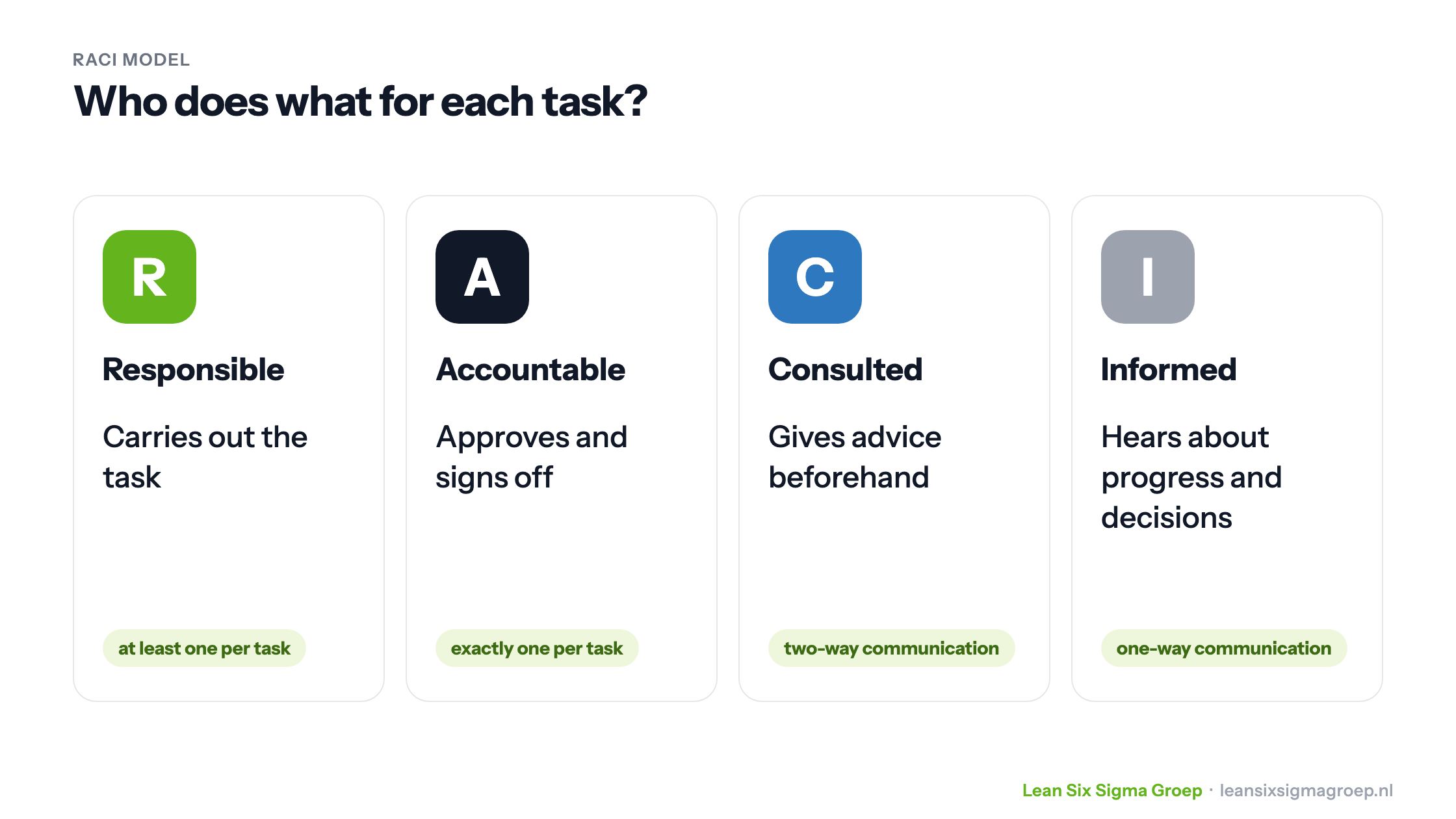
RACI is a model for recording, task by task, who has which role. The four letters stand for the roles people can have in a task:
- R, Responsible: the person who carries out the task. They answer to the person who is Accountable. A task has at least one R.
- A, Accountable: bears final responsibility for completing the task correctly. The Responsible person answers to them, and they approve (sign off) the result. Each task has exactly one A.
- C, Consulted: is asked for advice beforehand and so helps shape the result. This is two-way communication: the C thinks along, but does not carry out the task.
- I, Informed: is kept up to date on decisions, progress and results. This is one-way communication.
One person can also hold two roles in a task, for example A and R at the same time.
This is one of the tools you learn to apply in the Green Belt training.
RASCI and VERI
You will sometimes also hear about RASCI. The S stands for Supportive: someone who helps the R carry out the task, for example by providing resources or capacity. Unlike the C, who only gives advice, the S takes part in the work.
The Dutch version is the VERI matrix: Verantwoordelijk (responsible), Eindverantwoordelijk (accountable), Raadplegen (consult) and Informeren (inform).
The RACI matrix
The RACI matrix shows the role of everyone involved in a project or in day-to-day work. The names or job roles run across the top, and the first column lists the tasks, process steps or deliverables.
For each combination of a role and a task, you fill in a letter (R, A, C or I), or leave the cell empty. This gives a clear overview of who is involved in each task, and how.
Fill in the matrix together with the people who work in the process. In an improvement project, you often do this once the process has been improved, because the new process usually brings a new way of working. Once it is complete, share the matrix widely so everyone knows who has which role.
Example RACI matrix
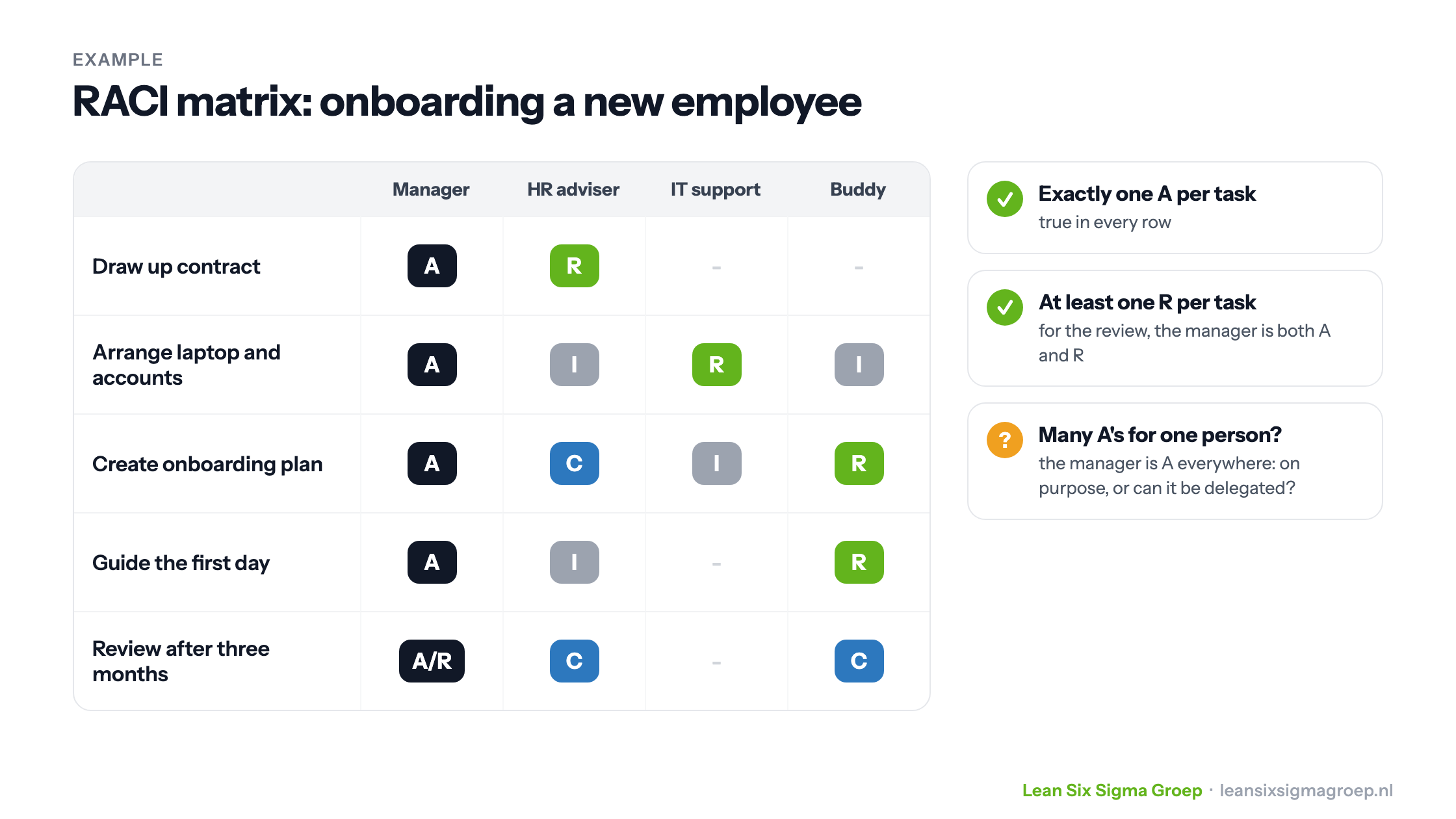
Below is a RACI matrix for onboarding a new employee, with the checks you can run on any matrix on the right.
How to check a RACI matrix
- Each task has exactly one A. With two, it is unclear who makes the final call.
- Each task has at least one R. Otherwise nobody carries out the task.
- Look per person too. If someone has a lot of R’s or A’s, there is a risk of overload or a bottleneck. Someone with only I’s may not belong in the matrix.
You can create and check a RACI matrix online straight away with our free RACI matrix tool.
Benefits of the RACI model
Filling in a RACI matrix together brings benefits such as:
- alignment and clarity on roles and responsibilities;
- more support for the change;
- better teamwork.