Voice of the Customer, VOC for short, is what the customer really wants and values. In Lean Six Sigma everything revolves around value, and value is what the customer asks for and is willing to pay for. To add value, you first need to know what the customer wants, and you find that out with VOC research.
Why ask the customer?
“I talk to dozens of customers every day, surely I know what they want?” a customer service employee once said. She did indeed have a lot of customer contact. But customers called her with a specific question, which she answered expertly with her years of experience. Because she was also measured on handling time, there was no room to ask follow-up questions. Moreover, she spoke to fewer than 0.01% of all customers, and nobody knew whether those customers were representative. Experience is valuable, but no substitute for research.
How to approach VOC research
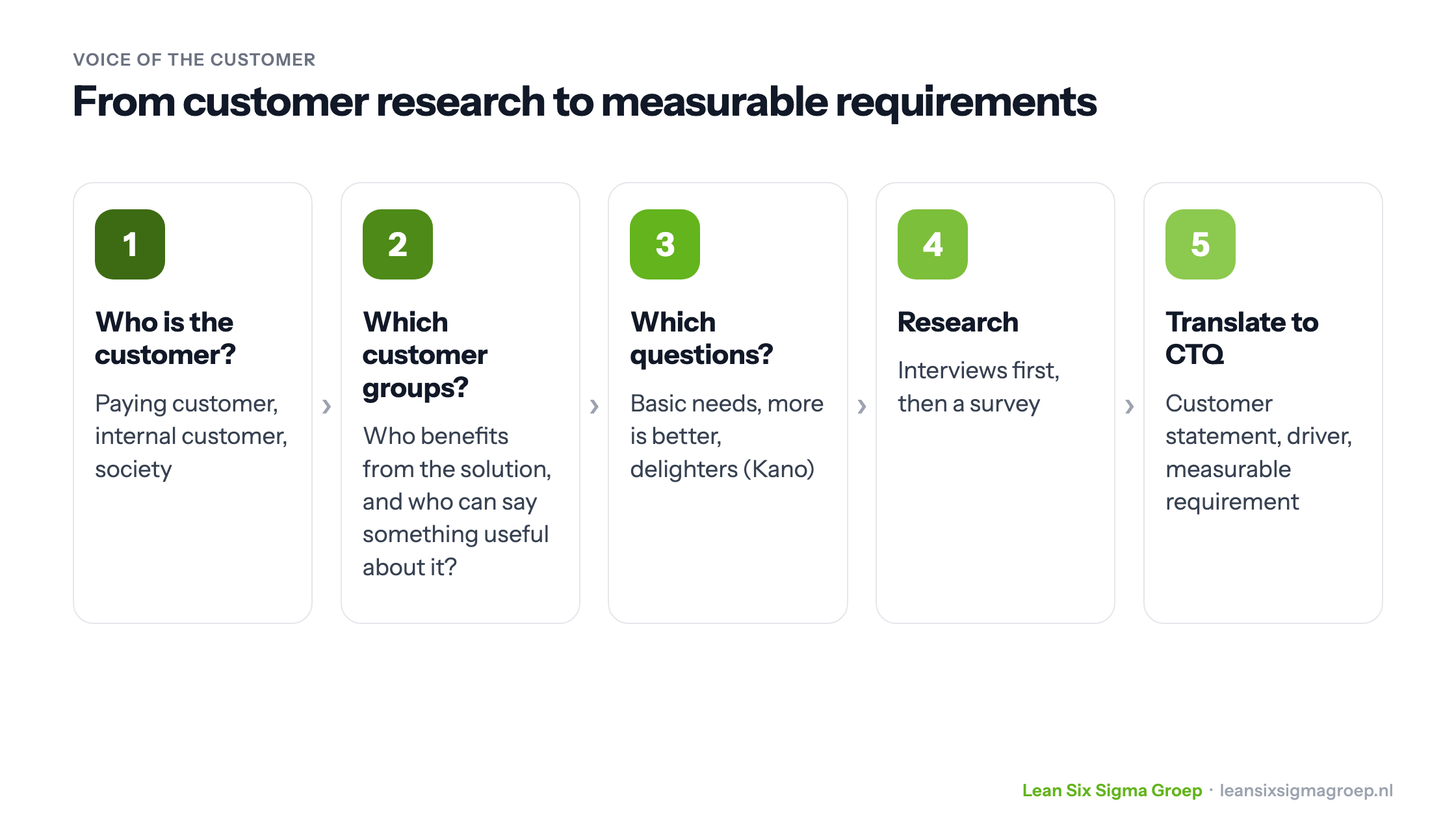
The image at the top of this article shows the steps.
1. Who is the customer?
That sounds easier than it is; it can lead to long discussions. There is the paying customer, who often values a low price, good quality and fast delivery. There may be an internal customer, the next department in the process. And sometimes society is a customer, valuing for example employment or sustainability. What the organisation itself wants is called the Voice of the Business.
2. Which customer groups do you approach?
If you do VOC research in a Lean Six Sigma project, ask yourself which customer groups benefit from solving the problem, and which can say something useful about it.
3. Which questions do you ask?
Ask about the three kinds of needs from the Kano model: basic needs (in a hotel: a clean bed), needs where more is better (a bigger room for the same price) and things that delight the customer (a personal welcome note).
4. Research
There are two methods, and they work best together.
This is one of the tools you learn to apply in the Green Belt training.
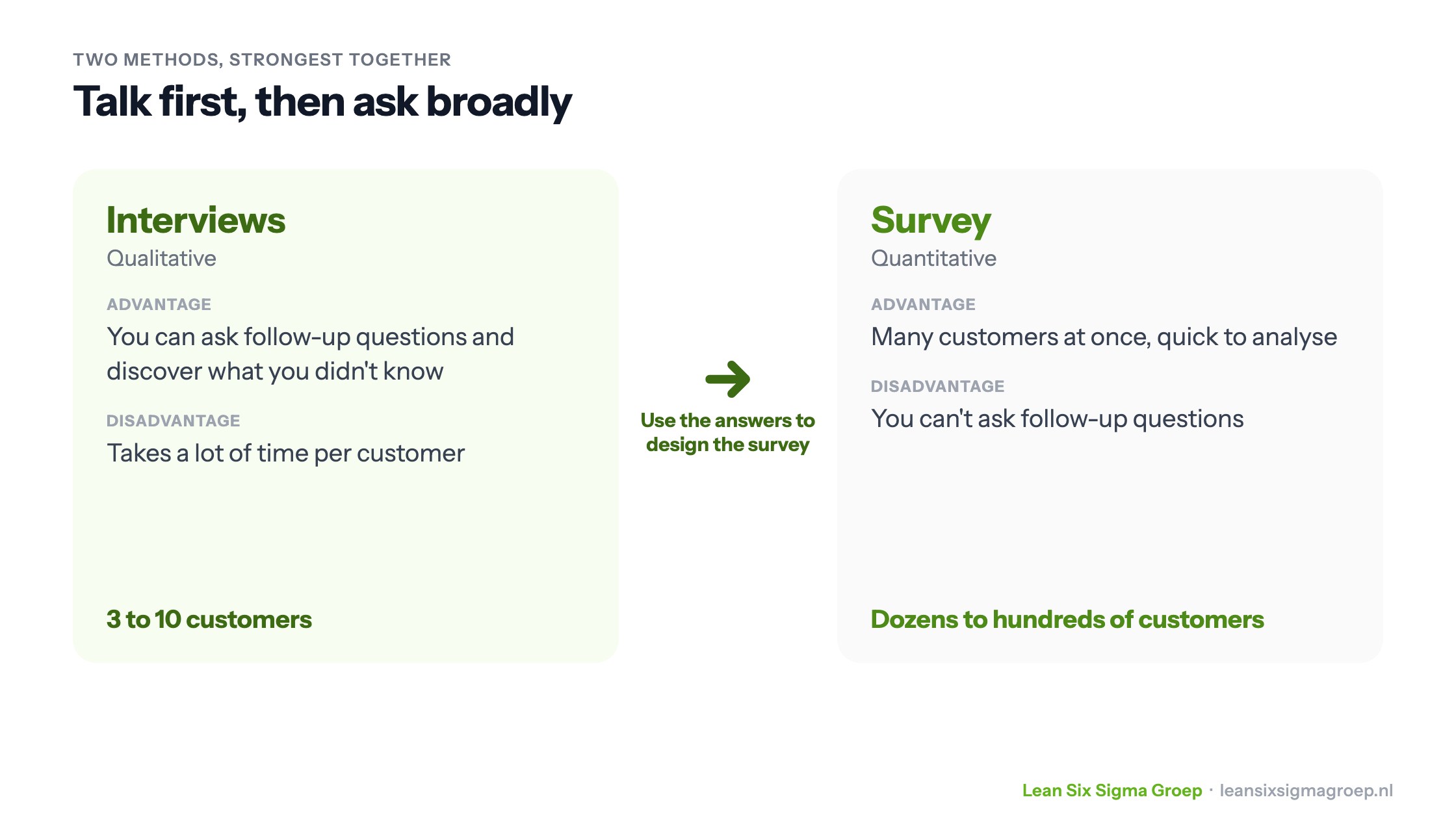
- Interviews (qualitative): visit the customer, invite them over or talk via Teams or Zoom. You can ask follow-up questions and discover what you didn’t know. Disadvantage: it takes a lot of time.
- A survey (quantitative): you reach many customers at once, and a well-designed survey is quick to analyse. Disadvantage: you can’t ask follow-up questions.
Combine them: interview a few customers first, design a survey based on their answers and send it to dozens or hundreds of customers. Existing sources, such as complaints, reviews and conversations with customer service, also often provide valuable clues.
5. Translate into measurable requirements
After the research you know what the customer wants. The last step is to translate that into measurable requirements for the process, so you can see how you are doing in the customer’s eyes. You do this for example with a CTQ tree: the customer statement “you are slow” is translated via the driver “speed” into a measurable requirement, such as “complaints handled within a week”. Such a measurable requirement is called a CTQ, Critical to Quality.
Why the Voice of the Customer matters so much
If you don’t know what the customer wants, you can’t add value. Knowing the VOC is therefore a precondition for every improvement project and for a well-run organisation. And the nice thing is: talking to customers is often great fun too.
Want to know more about the Voice of the Customer or Lean Six Sigma? Contact us at [email protected] or +31 88 53 26 700.