CTQ stands for Critical to Quality: the requirements that determine quality for the customer. A CTQ makes concrete when your product or service still meets the customer’s wishes, and when it doesn’t. With a CTQ tree, you translate a general customer need step by step into measurable requirements.
When do you use a CTQ?
You draw up CTQs in the Define phase of DMAIC. There you want to know exactly what the customer values, so you can improve the process accordingly. The CTQs then become your measurement points in the Measure phase: you measure how often the process meets the requirement.
Voice of the Customer and Voice of the Business
Requirements come from two directions:
- Voice of the Customer (VOC): what the customer wants. This is often about speed, quality and price.
- Voice of the Business (VOB): what the organisation wants. This is often about costs, revenue and risks.
If you keep asking, the two often come together. Sometimes they don’t, and that is a good starting point for an improvement project.
Finding out what the customer really wants
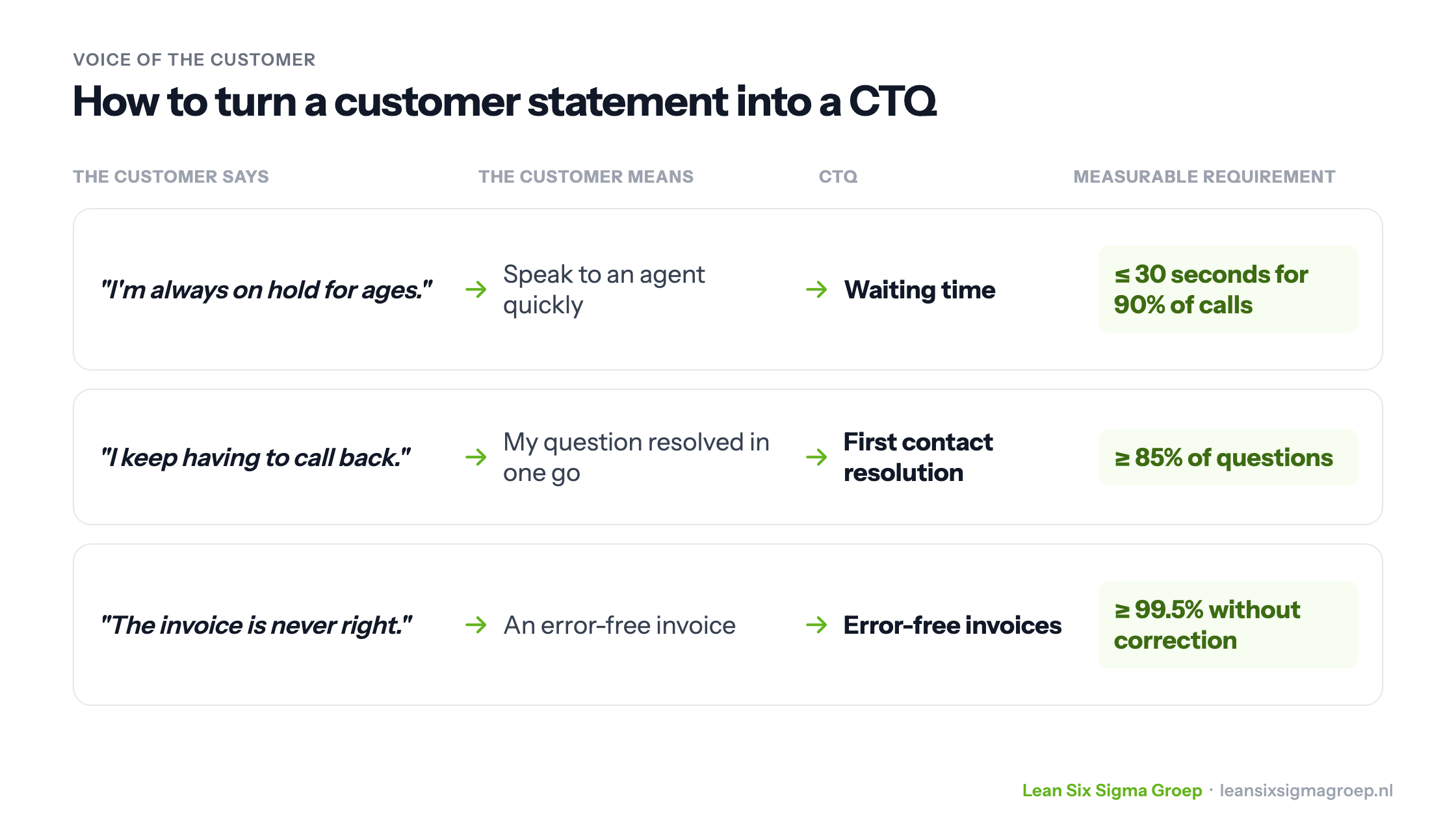
Customers rarely say directly what they need. “I’m always on hold for ages” is a complaint, not a requirement. So you keep asking, for example with 5 whys, until you understand what the customer really means. You gather information from interviews, focus groups, surveys, complaints and conversations with employees who deal with customers every day. The Kano model helps you decide which wishes are basic and which make the customer extra satisfied.
You translate each statement into what the customer means, and make that as concrete and measurable as possible.
The CTQ tree
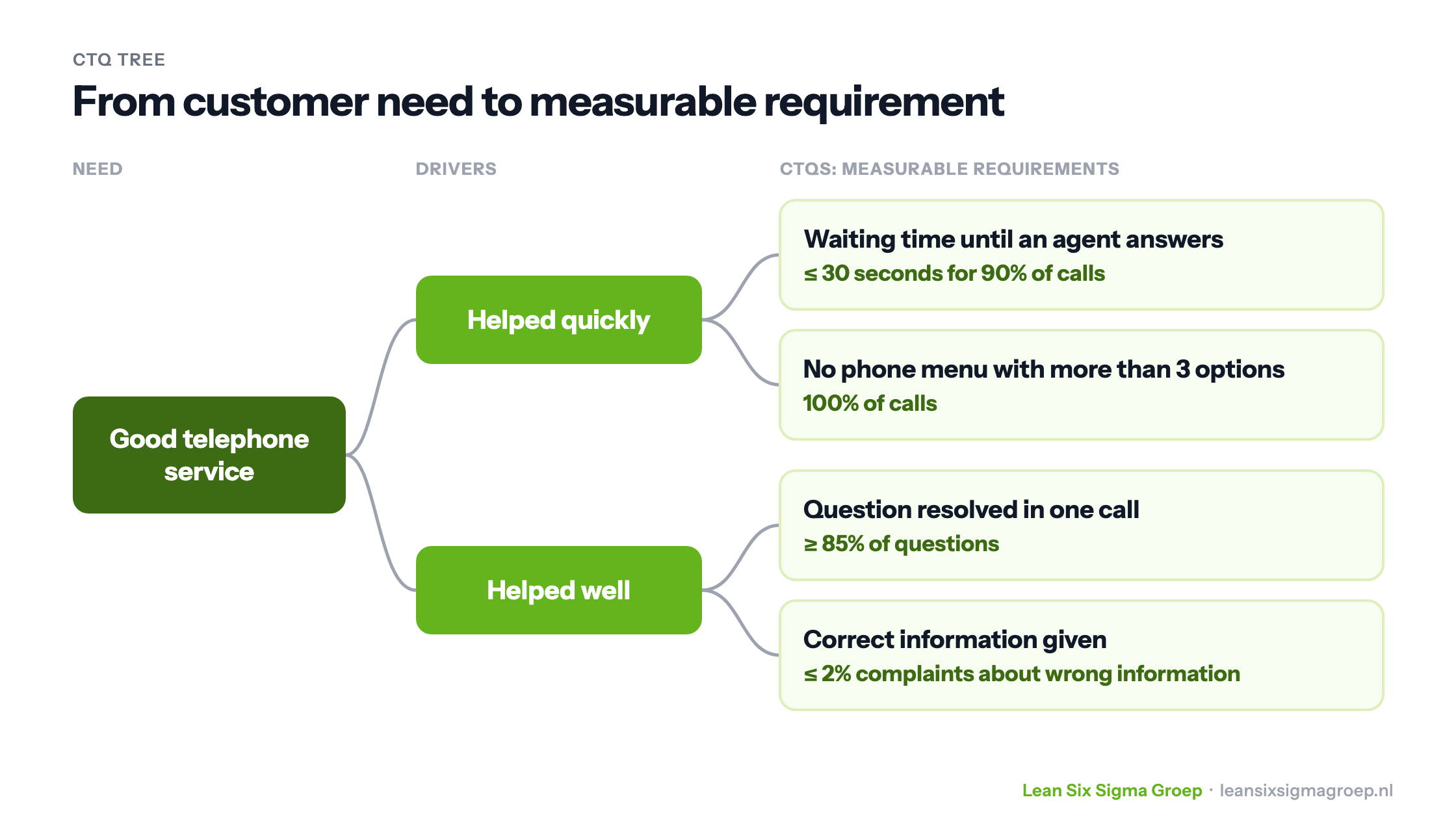
You build a CTQ tree in three layers, as shown in the image at the top of this article:
- Need: the customer’s general wish, for example “good telephone service”.
- Drivers: what the customer means by that, for example “helped quickly” and “helped well”.
- CTQs: the measurable requirements for each driver, with a target. For example: the waiting time until an agent answers is at most 30 seconds for 90% of calls.
A good CTQ is specific, measurable and comes from the customer, not from what the organisation itself thinks is important. Phrase it so you can establish for each product or contact whether it was met. Then you can also count the number of defects later.
Example: the telephone customer service
Customers want good telephone service. After asking further, “helped quickly” and “helped well” turn out to be the main drivers. Helped quickly means: an agent on the line within 30 seconds, without a long phone menu. Helped well means: the question resolved in one call, with the right information. Each requirement gets a target, so the improvement team knows exactly what to measure and improve.
Drawing up CTQs is covered in depth in the Green Belt training course.