Publicatie
Kano model
Analyse customer needs with the Kano model. Learn how this method helps you set priorities and develop products that customers value.
 Ben van AsseltPartner, Master Black Belt Consultant
Published 3 min read
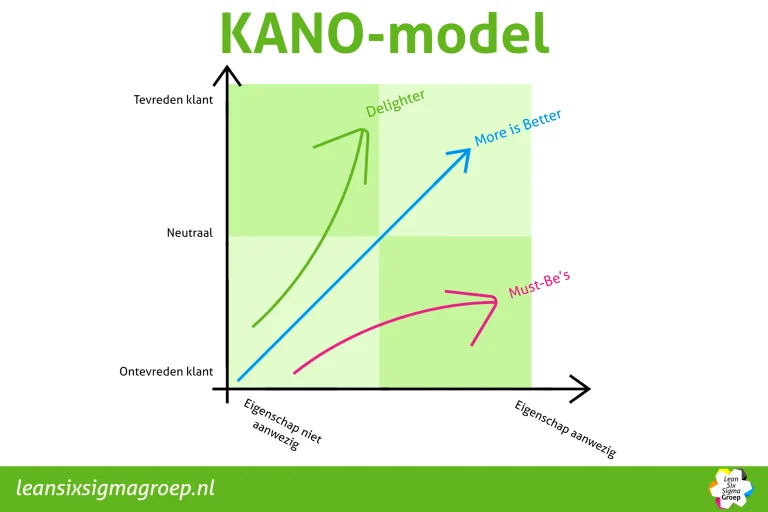
Many improvement projects aim to raise customer satisfaction. The starting point is understanding which attributes of a product or service actually satisfy a customer. The next question is how far the product or service meets those attributes today. An analysis with the Kano model is a good way to map out that information.
Origin of the Kano model
This ground-breaking model is named after its creator, Noriaki Kano, a Japanese professor who developed it in the 1980s. The Kano model is built on the idea that customers hold different expectations of products or services. Some aspects of a product or service are taken for granted and regarded as normal, while other aspects make a big difference to customer satisfaction.
Three types of attributes in the Kano model
The Kano model distinguishes three types of attributes:
- Basic attributes (must-be)
Customers take these attributes for granted. If they are missing, the customer is immediately dissatisfied.
Example: when you book a hotel room, you expect at the very least that there is a bed and that basic hygiene is in order. - Performance attributes (more is better)
Customers expect these attributes, but how much of them they get determines how satisfied they are.
Example: when you book a hotel room, the size of the room or the bed can be a performance attribute. The bigger, the more satisfied the customer. - Delight attributes (attractive)
Customers do not directly expect these attributes, yet they have a big impact on customer satisfaction. They can be small extras that make the difference.
Example: a personal, handwritten note waiting in the hotel room, together with a complimentary bottle of wine.
This is one of the tools you learn to apply in the Green Belt training.
How to carry out a Kano analysis in 3 steps
1. Get in touch with the customer
In practice, customer needs are often a matter of assumptions. We think we know what drives customers and how they experience a product or service. Customer satisfaction surveys come in all shapes and sizes, but not every survey tells you as much about what the customer really values in a product or service. That is why you need to get in touch with the customer. This can be an external (paying) customer or an internal one.
2. Collect data
When collecting data, you first decide which basic, performance and delight attributes matter. Then you gather data on how far those attributes are present in the current situation. In some cases you can already make an initial estimate of the three types of attributes beforehand, for instance based on quality, speed or cost. After that, you test the customer’s experience of those attributes, for example through interviews, surveys or focus groups.
3. Plot the results on the Kano model
Once all the information has been collected, you can plot it on the Kano model. That gives you a visual overview of the customer needs and how far those needs are being met in the current situation.
Prioritising with the Kano model
The Kano model can also be used to set priorities among improvement initiatives. The model helps you understand what customers expect and shows which attributes of a product or service have the greatest impact on customer satisfaction. By evaluating the features of the product or service and classifying them as basic, performance or delight attributes, an organisation can prioritise where to improve. Basic attributes must always be in order, otherwise the customer will not be satisfied, while performance and delight attributes can raise customer satisfaction when they are done well. By focusing improvement initiatives on the performance and delight attributes with the biggest impact on customer satisfaction, an organisation can set itself apart from competitors and increase customer loyalty. Another way to map out customer needs is the Customer Journey.
Satisfied customers thanks to the Kano model
The video below gives a clear and concise explanation of the Kano model and how various companies apply it. Learn how the Kano model helps companies understand customer needs, prioritise product attributes and gain a competitive advantage.
From theory to practice
Learn to apply this in practice
Topics like Kano model are applied directly to an improvement project from your own organisation in the Green Belt training.
Next start dates · Lean Six Sigma Green Belt training
Not ready for a training yet? Or .