Design of Experiments (DOE) is a way to discover with as few trials as possible which process settings give the best result. Instead of turning one knob at a time, you vary several factors at once, following a fixed plan. That shows not only what each factor does, but also how factors influence each other.
What is Design of Experiments?
Every process has an outcome you want to improve, the Y: the strength of a product, the lead time, the number of defects. That outcome depends on a number of factors, the Xs: temperature, pressure, raw material, number of staff. The Xs are the knobs you can turn.
In a DOE you decide in advance which factors to study, at which levels (for example low and high), and which combinations to test. After the trials, statistics show which factors really matter, how big their effect is, and whether they behave differently together than apart.
Why not one knob at a time?
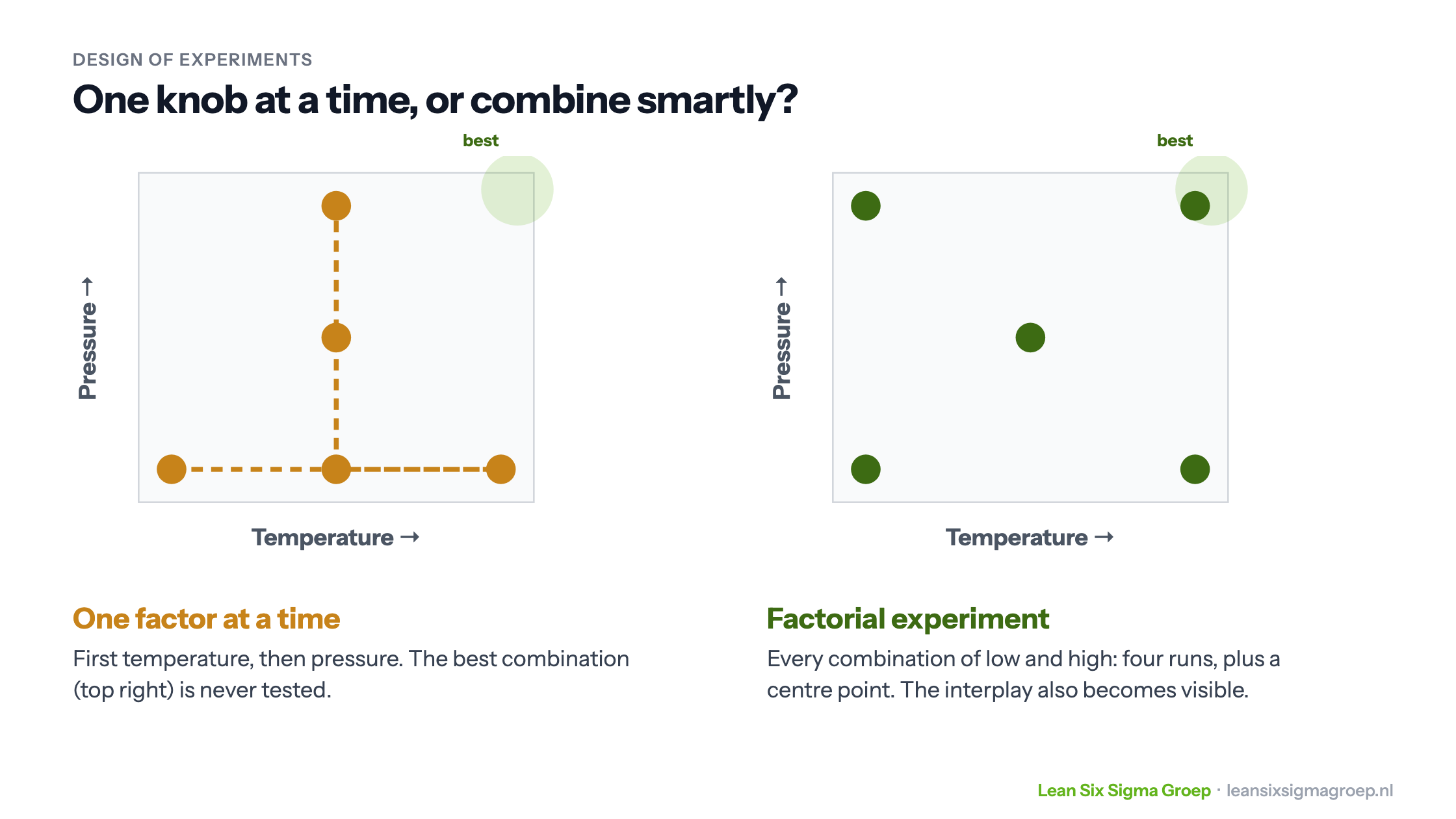
The traditional way is changing one factor at a time: first finding the best temperature, then the best pressure at that temperature. That seems logical, but has two big drawbacks, as shown in the image at the top of this article:
- You miss combinations. If the optimum lies at high temperature and high pressure, the step-by-step search can never get there.
- You don’t see interactions. Often the effect of one factor depends on another. You only see that when you vary them together.
A factorial experiment tests every combination of low and high. With two factors that is four runs, with three factors eight. If that is too many, a fractional design tests a cleverly chosen subset of combinations. That keeps the number of runs limited, while still showing the most important effects.
Interaction
The chart below shows what interaction is. At low pressure temperature hardly matters; at high pressure it matters a great deal.
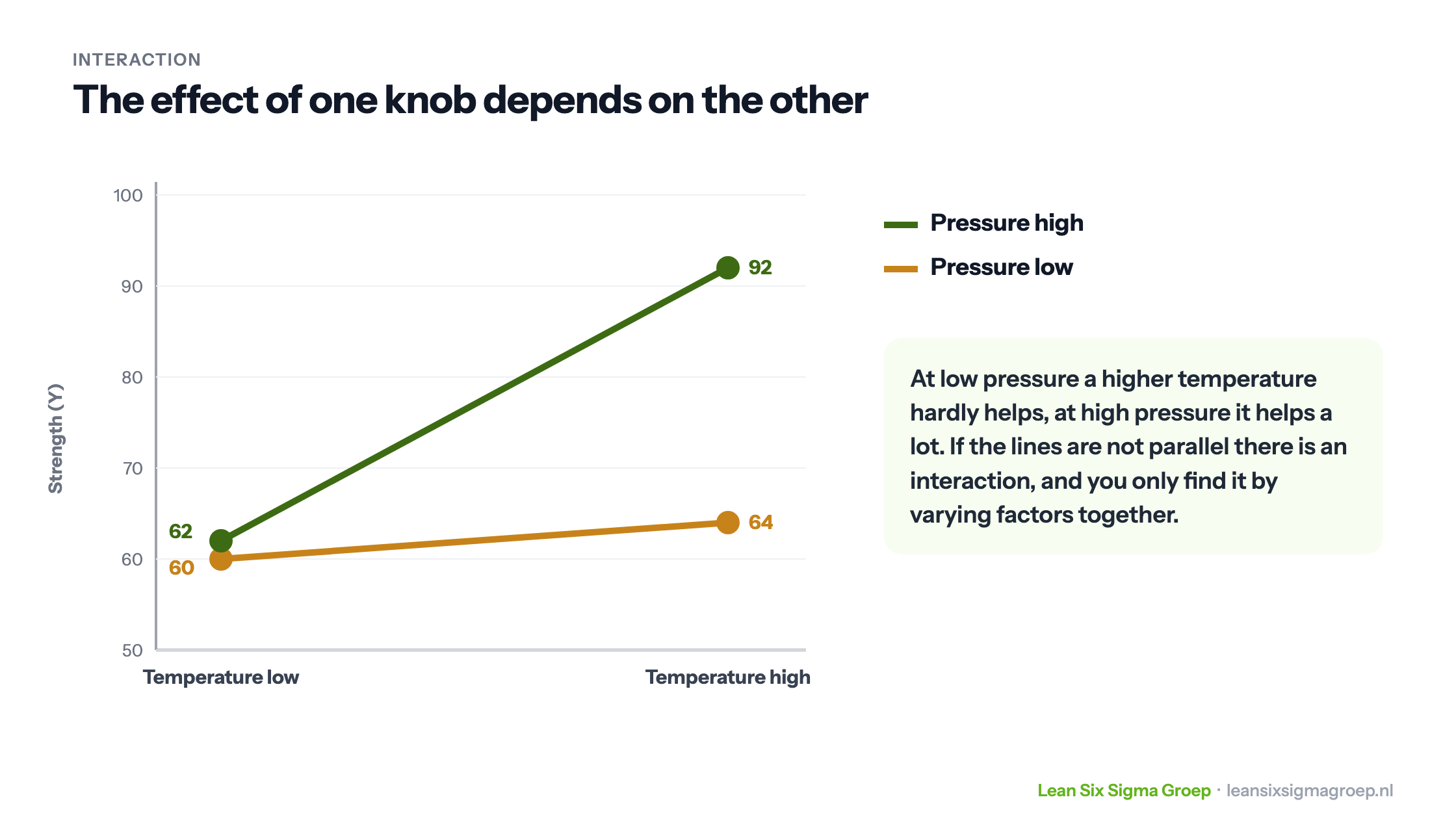
Anyone who studies temperature at low pressure concludes that temperature is unimportant, and so misses the best setting. A DOE prevents that.
The steps of a DOE
- Set the goal and the Y. What do you want to improve, and how do you measure it reliably?
- Choose the factors and levels. Which Xs do you suspect, based on process analysis and data, and between which values do you vary them?
- Choose the design. Full factorial, fractional, or a design to locate an optimum precisely.
- Run the trials. In random order (randomisation), so other influences, such as a machine warming up, don’t distort the result. Repeat runs where possible.
- Analyse and confirm. Which factors and interactions are significant? Then test the best setting found once more in practice.
Software such as Minitab, JMP or Design-Expert creates the design and the analysis, with ANOVA as the statistical basis.
A practical example
Plastics are everywhere: in car dashboards, blood bags and the sheathing of fibre-optic cables. Before such a product can be made, plastics and additives are melted together under high pressure and temperature in an extruder. The properties of the material depend on the recipe and the machine settings, and these influence each other. With a DOE you find the combination that produces the best material in a limited number of trials.
DOE is used in laboratories, factories and development departments, but also in services, for example to test which combination of subject line, timing and offer makes an email campaign work best.
Where does it come from?
The American philosopher and scientist Charles Sanders Peirce was already running randomised experiments in the 1880s. The British statistician Ronald Fisher laid the foundations of modern experimental design in the 1920s, at the Rothamsted agricultural research station. His book The Design of Experiments appeared in 1935.
DOE in Lean Six Sigma
Within DMAIC you use DOE in the Analyse phase, to prove which Xs really influence the Y, and in the Improve phase, to find the best setting. It is a typical Black Belt tool.
Want to learn how to set up and analyse experiments? Take a look at the Black Belt course. Below is a video about the steps of a DOE.
From theory to practice
Learn to apply this in practice
In the Black Belt training you apply topics like Design of Experiments to complex improvement projects, backed by statistical analysis.
Next start dates
Lean Six Sigma Black Belt training →See the training calendar for current start dates and locations.
Not ready for a training yet?