The Eisenhower Matrix, also called the urgent-important matrix, helps you prioritise tasks using two questions: is it urgent, and is it important? It shows straight away what to do now, what to schedule, what to delegate and what you are better off not doing at all.
This is one of the tools you learn to apply in the Green Belt training.
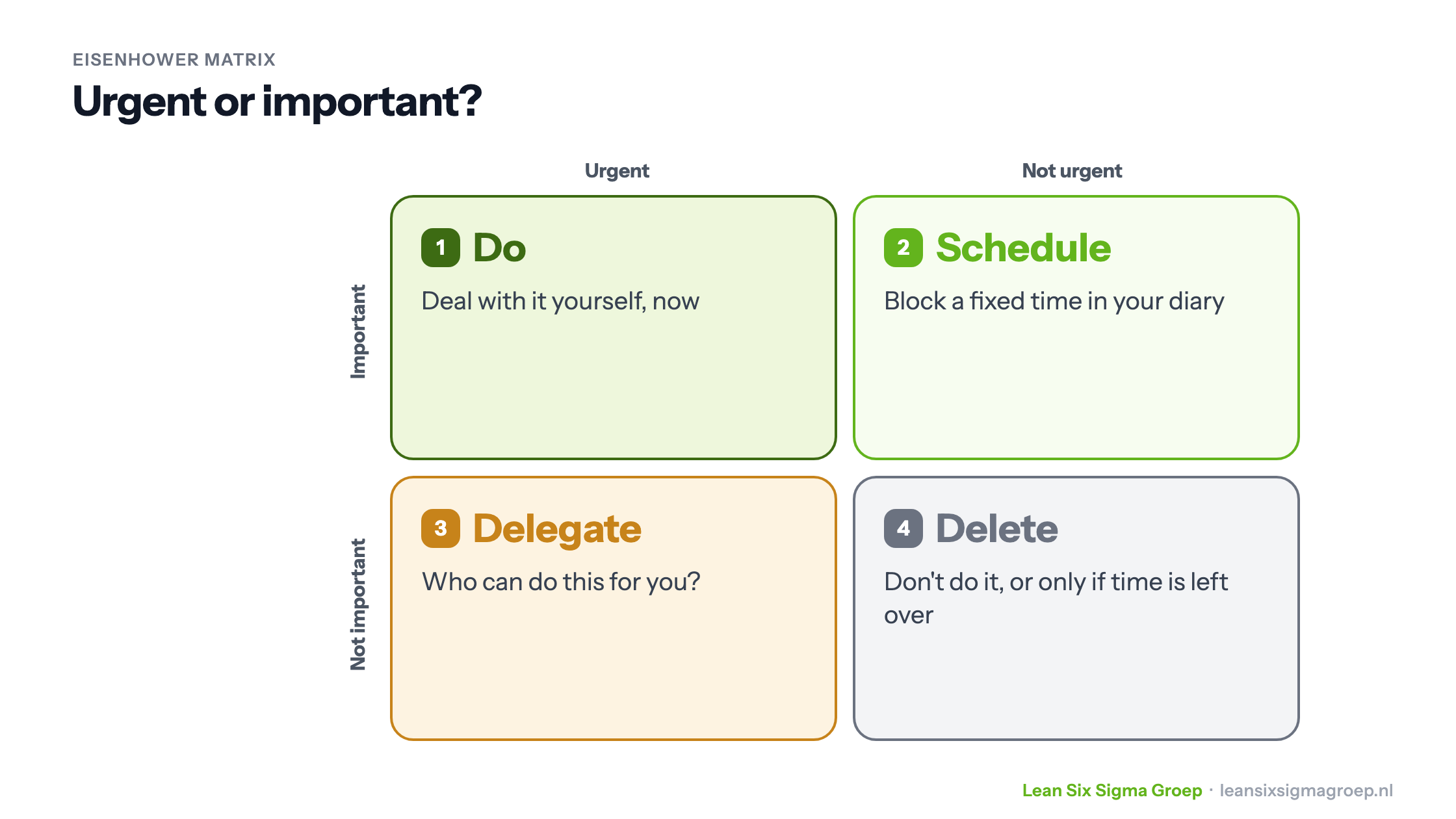
What are your priorities? Your day is full of tasks, emails and requests that all demand attention. So how do you choose where to start this day or this morning? Use the Eisenhower Matrix.
Where does the name come from?
Dwight D. Eisenhower was the 34th President of the United States, from 1953 to 1961. Before that he was a general in the US Army, Supreme Commander of the Allied forces in Europe during the Second World War and later the first Supreme Allied Commander of NATO in Europe.
Eisenhower constantly had to choose where to spend his time. In a 1954 speech he quoted a former college president: “I have two kinds of problems, the urgent and the important. The urgent are not important, and the important are never urgent.” The matrix itself came later, made popular by Stephen Covey in his book The 7 Habits of Highly Effective People (1989), who named it after Eisenhower.
How do you use the Eisenhower Matrix?
Sorting tasks by urgency and importance gives you four quadrants, each with its own approach:
- Important and urgent: do. Deal with it yourself, now.
- Important but not urgent: schedule. Block a fixed time in your diary.
- Urgent but not important: delegate. Who can do this for you?
- Neither urgent nor important: delete. Don’t do it, or only if time is left over.
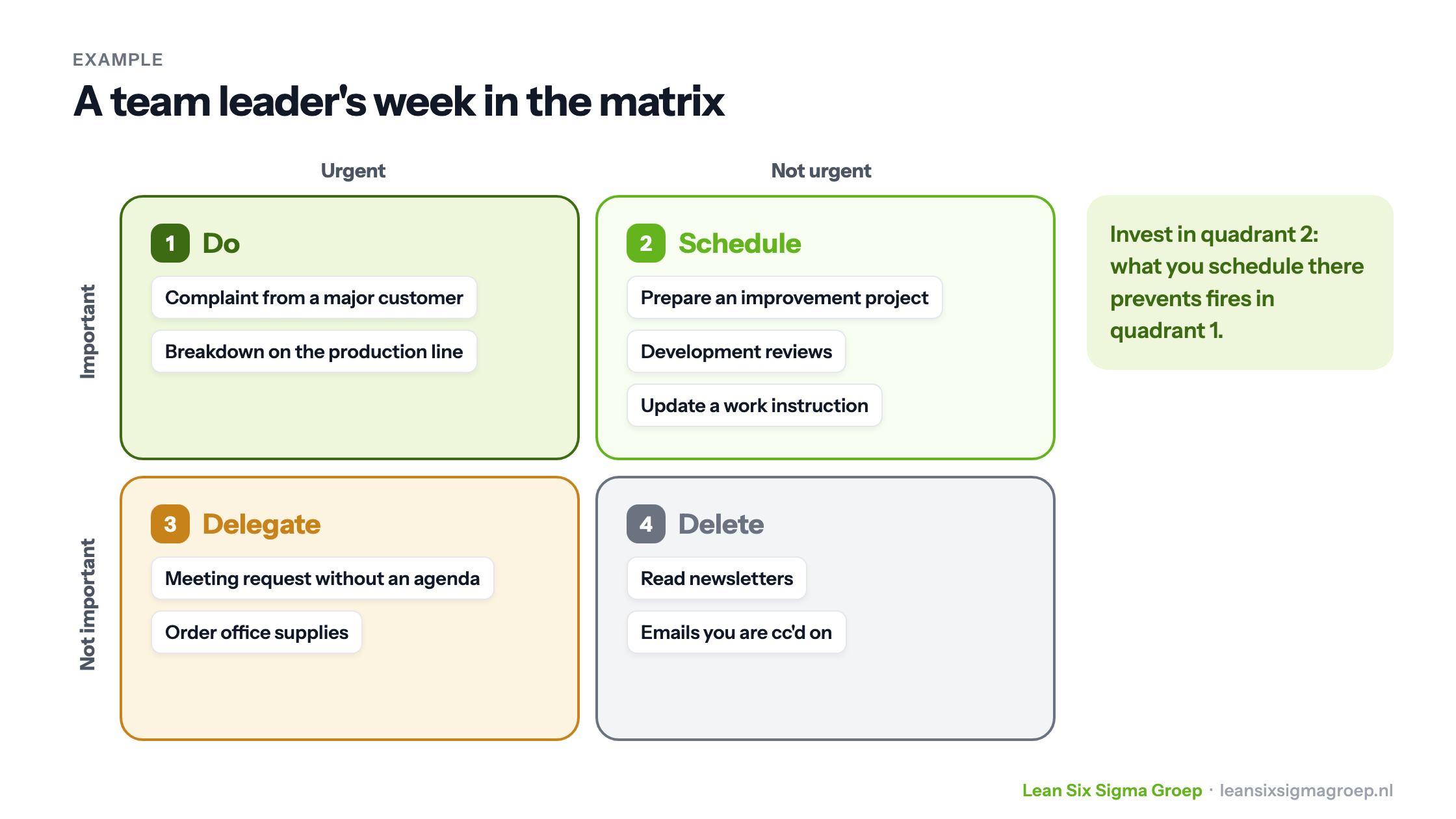
Urgent or important: what is the difference?
Start by sorting your tasks. To do that, you need to be clear about your priorities and about when something is genuinely urgent.
Urgent tasks are under time pressure. They demand a response now, which is why they shout loudest for attention.
Important tasks contribute to your longer-term goals. They usually don’t give immediate results, but that is exactly where the gain lies: what you schedule in quadrant 2, such as an improvement project or a good work instruction, prevents fires in quadrant 1 later.
Three tips for using the matrix well
1. Give the quadrants a colour
A fixed colour per quadrant lets you see at a glance what needs to happen first. Colour the do quadrant red, for example, so urgent tasks stand out.
2. Keep work and personal tasks apart
Make separate matrices for work and for personal tasks. That makes it clearer what lies ahead and helps you divide your time. A handy trick is to set aside fixed hours of the day for each and see how that works.
3. Limit the number of tasks per quadrant
Put too many tasks in a quadrant and the matrix loses its power. Keep it to seven or eight tasks per quadrant, so you don’t get overwhelmed.
A handy way to keep track of this is a Kanban board.
From theory to practice
Learn to apply this in practice
De Eisenhower-matrix helpt je prioriteren; in de Green Belt training leer je verspilling structureel uit je werk en processen halen.
Next start dates
Lean Six Sigma Green Belt training →Not ready for a training yet?