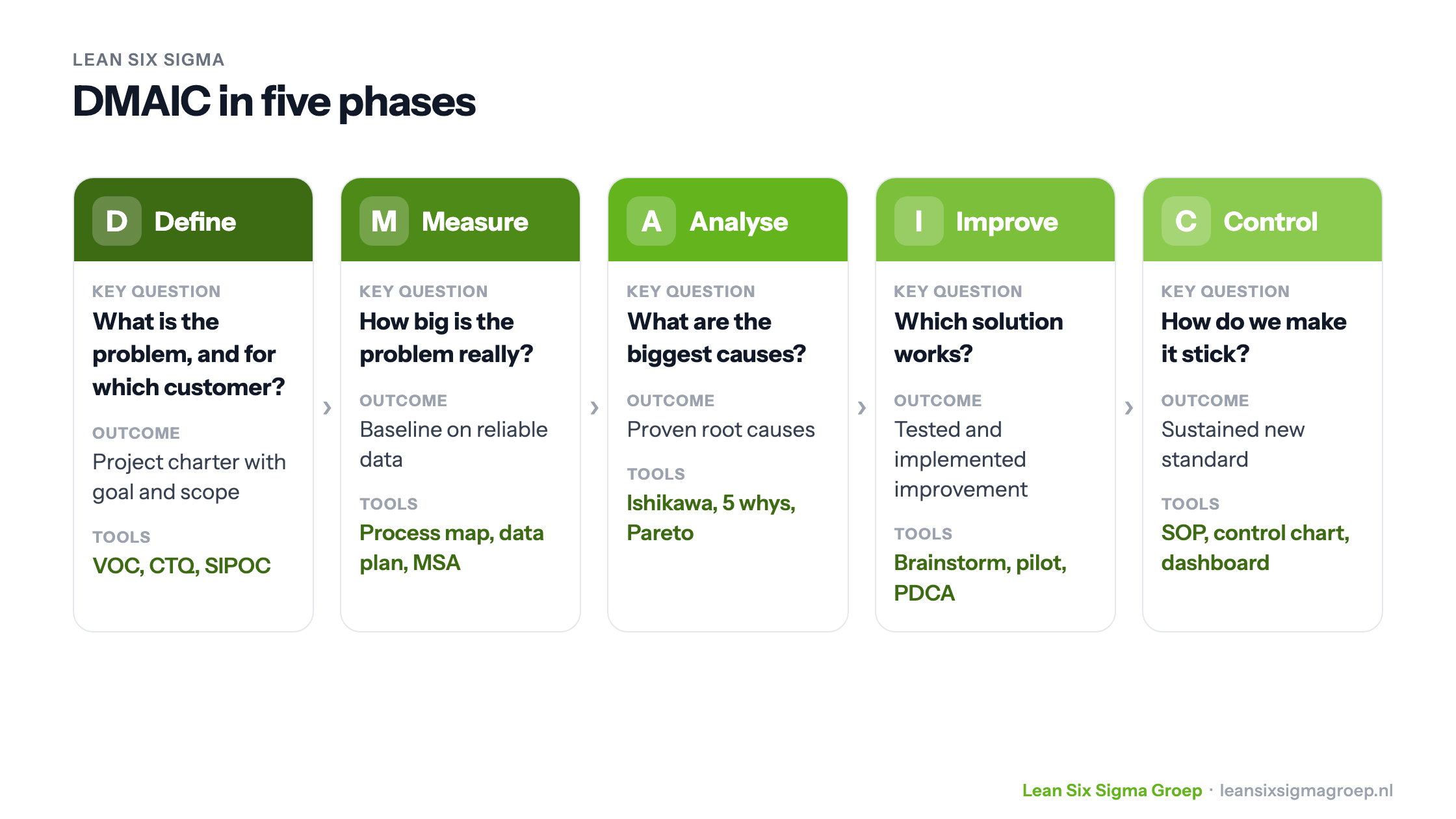
DMAIC stands for Define, Measure, Analyse, Improve and Control. It is a data-driven improvement cycle for improving, optimising and stabilising business processes. DMAIC is the core of Six Sigma projects: every project goes through these five phases to achieve the desired result.
Implementing improvements: which organisation doesn’t? Yet many improvement initiatives fail to reach their goal. That is often due to resistance on the shop floor, or because vision and strategy are not properly aligned.
To succeed, you need to know exactly what the problem is and how it translates into measurable data. In the end, it comes down to translating the customer’s needs into your business processes.
The five phases of DMAIC
The basis of Six Sigma is the DMAIC model. It consists of five phases:
- Define: you define the problem by answering these questions:
- Who is the customer?
- What matters to them?
- Which process is involved?
- How do we record the outcomes?
The result is a project charter with the problem, the goal and the scope of the project.
- Measure: you map the process and collect the relevant data. You carry out a baseline measurement, check with a measurement system analysis whether your measurements are reliable, and establish how big the problem is.
- Analyse: you analyse the data you collected. With a data and process analysis, you look for the causes of the problem and establish which matter most. A widely used tool is the Ishikawa diagram, one of the seven basic quality tools.
- Improve: you come up with solutions for the main causes, choose the best ones, test them, for example in a pilot, and then implement them.
- Control: you prevent the process from slipping back and secure the improvement, for example with a work instruction and an ongoing measurement that tracks process performance.
An example
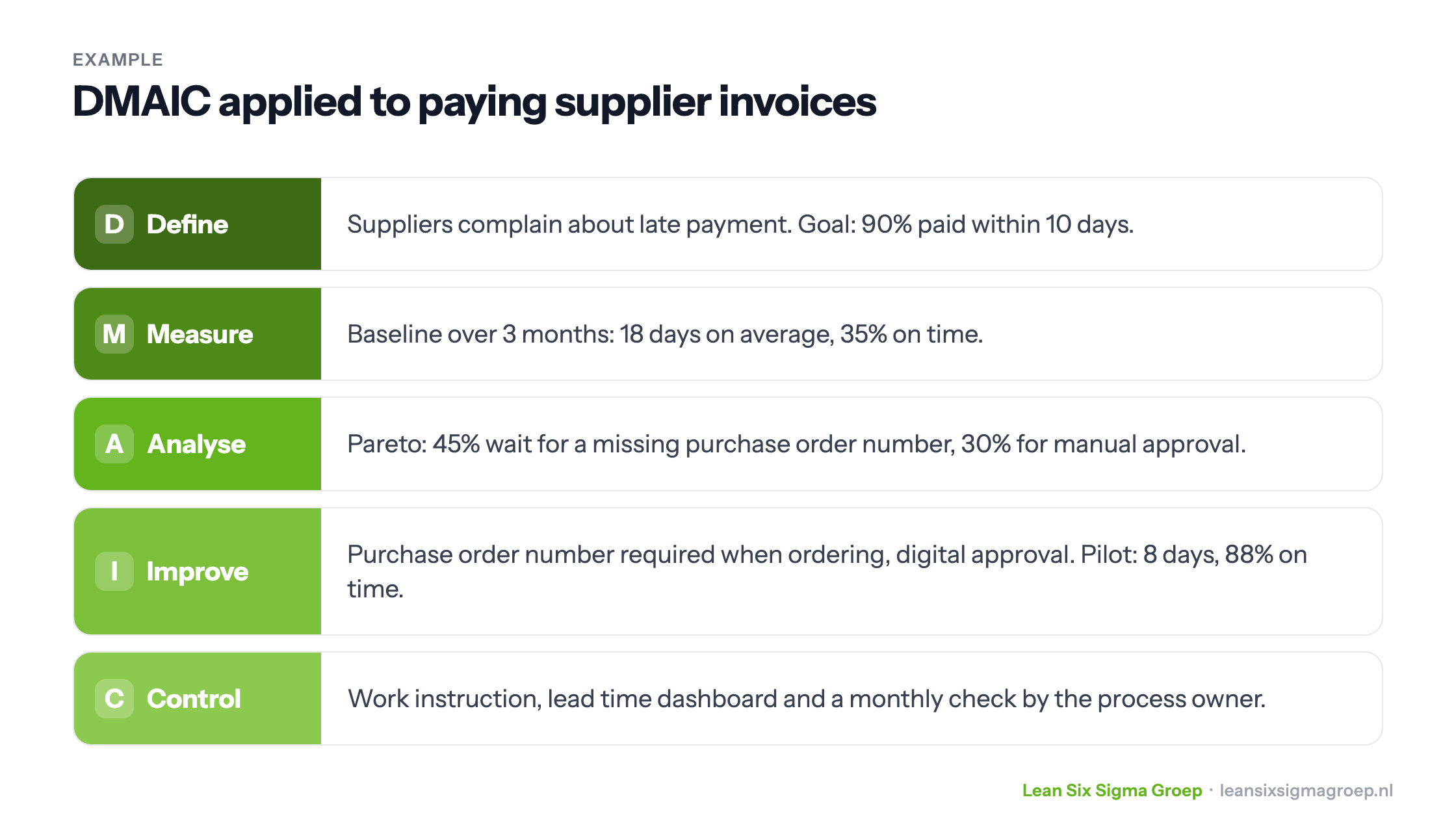
Below you can see how a department applies DMAIC to late payment of supplier invoices, from problem statement to sustaining the result.
DMAIC in Lean Six Sigma
The DMAIC cycle is now applied far more widely than in Six Sigma alone. In the Lean Six Sigma methodology, you combine it with the principles of Lean. Read more about the combination of Lean and Six Sigma.
Lean Six Sigma Groep combines the DMAIC model with other methods, so improvements also last. That way, aspects such as work culture and resistance are not overlooked.
In our Lean Six Sigma Green Belt and Black Belt training courses, these methods are covered in a practical way.