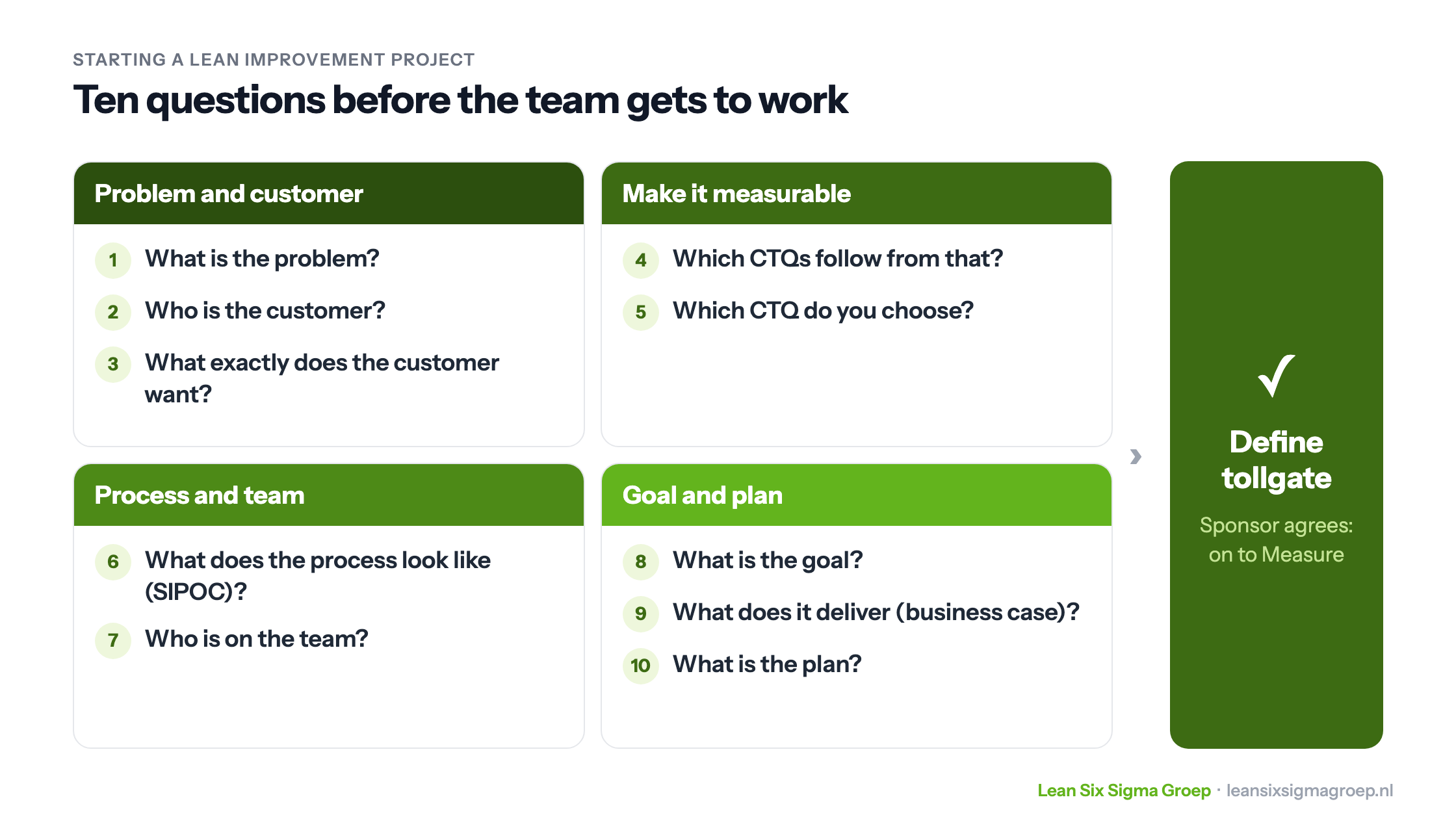
A Lean improvement project stands or falls with its start. Teams that jump straight to solutions often solve the wrong problem, or the right problem for the wrong customer. That is why the team first answers ten questions, as shown in the image at the top of this article. Together they form the Define phase of DMAIC, and the answers go into a project charter.
1. What is the problem?
Start with the problem, not the solution. What goes wrong, where, since when and how big is it? Think of long waiting times, too many errors, complaints or high costs. Describe it so that you can measure it: then you can show later that it has improved. Figures on lead time, error rate or customer satisfaction help.
2. Who is the customer?
The customer is whoever receives the output of the process. That can be an external customer, but also an internal one: another department waiting for your work. In Lean the customer defines value. Choose the wrong customer and you improve the wrong thing.
3. What exactly does the customer want?
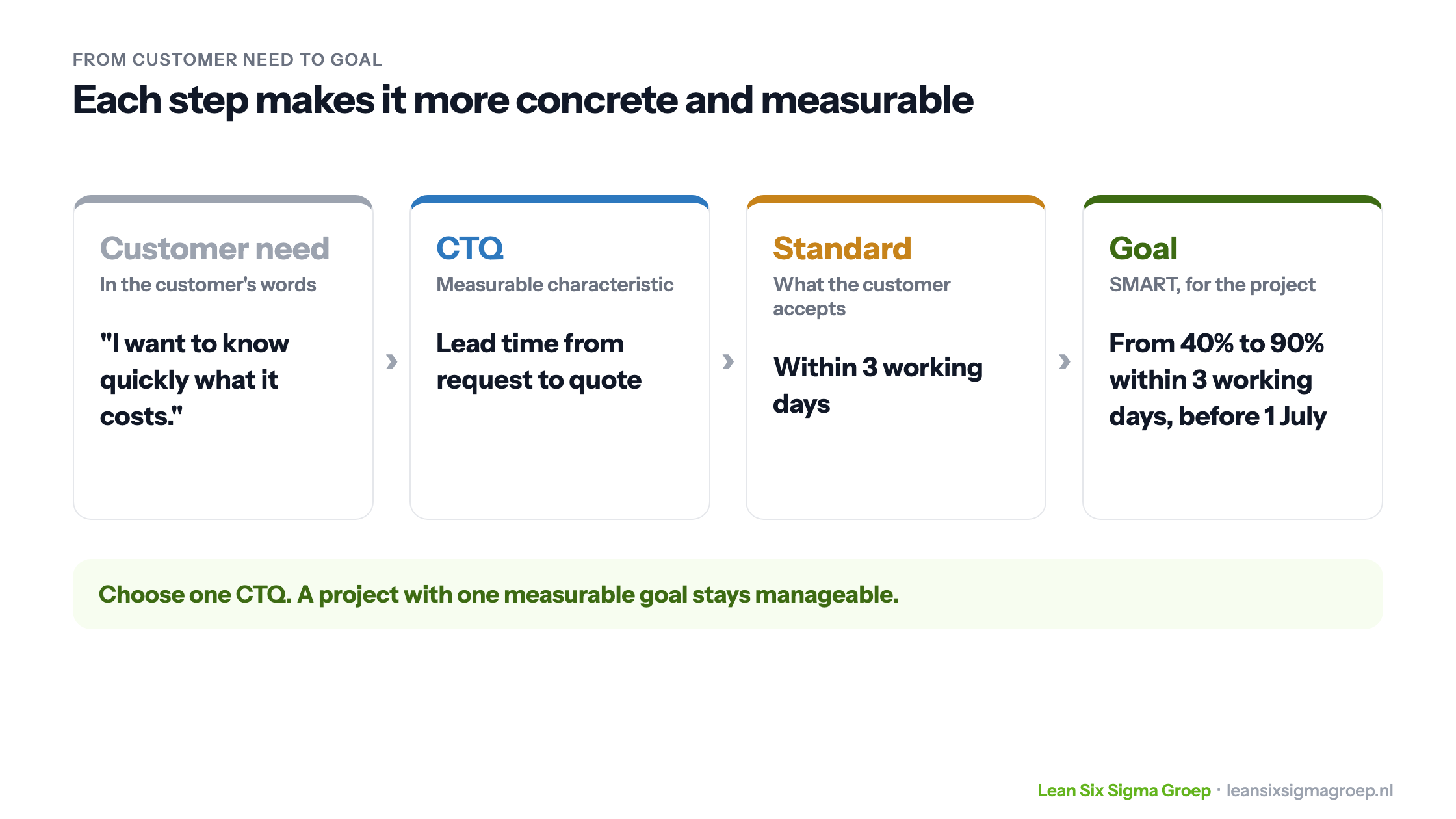
Customers usually care about quality, speed, price or flexibility, but which weighs most differs by customer and process. So ask, through conversations, surveys or an analysis of complaints. This is called the Voice of the Customer. Record the need in the customer’s own words, for example: “I want to know quickly what it costs.”
4. Which CTQs follow from that?
A customer need is often vague. A CTQ (Critical to Quality) makes it measurable: the characteristic of the process that determines whether the customer is satisfied, with a standard attached. “Knowing quickly what it costs” becomes, for example, the lead time from request to quote, with a standard of three working days. The image below shows those steps.
5. Which CTQ do you choose?
Several CTQs often come out. Choose one: the one that bothers the customer most, and that delivers the most for customer and organisation. A project with one measurable goal stays manageable. If customers mainly complain about late deliveries, lead time is the obvious choice.
6. What does the process look like?
Map the process at a high level with a SIPOC: suppliers, inputs, the five to seven main process steps, outputs and customers. This also sets where the project starts and ends. The detail comes later, in the Measure phase.
7. Who is on the team?
- The sponsor: commissions the project, provides time and resources, and makes decisions. Without a sponsor who owns the problem, a project stalls.
- The project leader: often a Green Belt or Black Belt, who leads the team through the steps.
- People from the process: they know the work, see the bottlenecks and will have to work differently afterwards.
- Where needed: someone with data skills, or someone who knows the customer well.
Also record who else has a stake in the project, with a stakeholder analysis.
8. What is the goal?
The goal follows from the chosen CTQ and is SMART: specific, measurable, achievable, realistic and time-bound. For example: from 40% to 90% of quotes within three working days, before 1 July.
9. What does it deliver?
The business case shows why the project is worthwhile: lower costs through less waste, more satisfied customers, more revenue or less work. Make it as concrete as possible, in money or hours where you can. Read more in the cost-benefit analysis.
10. What is the plan?
Set an end date and a tollgate moment for each DMAIC phase. A Green Belt improvement project usually takes three to six months.
The tollgate
At the end of each DMAIC phase there is a tollgate: a short meeting in which the sponsor judges whether the phase is complete and the project can move on. At the end of Define the question is whether the ten questions have been answered well: is the problem clear, is the goal fixed, is the business case approved and does the team have the time? If so, the Measure phase begins.
Answering these questions well increases the chance of an improvement project that really delivers, for the customer and for the organisation. In the Green Belt course you learn to lead such a project from start to finish.