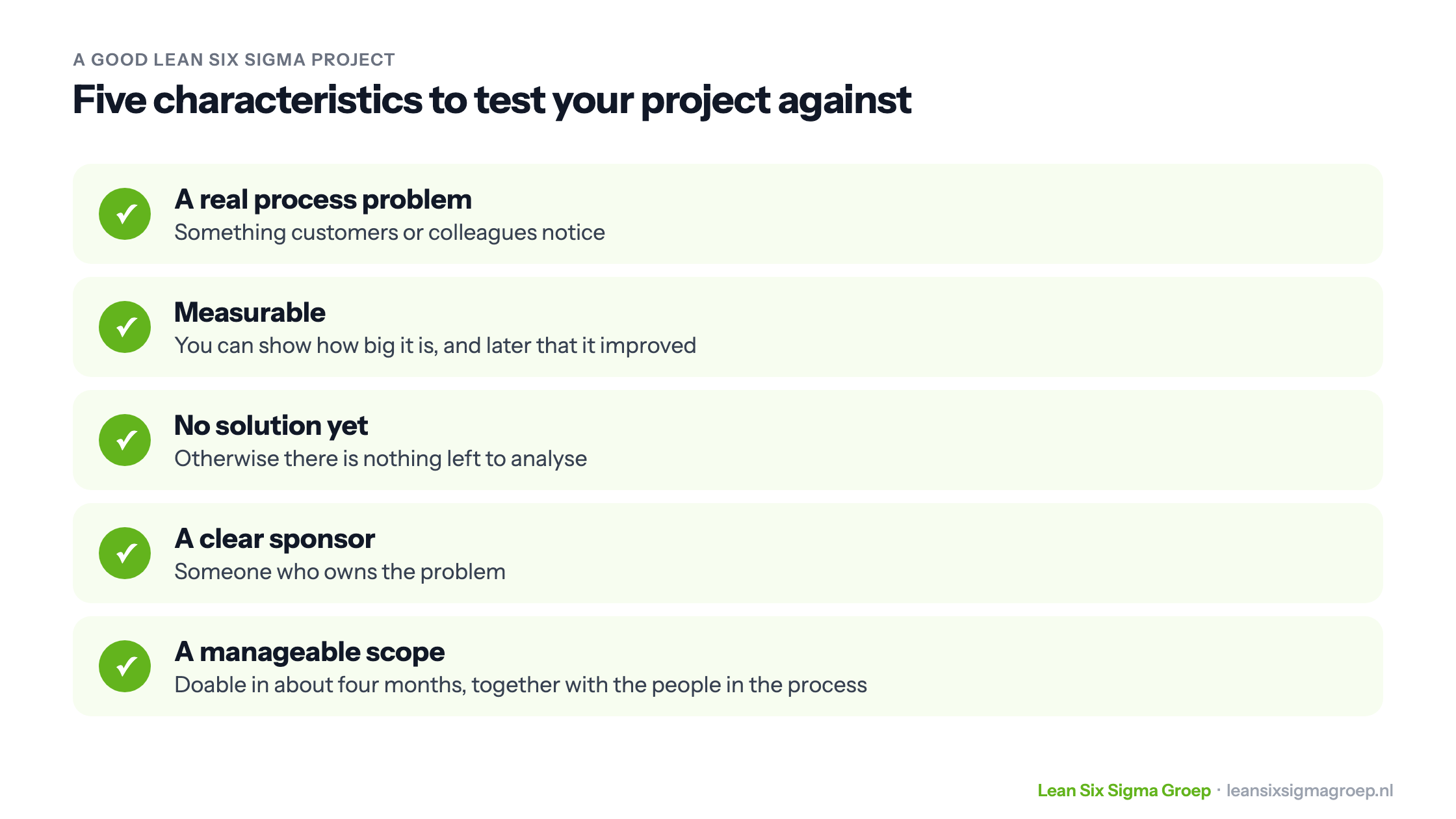
People who take, or plan to take, a course with us often ask: what is a good Lean Six Sigma project? A good project has five characteristics, as shown in the image at the top of this article: a real process problem, measurable, without a solution yet, with a clear sponsor and a manageable scope. We explain them below.
A real process problem
A good project starts with a problem that customers or colleagues notice: long waiting times, errors, complaints, rework. Preferably a problem that is urgent and that people will be glad to see solved. That helps enormously in getting everyone on board.
Measurable
You must be able to show how big the problem is now, and later that it has improved. If it is about the lead time of complaints, you measure how long handling takes now, and again after the improvement.
No solution yet
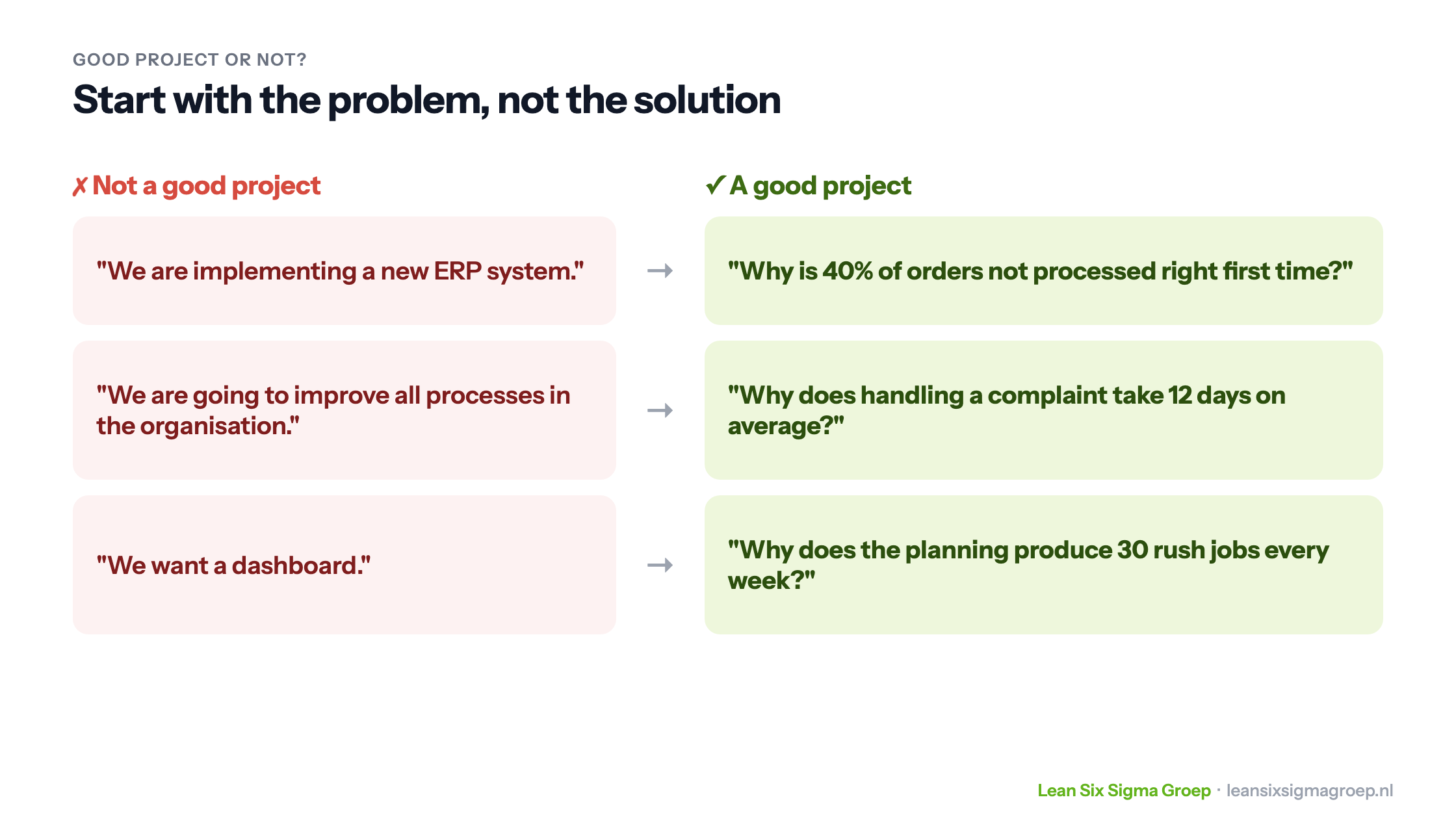
A good Lean Six Sigma project does not contain a solution yet. The idea is to go from problem to causes to solutions, and to implement them. “We are implementing a new IT system” is therefore not a good project: the solution is already fixed, and there is nothing left to analyse. “Why is 40% of orders not processed right first time?” is a good project. The image below gives more examples.
A clear sponsor
Every project needs someone who owns the problem: the sponsor. They give the project room, make sure people get time, and make decisions. Record the agreements in a project charter.
A manageable scope
“Don’t boil the ocean”, as they say in Lean. Don’t make the project too big. A Green Belt project takes about four months on average; long enough to go through the five phases of DMAIC properly, short enough to keep up the pace. If your project needs much longer, you often actually have several projects at once. Make the scope smaller first.
Together with the people in the process
The most important thing about a good project is not the subject, but the approach. People in the process improve their own process. They each carry a piece of the puzzle of the best process, and together they put it together. As a Green Belt or Black Belt you don’t improve the process yourself: you help a team arrive at a better process together.
In practice it can be hard to get the right people together, and time is often the biggest problem. Another reason to keep the scope small. A good project goes through the phases of DMAIC together with that team:
- Define: what does the customer want, what is the biggest bottleneck, and what is the goal?
- Measure: how big is the problem now? Also map the process, for example with a value stream map.
- Analyse: what are the causes, sought with process data and together with the team?
- Improve: which solutions work? Test and implement them, sometimes step by step towards an ideal process.
- Control: how does it stay better? For example with a daily stand-up at a board, and a follow-up measurement showing that the problem has shrunk.
In time: linking projects to goals
In organisations that have used Lean Six Sigma for longer, projects are often linked to KPIs: a KPI that lags behind is tackled with the method. That makes improvement a regular part of the work.