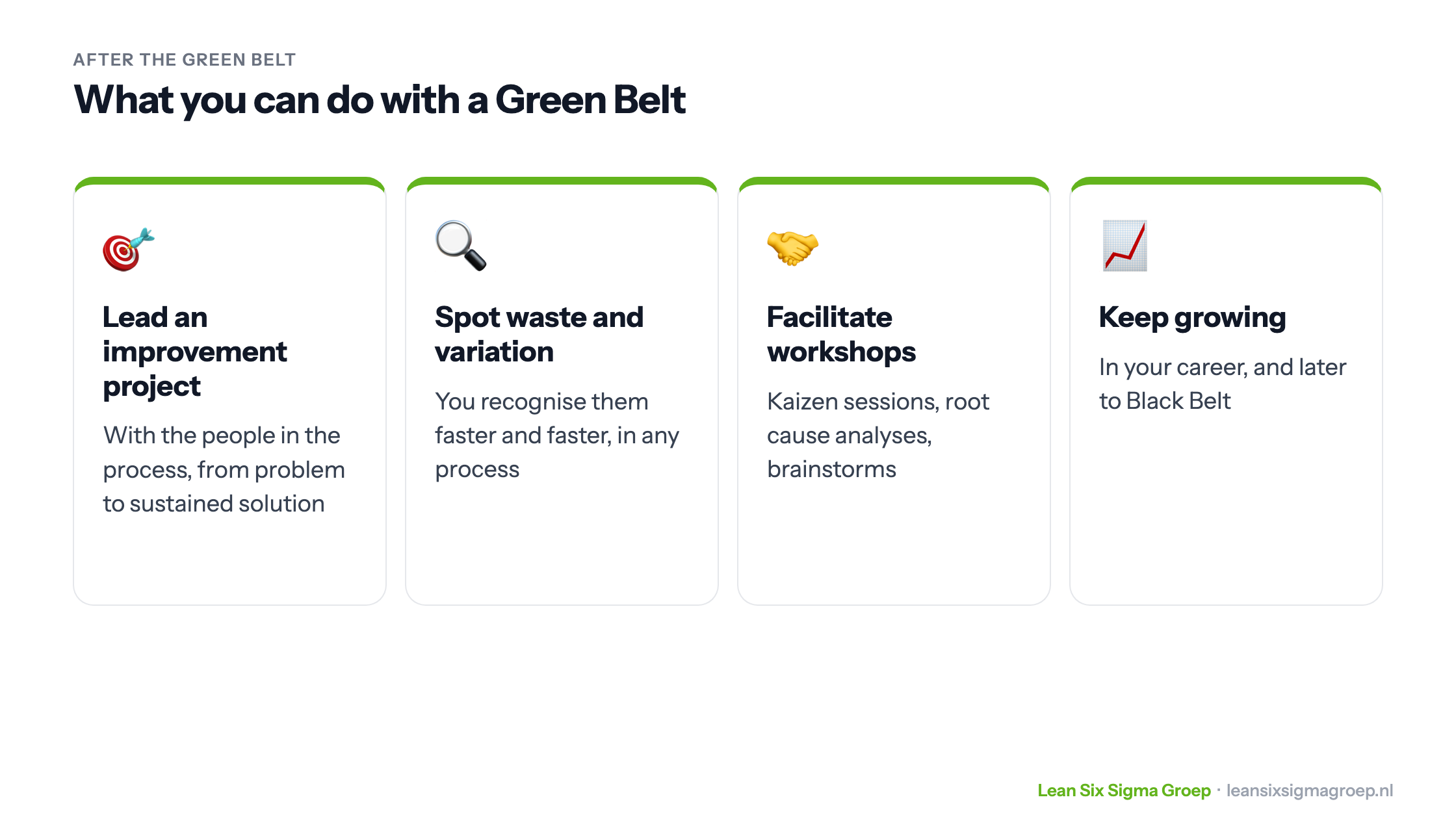
After a Green Belt course you know the five phases of DMAIC, how to find waste and variation, and what it takes to bring people along. But what do you do with it afterwards? This article lists the possibilities, as shown in the image at the top.
Lead an improvement project
The best way to put the theory into practice is to take on an improvement project in your own organisation, together with the people in the process. You move step by step through DMAIC from problem to root cause to a solution that keeps working. That cuts both ways: you help the organisation move forward, and the project can count towards your Green Belt certificate.
Spot waste and variation
Once you get a taste for it, you often take on more projects. You notice that you recognise waste and variation faster and faster, also outside your own department. And you become more skilled with the tools.
Facilitate workshops
A Green Belt also facilitates sessions: a Kaizen event, a root cause analysis with the team, a brainstorm on solutions. That skill, getting people to work together on a better process, often turns out to be as valuable in practice as the technique.
Your career
A Green Belt enriches your CV. Knowledge of continuous improvement applies in every sector and in many roles: from team leader to project manager, from quality officer to consultant. Read more about the role in what is a Green Belt?
Certificate of attendance or Green Belt certificate?
After the course you receive a certificate of attendance, provided you missed at most one day. That is different from a full Green Belt certificate, as shown below.
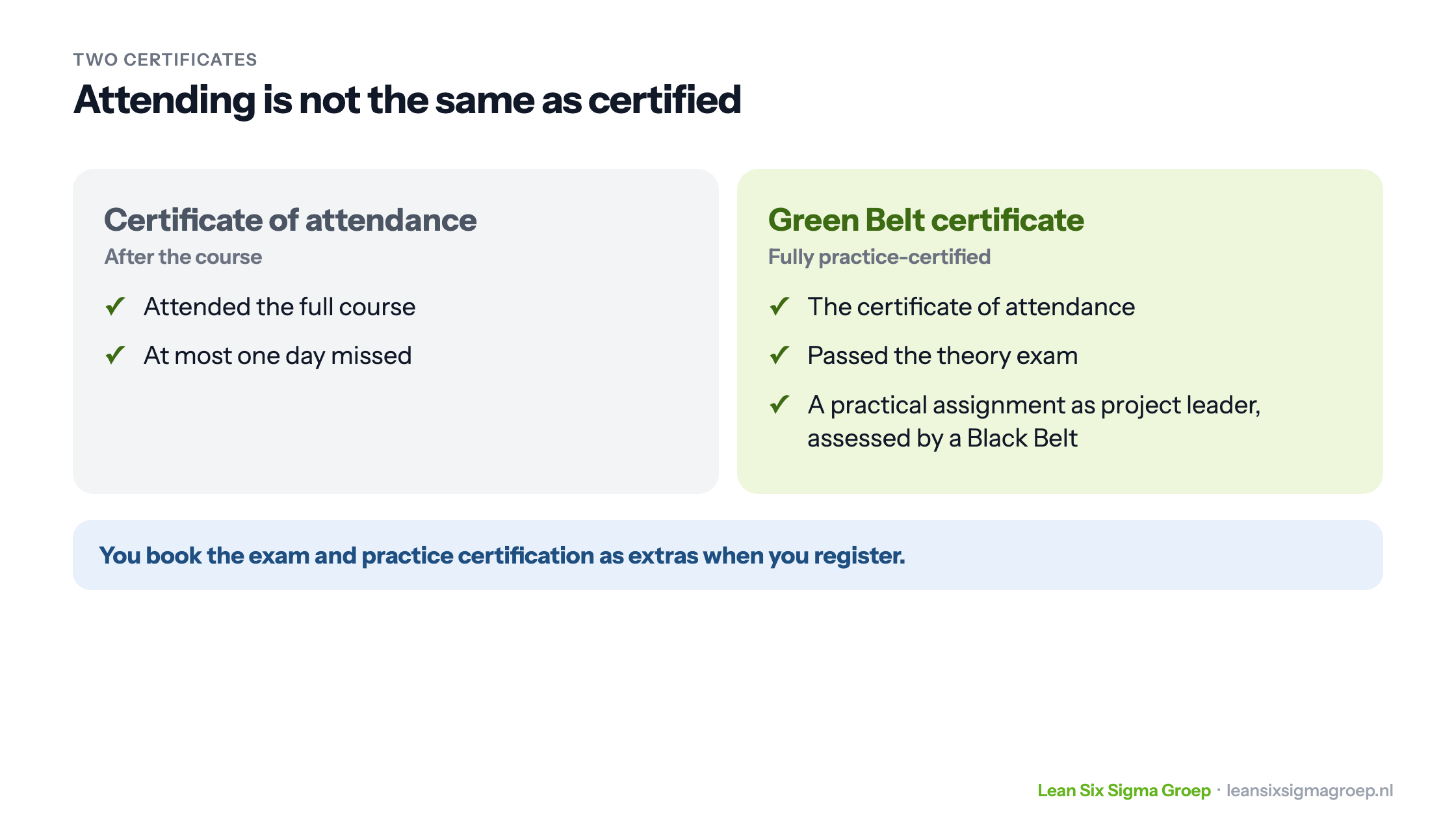
For the full LCS Lean Six Sigma Groep Green Belt certificate you also pass the theory exam, with multiple-choice and open questions, and carry out a practical assignment as project leader, assessed by a Black Belt from Lean Six Sigma Groep. The Green Belt exam and practice certification are not a standard part of the course: you add them when you register. The course includes two coaching sessions, and you can book extra coaching hours for support during your project.
And then: Black Belt
Some challenges are more complex, and then the Green Belt tools are not always enough. Advanced statistics, leading larger programmes and coaching Green Belts are covered in the Green Belt to Black Belt course.
Want to know what the course involves? Take a look at the Green Belt course.