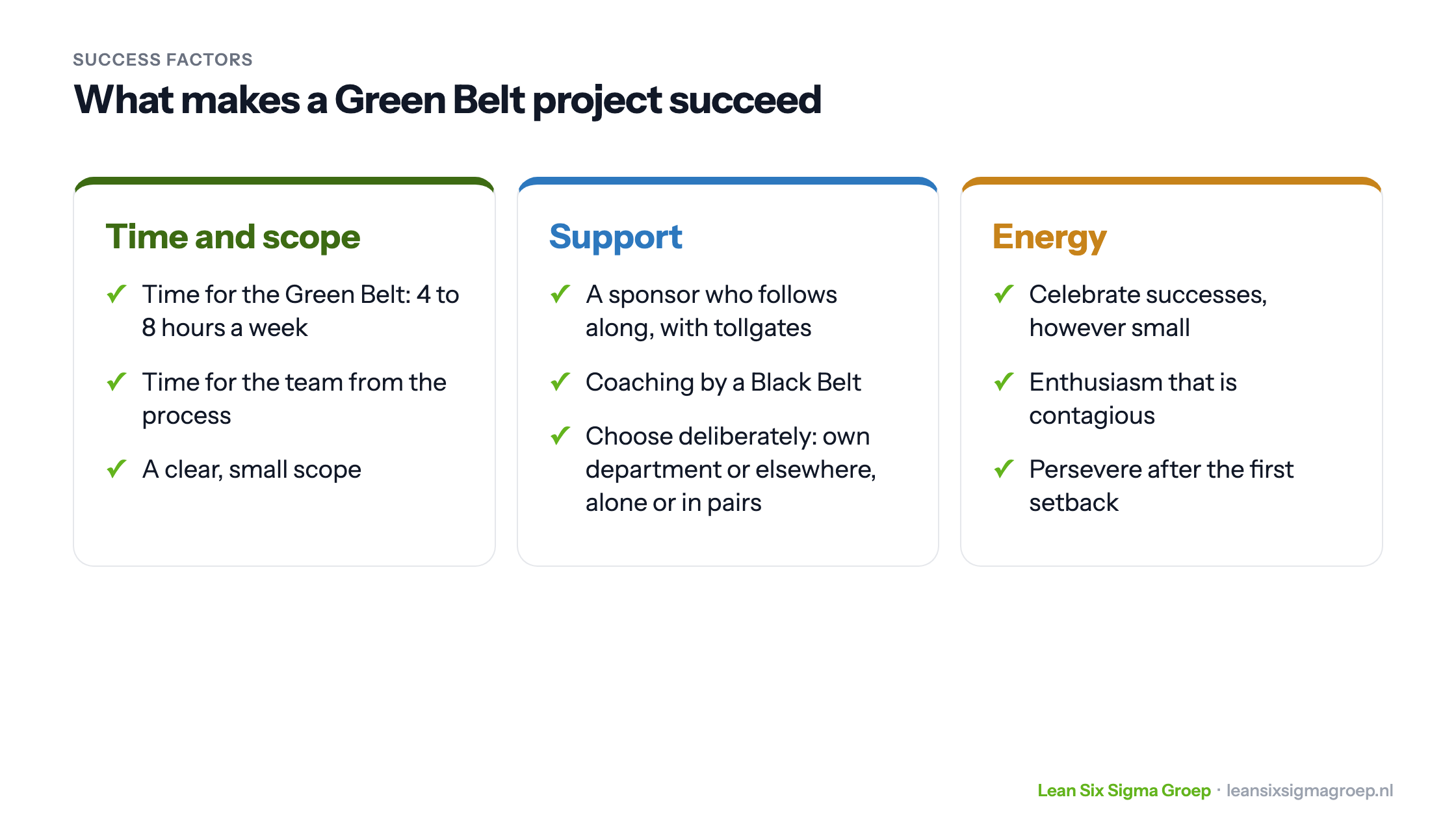
A Lean implementation often starts with training Green Belts. But training alone changes nothing: it only works when the Green Belts also do projects, and those projects succeed. From our experience come ten factors that help, in three groups: time and scope, support, and energy. They are shown in the image at the top of this article.
What makes a good project, the subject itself, is covered in what is a good Lean Six Sigma project? This article is about what the organisation needs to make such a project succeed.
Time and scope
- Time for the Green Belt. We advise at least 4 and preferably 8 hours a week. “Do it when you have time left” is rarely a good project model: employer and Green Belt need to genuinely reserve that time in advance.
- Time for the team. Not only the Green Belt needs time, so do the people from the process. Only they know how the work really goes, and they are often full of good ideas. You do Lean Six Sigma with the shop floor.
- A clear, small scope. The goal is clear and measurable, and the project is not too big. On average a Green Belt project takes about four months.
Support
- Management involvement. There is a clear sponsor who owns the problem, follows progress and checks in regularly, for example at the tollgates at the end of each phase.
- Coaching by a Black Belt, internal or external, to discuss progress and next steps and remove obstacles.
- Choose deliberately: own department or elsewhere. A project in your own area fits your daily work and you already know the process. A project in another department helps you look without bias, but takes more time.
- Choose deliberately: alone or in pairs. A project in a pair gives speed, and you can pair people who complement each other.
Energy
- Celebrate successes, however small. That keeps the energy up and makes change fun. Be good and tell it!
- Enthusiasm is contagious. An enthusiastic Green Belt creates enthusiastic team members. Making it fun produces not only better results, but also people who want to keep improving.
- Persevere. After the first successful project, more will hopefully follow. Not all equally successful: the road to continuous improvement is full of obstacles.
The oil slick
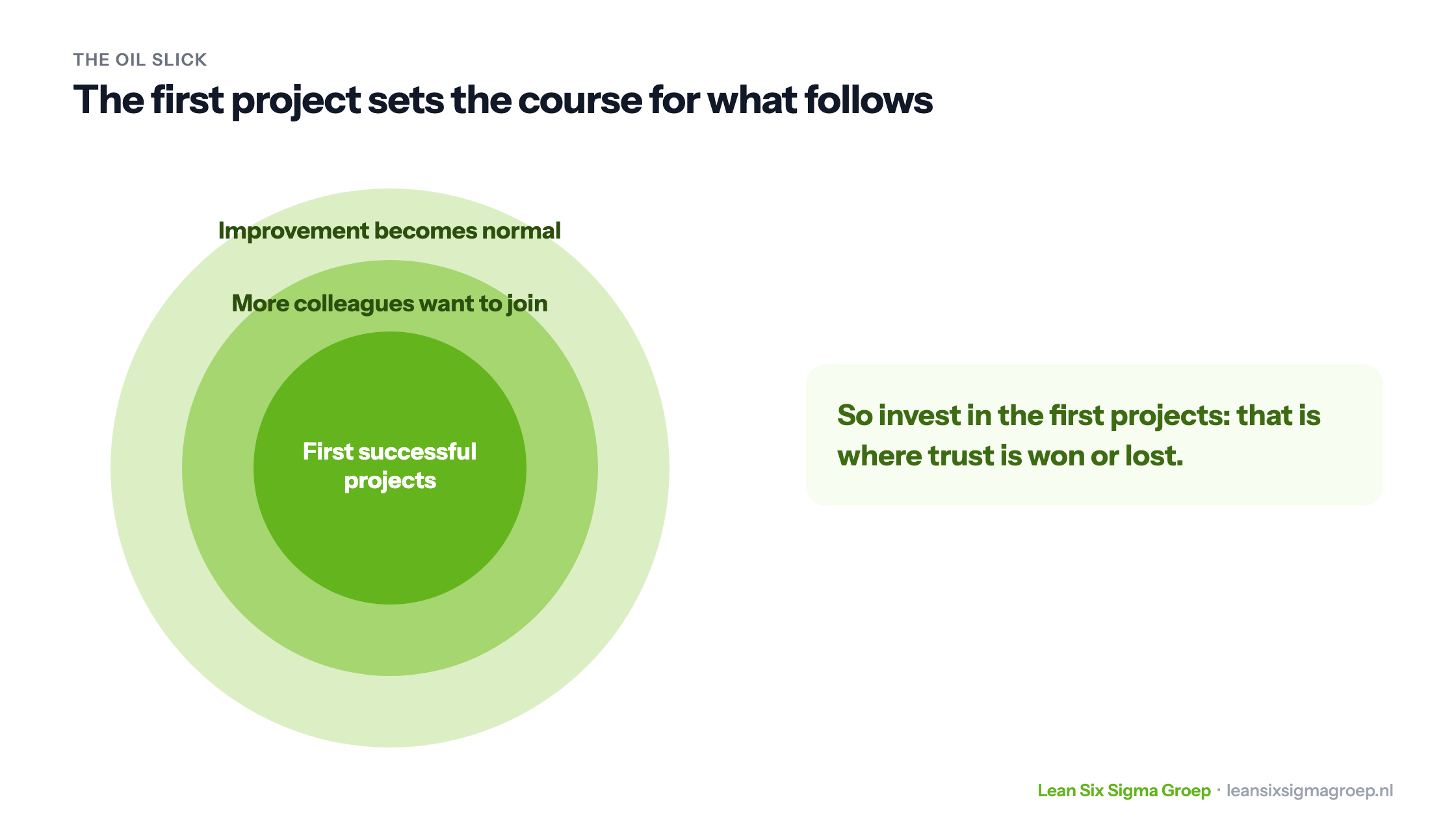
Why are the first projects so important? Because they set the course for what follows. If they succeed, you often see an oil slick spreading, as shown above: more colleagues become interested, Lean is used more often and the results become ever more visible. If they fail, trust is hard to win back. So invest in that first step.
Want to train and support Green Belts in your organisation? Take a look at the Green Belt course or our in-company training.