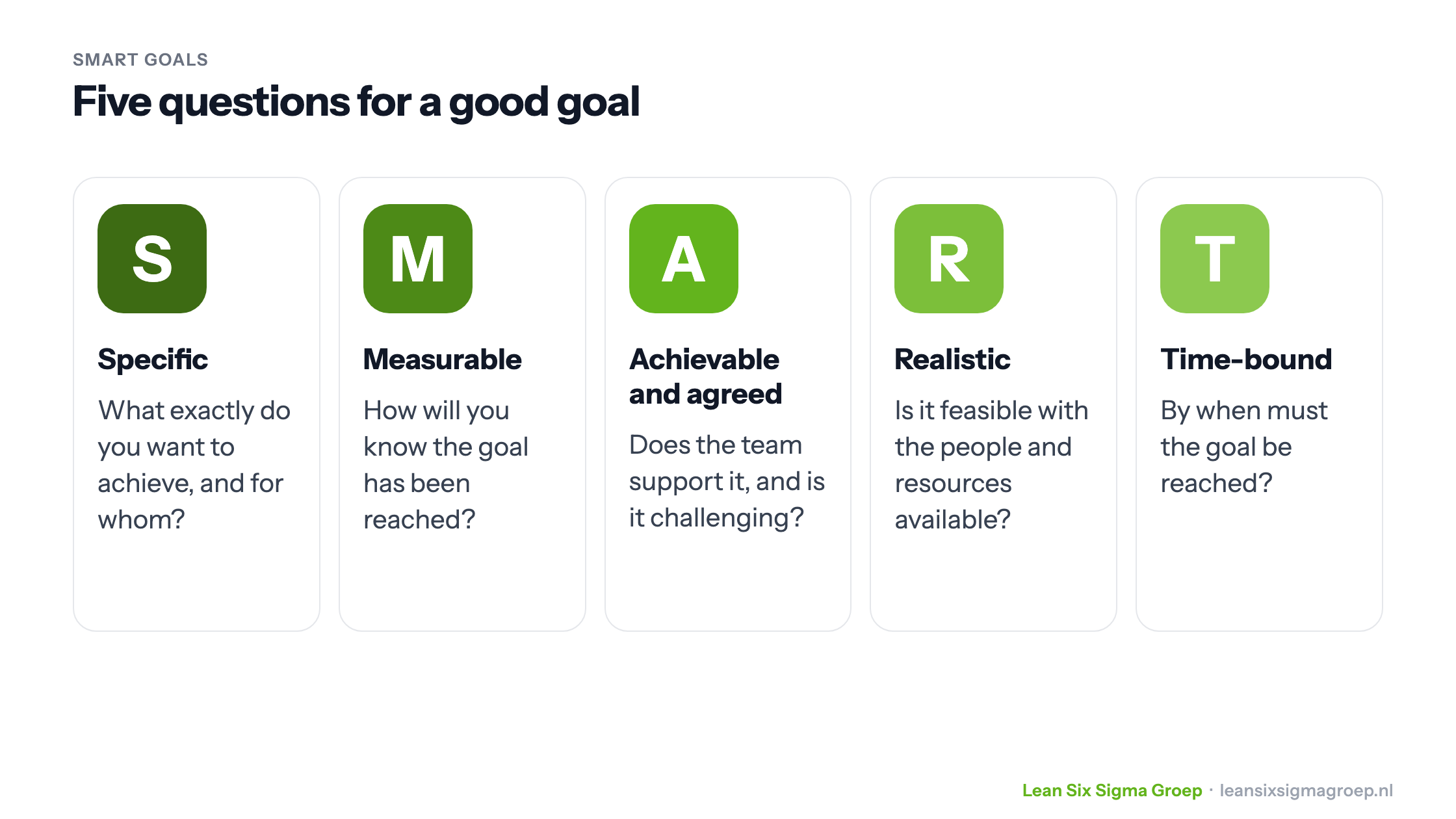
A SMART goal is specific, measurable, achievable, realistic and time-bound. Such a goal gives direction to daily work, and everyone knows when it has been reached. That makes SMART a simple but powerful tool for teams, organisations and yourself.
What is SMART?
SMART is a mnemonic for setting good goals. The acronym was coined in 1981 by George T. Doran, in an article in the journal Management Review. The idea behind it goes back to Peter Drucker, who described “management by objectives” in 1954: managing by clear, agreed goals instead of separate instructions.
A goal describes a desired situation you want to reach. The more concrete and measurable it is, the more likely you are to achieve it. Clear goals also mean less discussion: everyone knows what is expected, and that brings calm and motivation.
The five letters
The image at the top of this article shows the question to ask for each letter:
- Specific: what exactly do you want to achieve, and for whom? A goal is clear when everyone understands it the same way.
- Measurable: how will you know the goal has been reached? Use a number, a percentage or a concrete result.
- Achievable and agreed: do the people who have to do it support it, and is the goal challenging enough? The A is explained in several ways.
- Realistic: is it feasible with the people, resources and time available?
- Time-bound: by when must the goal be reached?
From vague to SMART
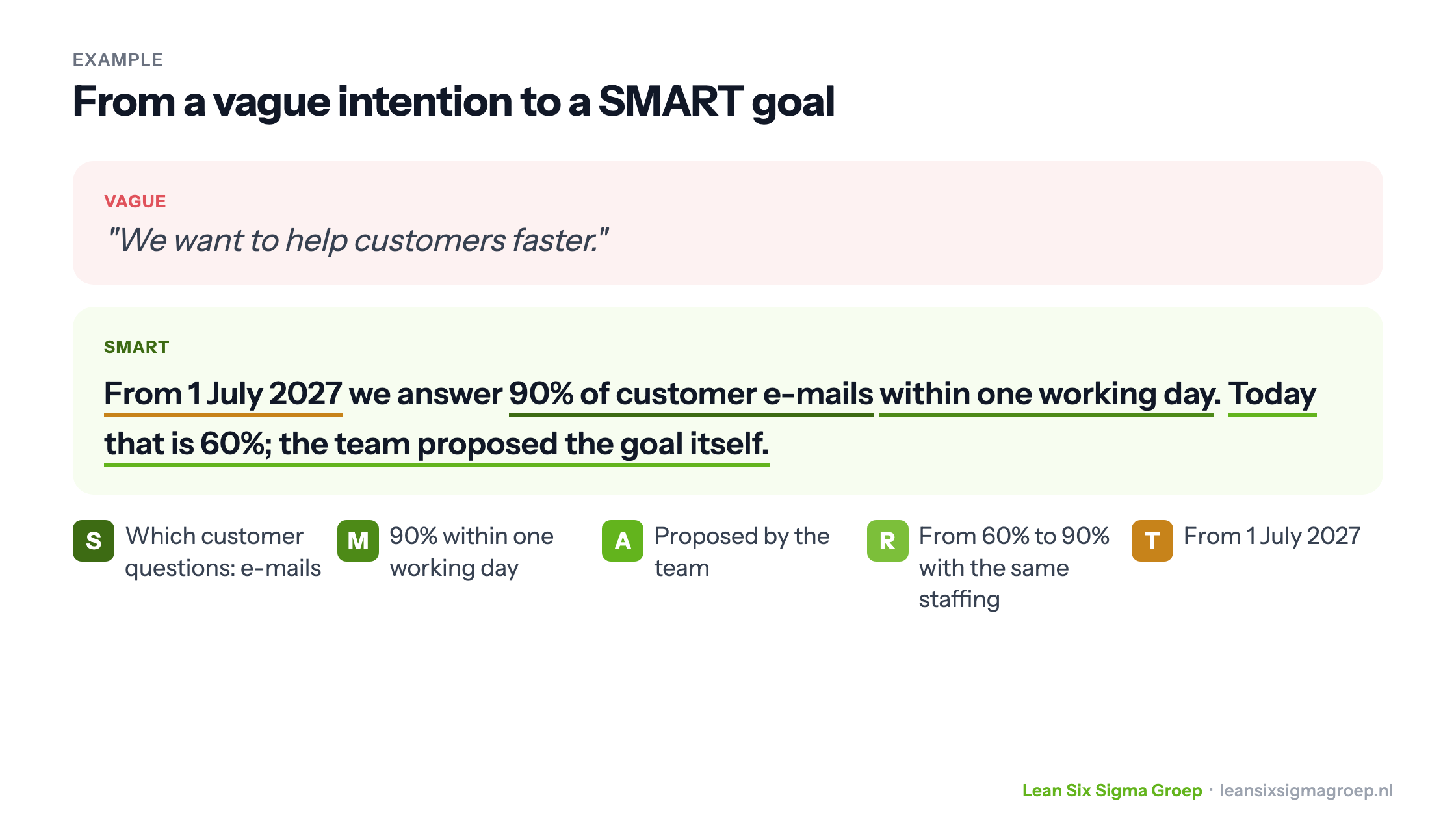
“We want to help customers faster” is a good intention, but not a goal: nobody knows when it has succeeded. This is how you make it SMART:
More examples
- Team goal: from 1 July 2027, we handle 6 cases per employee per day, up from 5 today. We achieve this with a new workflow system that all employees use and that reduces the administrative burden.
- Organisational goal: by the end of 2027 we have a market share of 20% in region Y, up from 15% today. To get there, we open a branch in region Y in the first quarter, which generates at least € 200,000 in revenue before 31 December.
- Personal goal: “I want to take a course this year” becomes “this year I take the Green Belt training course and pass the exam by December at the latest, so I can lead improvement projects independently.”
Managing by SMART goals
Setting a SMART goal is one thing, reaching it is another. For that you need to track progress and adjust in time. That takes up-to-date figures and regular, constructive meetings, in a fixed rhythm. Teams review progress daily or weekly, learn from each other and agree actions. This is called process management.
In Lean and Agile organisations this is second nature. Goals are translated into KPIs and discussed in the daily stand-up or in an Obeya. Obeya comes from the Toyota Production System and literally means “big room”: a space where all goals, performance and actions hang visibly on the wall. Lean Six Sigma Groep uses it with clients at strategic, tactical and operational level. A related method is OKR, which links ambitious goals to measurable results.
SMART in conversations
SMART also helps in conversations, for example in a job interview. A SMART answer avoids long stories that don’t answer the question. An example:
Question: “Do you have experience as an account manager?”
Answer: “Yes. As a recruitment consultant at company B, from 2020 to 2022 I had my own client portfolio, for which I was fully responsible, from sales to evaluation. I also kept in touch with former clients. When I started, my portfolio brought in € V per month; when I left, € W. My colleagues’ portfolios didn’t grow in that period, so it wasn’t the market.”
That answer is specific (which employer and role), measurable (the revenue), ambitious (better than colleagues), realistic (it has already been achieved) and time-bound (2020 to 2022).
In summary
SMART is a simple way to make goals clear, and to keep conversations about goals shorter and more effective.